



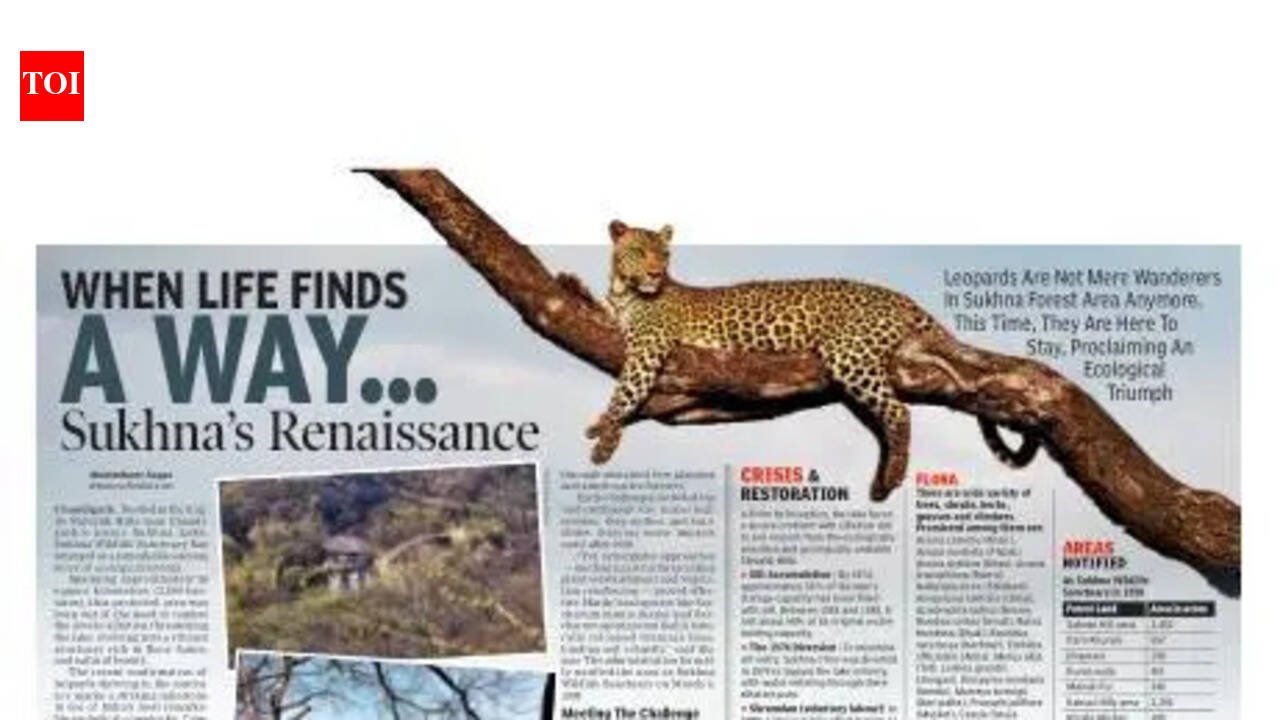
Chandigarh: Nestled in the fragile Shivalik Hills near Chandigarh’s iconic Sukhna Lake, Sukhna Wildlife Sanctuary has emerged as a remarkable success story of ecological revival.Spanning approximately 26 square kilometres (2,600 hectares), this protected area was born out of the need to combat the severe siltation threatening the lake, evolving into a vibrant sanctuary rich in flora, fauna, and natural beauty.The recent confirmation of leopards thriving in the sanctuary marks a striking milestone in one of India’s most remarkable ecological comebacks. Camera traps deployed during a collaborative wildlife survey have captured clear images of these elusive predators, underscoring how decades of dedicated restoration have transformed a once-eroded landscape into a self-sustaining forest capable of supporting large carnivores.Although occasional leopard sightings have been reported in the past, this time, things are different. “There is definitive proof that leopards have established the sanctuary as their permanent home now. Earlier, leopards would occasionally cross over from neighbouring forested areas for some time and then return to their permanent territory,” said UT chief conservator of forest (CCF) Saurabh Kumar. Recent motion-triggered camera traps in the Sukhna Wildlife Sanctuary captured clear images of at least two leopards in the Kansal range of the 26-square kilometer sanctuary, with officials postulating the presence of at least one female as well. Follow-up field inspections in Dec 2025 revealed fresh pug marks and widespread activity at multiple sites, confirming active movement across the protected area.For forest officials, these sightings go beyond a simple wildlife encounter. “The establishment of leopards at the top of the food chain is a resounding validation that the ecosystem has matured into a near-natural, self-sustaining forest capable of supporting apex predators,” said Kumar, highlighting the triumph of long-term conservation efforts.From Barren Slopes to Thriving SanctuarySukhna Lake itself was created in 1958 by damming in Sukhna Choe, a seasonal stream, as part of Le Corbusier’s visionary plan for the city. Designed to collect run-off from the hills, the lake soon faced a grave threat: Rapid siltation from severe soil erosion on denuded Shivalik slopes.The lake, with an initial storage capacity of 1,074 million cubic meters and water spread of 1.52 to 2.28 square kilometres, drew from a 4,207-hectare catchment of hilly and agricultural land.However, the ecologically fragile Shivaliks, prone to erosion during monsoons, caused rapid siltation from denuded slopes, with rates exceeding 150 tons per hectare per year in some areas. By 1988, an estimated 66% of the lake’s original capacity had been lost to sediment build-up, endangering this man-made masterpiece.In the 1960s, the Punjab govt (later vesting with Chandigarh UT) acquired 25.42 square kilometres of the critical hilly catchment for soil and moisture conservation.“Due to heavy soil erosion in this area, all attempts, in the beginning, to take up plantation failed. Authorities are even said to have attempted seed sowing though helicopter, but failed,” said Kumar.Subhash Chawla, a former mayor who is an original inhabitant of a village that existed in the area even before Chandigarh was created, remembers a different world. “There were small hamlets in this area. There were many wells but no water, as all the wells were completely dried up. There was no water and fodder for domestic animals. The land was very stony and there was no farming in the area,” he recalled. “When the erstwhile Punjab govt decided to acquire this area in 1962, there was no resentment from any quarter and people were rehabilitated in other areas,” he said. The UT forest department launched intensive measures, blending vegetative and engineering interventions: Extensive afforestation, slope stabilisation structures, and erosion control. These efforts dramatically reduced siltation to just 3-5 tons per hectare per year.Barren, gully-scarred landscapes — once devoid of vegetation, water, or fodder —were transformed through sustained tree planting and ameliorative forestry.Early challenges included the vast catchment size, initial high erosion, deep gullies, and landslides, delaying major impacts until after 1966.“Yet, synergistic approaches — mechanical structures aiding plant establishment and vegetation reinforcing — proved effective. Hardy local species like Saccharum munja (kana) and Saccharum spontaneum (kahi) naturally colonised drainage lines, binding soil robustly,” said Kumar. The administration formally notified the area as Sukhna Wildlife Sanctuary on March 6, 1998.BOX1: Meeting The Challenge Although soil erosion control measures in the Sukhna Lake catchment area began in the early 1960s, their significant effects took time to materialise due to the catchment’s large size and the exceptionally high erosion rates.Efforts to protect the lake commenced with the phased acquisition of approximately 26 square kilometres of land in the catchment, followed by intensive tree plantation on the acquired area. However, large-scale plantation programmes could not be implemented until after 1966, by which point substantial silt had already accumulated in the lake.In the early 1970s, soil conservation initiatives were introduced on a relatively modest scale.Even carefully planned plantation efforts fell short of expectations, as the severely degraded and challenging terrain posed formidable obstacles to achieving reasonable survival rates for trees. The area featured an extensive network of gullies that deepened and widened, coupled with frequent landslides, all of which hindered successful afforestation.Consequently, authorities shifted to a more comprehensive strategy, combining intensive soil conservation measures with tree planting to better stabilise slopes and reduce silt inflow to the lake.Vegetative MeasuresPlantation of Indigenous speciesPlantation of soil binding grasses (Arundo donax etc.)Patch sowing in hilly slopesNatural regenerationEngineering MeasuresSilt retention damsGully plugging structuresGrade stabilisers, spur, revetment etc.Desalination of silted up damsBOX2 – Crisis and Ecological Restoration From its inception, the lake faced a severe problem with siltation due to soil erosion from the ecologically sensitive and geologically unstable Shivalik Hills. Silt Accumulation: By 1974, approximately 63% of the lake’s storage capacity had been filled with silt. Between 1958 and 1988, it lost about 66% of its original water-holding capacity.The 1974 Diversion: To minimise silt entry, Sukhna Choe was diverted in 1974 to bypass the lake entirely, with water entering through three siltation pots.Shramdan (voluntary labour): In 1988, a major public effort began, as part of which Chandigarh residents provided voluntary manual labour to desilt the lake bed.Wildlife Sanctuary Formation: Massive afforestation and soil conservation efforts led to the creation of the Sukhna Wildlife Sanctuary in March 1998. This 2,600-hectare area protects the lake’s catchment and is now home to species like leopards, sambar deer, and various migratory birds. Recognition and Legal StatusIn recent years, the lake’s status has evolved from a simple reservoir to a protected entity with legal rights.National Wetland: The Govt of India has designated Sukhna Lake as a protected National wetland.Living Entity: In 2020, the Punjab and Haryana High Court declared Sukhna Lake a “living entity” or “legal person.” This status grants the lake its own rights, duties, and liabilities, with all citizens of Chandigarh declared as loco parentis (acting as parents) to ensure its survival and preservation.Eco-Sensitive Zone: An area of 2 km to 2.75 km around the lake is designated as an eco-sensitive zone, where new construction is strictly banned to protect the ecosystem. BOX3: A Maturing Ecosystem and Symbol of ResilienceThe sanctuary now teems with biodiversity: it hosts among the region’s highest concentrations of sambar deer, along with chital, wild boar, jackals, jungle cats, porcupines, langurs, and more than 150 bird species. The recent arrival and apparent settling of leopards crowns this food pyramid, underscoring how patient, science-driven conservation has reversed degradation in a once-fragile catchment.Officials view the leopard’s return not just as a wildlife milestone, but as living proof that a man-made forest landscape — initially engineered to protect an urban lake — has evolved into a balanced, resilient wilderness. Positioned near a bustling city yet safeguarding natural processes, the Sukhna Wildlife Sanctuary serves as both Chandigarh’s vital ecological buffer for Sukhna Lake and a powerful testament to the potential of sustained intervention to heal and regenerate the environment.FLORAThere are wide variety of trees, shrubs, herbs, grasses and climbers. Prominent among them are: Acacia catechu (Khair), Acacia modesta (Phulai), Acacia Arabica (Kikar), Acacia leucophloea (Raeru), Dalbergia sisoo (Shisham), Anogeissus latifolia (Chhal), Azadirachta indica (Neem), Bombax ceiba (Semal), Butea frondosa (Dhak), Bauhinia racemosa (Kachnar), Emblica officinalis (Amla), Morus alba (Tut), Lannea grandis (Jhingan), Diospyros montana (Kendu), Murraya koenigii (Kari patta), Prosopis juliflora (Musket), Cassia fistula (Amaltas), Zizyphus jujoba (Ber), Vitex negundo (Bana or nirgundi), Carissa spinarum (Karaunda), Adhatoda vasica (Vasaka), Saccharum sararoxb (Moonj), Tinospora cordifolia (Giloe), Abrus precatorious (Rati) etc.FAUNAMammals: Leopard Sambhar Spotted Deer (Chittal) Pangolin (ant eater) Wild boar Jackal Small Indian Civet Jungle Cat Porcupine Hanuman Langur Rhesus Monkey Indian HareCommon Mongoose Common rat Squirrel etcBirds: Over 262 varieties of birds. Peacock Red jungle fowl Grey partridge Cuckoos Night jars Golden Oriole Kingfisher Swifts Hoopoes Hornbills Barbets Woodpeckers Rollers Barn owls Parrots Doves Jacanas Plovers Coots Hawks Geese Swan Ducks Grebes Black drongo Tree pie Jungle crow Bulbul Hill myna Koel Bee-eater Common Myna etcReptiles: Cobra, Rat snake, Common Krait, Russell’s viper, Indian Python and common Monitor (Gho) etcInsects: Wide variety of butterflies, moth, honey-bee and other micro-organisms are in abundance.BOX4- Tourism Potential With a view to promote eco-tourism ‘nature trails/trek routes’ have been created throughout the length and breadth of the forest.There are eight designated trek routes in Sukhna Wildlife Sanctuary: Route No.1: Kansal Log Hut and back (Bhagwanpura side) (5km).Route No. 2: Kansal Log Hut and back (towards Nepli) (2.5km)Route No. 3: Kansal Log Hut to Nepli Gate (9km)Route No. 4: Kansal Log Hut to Sukhomajri (5km)Route No. 5: Nepli Gate to Nathewala and back (6km)Route No. 6: Nepli Gate to Nepli Inspection Hut via Nathewala (6km)Route No. 7: Nepli Gate to Nepli Inspection Hut via Ghareri (5km)Route No. 8: Nepli Inspection Hut to Kansal Log Hut (8km)BOX5: Areas notified as Sukhna Wildlife Sanctuary in 1998Name of Forest Land | Area in acresSaketri Hill area | 2,452Dara Khurani | 557Dhamala | 198Kuran wala | 461Manak Pur | 346Kansal Hilly area | 2,296Khuda Alisher | 108Total | 6,418Chd’s green cover over the years (in sqkm)1997 | 331999 | 332001 | 412003 | 492005 | 502009 | 542011 | 522013 | 532015 | 572017 | 572019 | 732021 | 632023 | 72Chd’s Forest Cover (in sqkm)1997 | 71999 | 72001 | 132003 | 152005 | 152009 | 172011 | 162013 | 172015 | 222017 | 212019 | 222021 | 222023 | 25


