



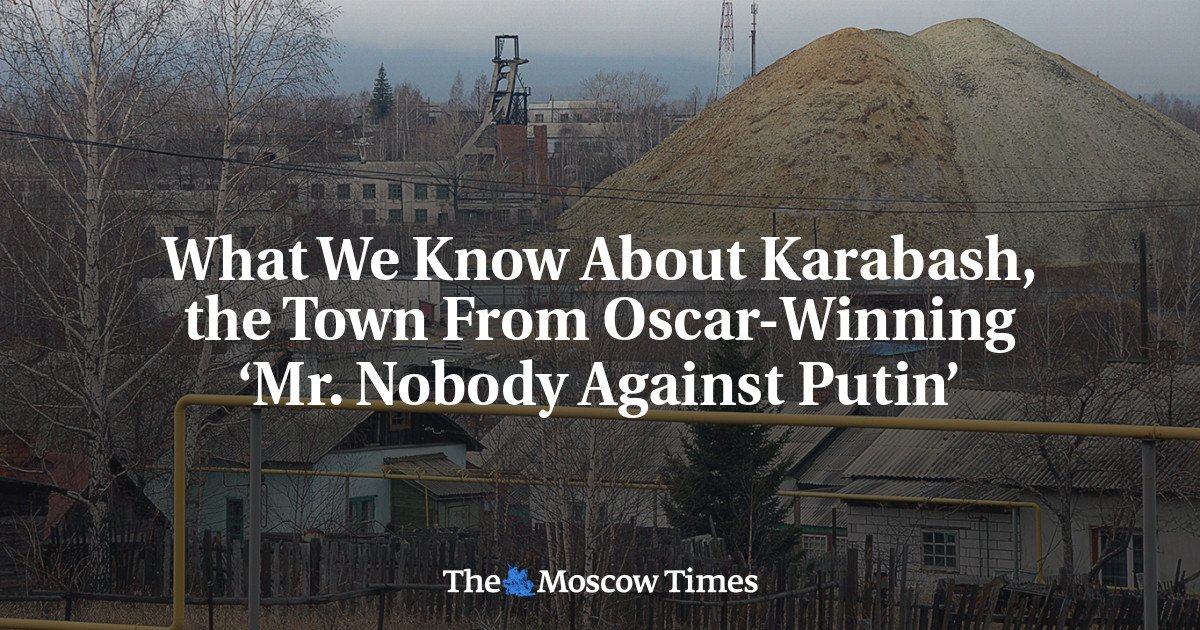
The small town of Karabash in Russia’s Chelyabinsk region has gained worldwide fame after a documentary filmed by local school videographer Pavel Talankin won an Academy Award on Sunday.
Before Talankin’s “Mr. Nobody Against Putin” was released, Karabash was little-known both in Russia and abroad, only occasionally making headlines for its reputation as one of the most polluted places on the planet.
To help you get to know Karabash, The Moscow Times collected five things to know about the town:
Pesotsky (CC BY 3.0)
Turkic toponyms
Karabash was founded in 1822 as a gold-mining settlement after deposits were discovered in a local river.
Known today as Sak-Elga, the river’s name likely originated from Bashkir, a language spoken by the local Indigenous Turkic group of the same name.
Its name roughly translates to “punctured river,” referring to the holes left by gold miners.
The name Karabash also has Bashkir origins, meaning “black head.”
Though most ethnic Bashkirs now live in the neighboring republic of Bashkortostan, some inhabitants of Karabash still identify as ethnic Bashkirs, according to the census.
Scottish connection
In 1910, Scottish mining engineer and entrepreneur John Leslie Urquhart founded a copper-producing plant in Karabash that would help expand the settlement into a proper town.
Urquhart had previously bought out a group of metallurgical enterprises 30 kilometers northeast of Karabash near the town of Kyshtym, where he moved with his family.
Urquhart, who also owned plants in what is now Kazakhstan, was pushed out of the country following the 1917 Russian Revolution.
LEETE (CC BY-SA 3.0)
Sergey Narukov / CC BY 3.0 via Wikimedia Commons
Martian landscapes
Life in Karabash has revolved around copper mining and refining at the Karabashmed plant for over a century.
During the Soviet era, Karabashmed’s operations were effectively carried out with complete disregard for the environment.
Refining waste was dumped directly into the Sak-Elga river, turning its waters bright orange.
Black mountains of copper slag piled up in the vicinity of the plant have also become a permanent feature of the town’s landscape.
“These landscapes are devoid of life,” journalist Alexander Nadsadny wrote of the town in 2018. “They look like a dead Martian desert.”
These extraterrestrial landscapes are complemented by grey smog and occasional acid rain — both the result of extreme pollution.
Pesotsky (CC BY 3.0)
Fleeing people
Karabash’s population hit a peak of nearly 40,000 people in the 1940s when thousands were evacuated to the area from western Russia during World War II.
But the town has witnessed a rapid population decline since the 1980s, with slightly more than 10,000 people living there today.
The main reason for the mass exodus was the brief closure of the Karabashmed plant, which employs the majority of the town’s residents to this day. Low salaries and mounting health issues caused by poor ecology have also pushed young people out of the town.
Anton Fadeev / fototerra.ru
New Karabash City
Karabashmed’s owner, the Russian Copper Company (RCC), has been trying to clean up the town’s image since 2010.
This push is likely a part of the RCC’s carefully thought-out PR campaign aimed at swaying public opinion amid protests against its rapid expansion in the region.
As part of the campaign, local media have been publishing articles hailing the development of a brand-new neighborhood with parks and sports facilities dubbed “New Karabash.”
Some publications went as far as painting Karabash as an up-and-coming destination for regional tourism.
“The air in the city doesn’t feel like it did 15 years ago and birds have returned to the city,” said an article on regional travel news website Nash Ural. “Locals say there weren’t even sparrows here before.”
Artyom Krasnov / 74.ru
A Message from The Moscow Times:
Dear readers,
We are facing unprecedented challenges. Russia’s Prosecutor General’s Office has designated The Moscow Times as an “undesirable” organization, criminalizing our work and putting our staff at risk of prosecution. This follows our earlier unjust labeling as a “foreign agent.”
These actions are direct attempts to silence independent journalism in Russia. The authorities claim our work “discredits the decisions of the Russian leadership.” We see things differently: we strive to provide accurate, unbiased reporting on Russia.
We, the journalists of The Moscow Times, refuse to be silenced. But to continue our work, we need your help.
Your support, no matter how small, makes a world of difference. If you can, please support us monthly starting from just $2. It’s quick to set up, and every contribution makes a significant impact.
By supporting The Moscow Times, you’re defending open, independent journalism in the face of repression. Thank you for standing with us.
Continue
Not ready to support today?
Remind me later.
×
Remind me next month
Thank you! Your reminder is set.


