


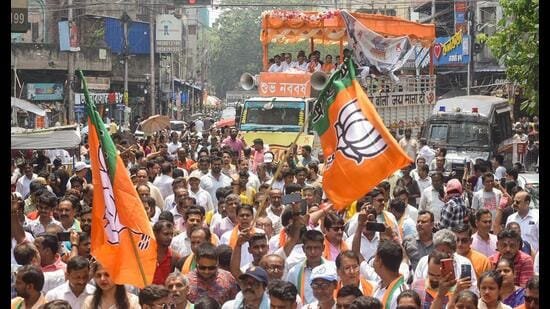
Recently, Prime Minister (PM) Narendra Modi participated in the swearing-in ceremony in two states. These weren’t organised merely to declare Samrat Chaudhary and Suvendu Adhikari as chief ministers of their respective states. They were a declaration of an electoral ashwamedh yagya by the saffron outfit inspired by its outstanding success in recent years.
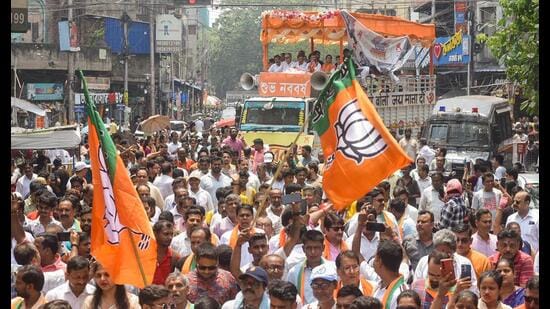
In May 2014, when Modi assumed charge at the Centre, the National Democratic Alliance (NDA) with all its allies was in power in just seven states of the country. Today, NDA rules 22 states and Union Territories in the country. The BJP has chief ministers in 15 important states. How did they achieve such success? Some partisan observers call it a victory of communalism. But is the explanation really that simple?
In 1988, the Rashtriya Swayamsevak Sangh (RSS) lent Modi to the BJP, which put him in charge of Gujarat. His first test was the Gujarat municipal elections held a year later. In this election, the BJP secured the Ahmedabad mayoral post for the first time. It was the beginning of the BJP’s victory march in the state.
At that time, there was a major bootlegger in Gujarat, Abdul Latif. He had contested independently in five councillor seats. His supporters presented him as a caged tiger. During mayoral elections Modi made it a poll plank and won the elections. Those who looked at the contest from a communal prism missed the point entirely. Latif wasn’t a war hero like Abdul Hamid or scientist like Abdul Kalam. He was a history sheeter. How could his victory or defeat be a win or loss for secularism?
It’s here that Modi established a new political template — targeting election issues, profiling political rivals and delivering on the manifesto. This is the reason why assemblies from Uttarakhand to Odisha and from Garo hills to Gujarat have turned saffron.
West Bengal is the latest example of this template. In the 2021 assembly elections, the BJP cornered 38.15% of the votes. Many anticipated that by the 2026 election, Mamata Banerjee would be in trouble. Are the majority of Hindus that voted for the BJP communal? Not at all. Let me narrate an incident. A colleague’s father, a retired professor, saw part of his property in Burdwan usurped by a small-time goon. The goon was a Left Front worker till the TMC came to power — that’s when he became a Trinamool Congress foot soldier. When the old professor raised his voice against him, the goon misbehaved with him.
When he went to the police to complain, he was berated and abused. In West Bengal you can find thousands of such stories of “cut money” and land grab. Why would these people vote for the TMC?
To win West Bengal, the BJP learnt from its past mistakes. Union home minister Amit Shah did 66 rallies and road shows and reviewed preparations at each polling booth. The entire focus of the BJP campaign was on the Trinamool’s misgovernance and misbehaviour. When both BJP and TMC leaders fanned communal passions during the campaign, we can’t blame one party for polarisation.
The BJP has additional responsibility after winning Ang (Bihar), Bang (West Bengal) and Kalinga (Odisha). Bihar and Odisha are among the 10 poorest states in the country. Bengal is comparatively better off, but faces many challenges.
Next year, seven important states will go to the polls. Five — Uttar Pradesh, Uttarakhand, Manipur, Gujarat and Goa — have BJP governments. In the two others, Punjab and Himachal Pradesh, a resurgent BJP will give it all to wrest control. Bihar, West Bengal, and Odisha along with the northeastern states, send 128 members to Parliament. In the region, there’s only one Opposition-ruled state — Jharkhand. It has 14 Lok Sabha seats. If we take Jharkhand into account, right now, the Opposition controls 51 parliamentary seats from the region. However, for the BJP, the region offers space to increase its tally in the 2029 general elections.
If the Opposition wants to stall the BJP juggernaut, they will have to make amends in their strategy and approach. The West Bengal results clearly indicate that the days of worn out allegations and hollow emotionality are over. It’s impossible to win an election in the absence of precise strategy, organisational cohesion, direct connection with the public and able leadership.
Shashi Shekhar is editor-in-chief, Hindustan. The views expressed are personal
