



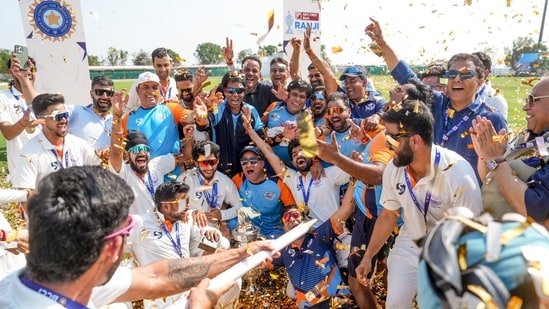
Jammu and Kashmir have scripted history by winning the Ranji Trophy 2025-26 season. But they did not win this Ranji Trophy because of one hot streak or one standout player alone. They won because, among the eight quarter-finalists, they had the strongest championship combination: elite wicket-taking at the top, reliable support bowling, and a batting card that went deeper than most teams they faced.
If you compare the quarter-final field properly, Karnataka looked like the strongest batting side on headline numbers, Bengal looked like the closest bowling rival, and Uttarakhand had one of the best individual wicket-taking seasons in the pool. J&K still came out on top because they were the most complete side across both disciplines.
The biggest difference: J&K had the best top-two bowling pair
This is where J&K separated from the field.
J&K’s top two bowlers were:
- Auqib Nabi: 60 wickets at 12.56
- SR Kumar: 31 wickets at 15.77
That is 91 wickets from the top two bowlers, both at elite averages.
Now compare that with the other quarter-finalists’ best pairs:
- Bengal: Shahbaz Ahmed (39 at 16.53) + Mohammed Shami (37 at 16.72) = 76 wickets
- Uttarakhand: Mayank Mishra (59 at 17.69) + J Suchith (26 at 27.19) = 85 wickets
- Karnataka: Shreyas Gopal (48 at 23.14) + V Kaverappa (21 at 20.04) = 69 wickets
- Madhya Pradesh: K Kartikeya (35 at 22.71) + SS Jain (30 at 20.43) = 65 wickets
- Andhra: Saurabh Kumar (32 at 25.00) + T Vijay (24 at 27.08) = 56 wickets
- Mumbai: SZ Mulani (30 at 26.60) + TU Deshpande (25 at 25.76) = 55 wickets
- Jharkhand: AS Roy (29 at 23.51) + SS Raj (18 at 21.94) = 47 wickets
This is the core data point. J&K were not just “good with the ball.” They had the best top-end wicket machine in the quarter-final pool.
J&K also had stronger bowling depth behind the stars
Many teams had one elite bowler. A few had a strong pair. J&K had a pair plus support. Additional J&K wicket-takers:
- Yudhvir Singh: 21 wickets at 26.19
- Abid Mushtaq: 20 wickets at 31.75
- VY Sharma: 13 wickets at 26.07
That means J&K’s attack did not collapse if one bowler had an off session. They could keep pressure from multiple ends, which is critical in first-class knockouts.
Their top three wicket tally (Auqib + SR Kumar + Yudhvir) was 112 wickets, which is ahead of every other quarter-finalist in your dataset. That gives a side the ability to win in different match scripts — low totals, fourth-innings pressure, or long first-innings control.
They were not the best batting side, but they were one of the deepest
This is the part that makes J&K champions, not just a good bowling team.
Karnataka clearly had the most intimidating batting numbers:
- R Smaran 950
- KK Nair 699
- MA Agarwal 678
- D Padikkal 543
- KL Rahul 470
Bengal and Mumbai also had strong top-end production.
J&K’s batting edge came from distribution, not one giant season:
- Abdul Samad: 748
- Paras Dogra: 637
- K Wadhawan: 474
- Qamran Iqbal: 471
- Abid Mushtaq: 445
- SP Khajuria: 369
- SS Pundir: 330
- Sahil Lotra: 281
- Yudhvir Singh: 250
That is a long list of meaningful contributions. In knockout cricket, this matters more than just having the highest run-scorer. J&K’s batting card kept producing across slots, reducing the risk of collapse and creating recovery options.
The hidden edge: J&K had more match-shaping all-round contributions
J&K’s title profile becomes even stronger when you include players contributing in both disciplines:
- Abid Mushtaq: 445 runs + 20 wickets
- Yudhvir Singh: 250 runs + 21 wickets
- Auqib Nabi: 245 runs + 60 wickets
- Sahil Lotra: 281 runs + 8 wickets
These are not bonus stats. They directly affect match outcomes in red-ball cricket by extending innings and adding bowling options. Across three knockout rounds, teams with more multi-skill contributors usually absorb pressure better. J&K’s numbers reflect exactly that.
The knockout run matched the season profile
J&K’s results were not random or out of character. They fit the comparative data.
They beat Madhya Pradesh by 56 runs in the quarter-final — a tight game where bowling depth and lower-order value matter.
They beat Bengal by 6 wickets in the semi-final after bowling Bengal out for 99 in the second innings — exactly the kind of collapse-forcing performance their bowling numbers suggest.
In the final against batting-heavy Karnataka, they took control through the first innings: Karnataka 293, J&K 584, then J&K 342/4 in the draw to win the title on first-innings lead.
That sequence is the strongest proof of the story: J&K could beat a balanced team, a bowling-heavy challenger, and a batting-heavy giant.
The verdict
Jammu & Kashmir became champions because they were the best-balanced knockout side among the eight quarter-finalists.
They had:
- the best top-two bowling combination,
- the highest top-three wicket volume,
- enough batting depth to avoid overdependence on one or two players,
- and multiple all-round contributors who kept shifting matches in their favour.
Karnataka had the bigger batting numbers. Bengal had the closest attack profile. Uttarakhand had an elite spearhead. J&K had the strongest overall system — and that is what won them the Ranji Trophy.


