






The Nifty 50 is a major stock index in India. It follows 50 large and liquid companies listed on the National Stock Exchange or NSE. The index tells you how this group of stocks has moved as a whole. It also gives a quick glimpse of a large part of the Indian equity market.
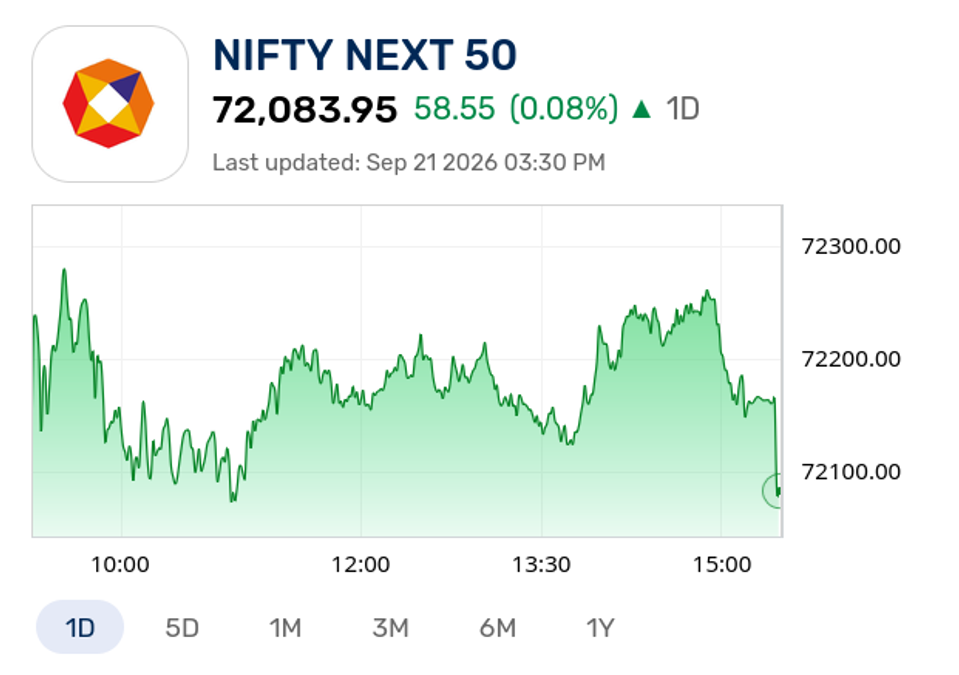
Nifty Next 50 is part of the same family of indices. It comprises 50 stocks of Nifty 100 excluding Nifty 50 stocks. These two indexes have no common stocks. Both give readers another way of looking at large listed companies.
What the Nifty 50 Tells You
The index covers companies in many parts of the economy. They include banks, IT, energy, healthcare, autos and consumer goods. The index does not comprise just one sector.
The base date for the index is November 3, 1995. Its value base is 1,000. As of March 30, 2026, Nifty 50 stocks accounted for around 53.73% of the free-float market value of all the stocks listed on the NSE.
What is the Nifty 50 Index?
The Nifty 50 is calculated on a free-float market capitalization basis. It has been using this method since June 26, 2009. The concept is simple. Only shares deemed to be available for public trading are included.
The process is described here in five steps:
1. Evaluate the total market value: First take the total shares of a company. Multiply that by its present share price. The result is the total market value of the company.
2. Search for free-float shares: The index math does not include all of the shares. Shares held by the promoter are excluded. Excludes locked shares and some strategic holdings. This is the free-float part.
3. Use the IWF: IWF stands for Investable Weight Factor. This is a measure of the percentage of a company’s stock that can be included in the index. The IWF is applied to the firm’s total outstanding shares.
4. Calculate free-float market cap: A simple formula is this: Free float market value = Total shares IWF Price per share This is done for all 50 stocks. The free float values are then added together.
5. Find the value of index: The official formula is as follows: Index Value = Index Market Capitalisation Base Free-Float Market Capitalisation x Base Index Value
It changes the base when it needs to. This can occur following certain corporate actions or changes to indices. Such changes contribute to the index series’ consistency over time.
A Simple Example
Let’s say Company A has 100 crore shares. Each share is valued at Rs. 200. Its IWF is.60. So 60% of its stocks are factored into the index maths.
It has a free-float market value of: 100 crore × 0.60 × 200 12,000 crore
For each index stock the same method is applied. A high free-float value gets a stock a high weight. A change in that stock can therefore have a large effect on the index. A stock with small weight does not affect the final move much.
How Are Stocks Selected?
A seat in the Nifty 50 is not for life. NSE Indices has set rules for entry and exit. The rules take into account market value, free-float, liquidity and impact cost.
The index is reviewed biannually. Changes take effect on the last working day in March and September. Further changes may also occur. This could be after a delisting, a suspension or a scheme of arrangement.
This review process ensures the stock list adheres to the rules stated. The current list should still be verified by means of market research.
Why Nifty 50 Matters
The index serves as a market benchmark. It also tracks daily movements in the cash market. It can be used as a benchmark for funds and portfolios. It can also be tracked by index funds and exchange-traded funds. The index has futures and options listed on the NSE.
It can also help readers compare returns across time. For example, a fund may be compared to the index for the same period. But that does not mean both will give the same returns. Fees, cash levels and the fund plan could be a disconnect.
Nifty 50 is not the list of all listed stocks. It simply tracks its chosen 50 stocks and their weights. Other indicators for other market views.
Conclusion
The Nifty 50 is a market index with 50 stocks. It employs the free-float market capitalisation methodology. Its value depends on the share price, the number of shares in issue, the IWF and the index base. These parts make index changes easier to read. You can also use it to look at another part of the Nifty 100 set, the Nifty Next 50.


