


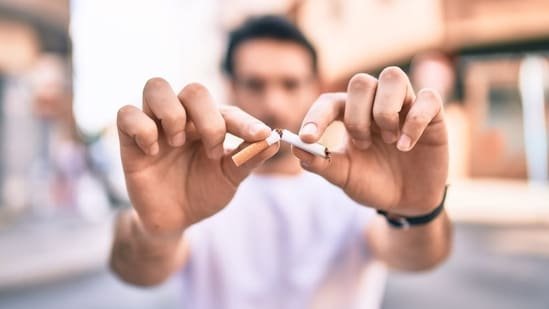
Smoking is a dangerous, fatal habit and there is no safe limit to it, no matter how one tries to justify it, whether as a social smoker during office breaks or by promising to only a one cigarette a day. But such compromises of ‘once in a while’ can still harm the body, as tobacco affects almost every organ and major physiological systems.
When you completely quit smoking, not just once in a while but strictly, your body begins to show major changes. From the first few minutes after your last cigarette, the healing process slowly begins.
In a conversation with HT Lifestyle, Dr (Col) SP Rai, consultant, pulmonary medicine and sleep medicine at Kokilaben Dhirubhai Ambani Hospital, Mumbai, walked us through the changes the body goes through after quitting smoking, right from the first few minutes to the months that follow.
Human body has the ability to heal
The very moment a person begins smoking, tobacco’s destructive effects also begin affecting the body. The doctor, in fact, warned that the damage is not limited to the lungs solely, but rather extends to almost every organ, including the heart, blood vessels, brain and skin.
But here is the silver lining: the recovery begins the moment you quit smoking.
Dr Rai assured, “The damage caused by tobacco can feel overwhelming, but the truth is, the human body has a remarkable ability to heal itself. What surprises most people is that recovery does not wait, it begins within minutes of putting out the last cigarette.”
Recovery timeline
The recovery process after quitting smoking does not begin after months or years, but rather it is immediate. The first few changes show up in minutes.
“Just 20 minutes after quitting, heart rate and blood pressure start dropping back toward normal. Within 12 hours, carbon monoxide levels in the blood return to normal, and oxygen begins circulating more effectively through the body,” the pulmonologist said, describing the changes that begin within the first 24 hours of quitting smoking.
Then, within weeks or months, the doctor said that blood flow improves and the lungs begin to recover. Activities that may have once felt laborious while smoking, such as walking to the corner, climbing a flight of stairs or getting through a workout, start to feel more manageable.
The changes then become more evident over the long term. As per the pulmonologist, at the one-year mark, the risk of coronary heart disease drops by roughly half compared to someone who continues to smoke. Given that smoking is one of the leading risk factors for heart attacks and strokes worldwide, this is a significant shift.
The benefits then continue to build with every smoke-free year. He elaborated, “The longer a person stays smoke-free, the more the body continues to repair itself. By five years, the risk of stroke can fall to levels seen in non-smokers. By ten years, the risk of dying from lung cancer is nearly half that of a continuing smoker, and the risks of several other cancers decline substantially too. By fifteen years, the risk of coronary heart disease comes close to that of someone who never smoked at all.”
So, the body continues to repair itself year after year, reducing the risk of serious conditions like stroke, lung cancer and coronary heart disease. The longer a person remains smoke-free, the more these risks continue to decline
Symptoms begin to improve
The pulmonologist noted that coughing and breathlessness begin to reduce, while the lungs slowly start to ‘clear out everything’ that had built up over the years of smoking. The changes can be wide-ranging, going beyond internal physiological improvements. Over time, a person may also begin to notice visible changes in how they feel and look. “Breathing improves taste and smell, energy levels pick up, and the skin looks healthier,” Dr Rai said.
Note to readers: This article is for informational purposes only and not a substitute for professional medical advice. Always seek the advice of your doctor with any questions about a medical condition
