


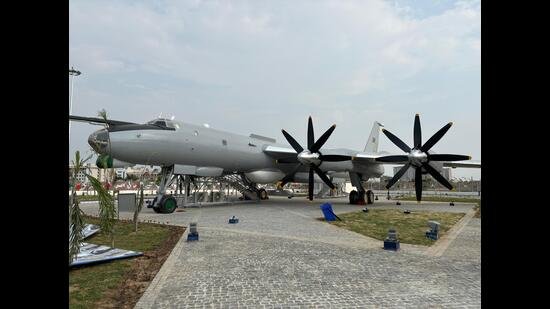
The newly inaugurated Nausena Shaurya Sangrahalaya and Nausena Shaurya Vatika, located near the Ekana Cricket Stadium, will open its gates to the public on June 16, offering a rare opportunity to see original naval equipment that once served aboard Indian warships and aircraft.

Unlike conventional museums that rely on replicas, nearly every major exhibit at the complex is an authentic piece of military hardware decommissioned from the Indian Navy.
The centrepiece of the open-air museum is the massive TU-142M maritime reconnaissance aircraft, a long-range submarine hunter that served as one of the most formidable surveillance platforms of the Navy.
Developed in the erstwhile Soviet Union, the aircraft could fly at speeds exceeding 900 kmph and cover nearly 12,700 km without refuelling. The aircraft was designed to locate enemy submarines hidden deep in the ocean before launching torpedoes and depth charges.
Towering over visitors, the TU-142 is expected to be among the biggest attractions for school groups, defence enthusiasts and families.
Another prominent exhibit is the CET-53M anti-submarine torpedo. Designed in the Soviet Union, the underwater weapon was developed to track and destroy submarines attempting to move silently in the sea. Guided by acoustic signals, the torpedo could pursue a target over distances of more than 15 kilometres and dive to depths of 200 metres before delivering a 200-kg explosive payload.
Visitors will also encounter the AK-230 gun system, a twin-barrel naval weapon designed to counter incoming aircraft and missile threats. The radar-guided system could fire up to 2,000 rounds per minute, creating a protective shield around a warship during combat situations.
Among the exhibits linked to INS Gomti, a decommissioned Indian Navy frigate, named after Lucknow’s Gomti river, is the vessel’s main mast. Mounted on the mast was the RAWL radar developed by Bharat Electronics Limited. The radar could detect enemy aircraft and missiles at distances exceeding 300 kilometres, farther than the road distance between Lucknow and Varanasi.
The open-air display also includes missile launchers, radar antennas, torpedo launchers, anchors, ship propellers and other equipment recovered from naval platforms after their retirement from service.
₹42-crore project
The project has been developed in two phases at a combined cost of more than ₹42 crore. The Nausena Shaurya Vatika, which houses the TU-142 aircraft and outdoor exhibits, has been built at a cost of ₹19.01 crore, while the INS Gomti Shaurya Sangrahalaya has been developed at a cost of ₹23.17 crore.
A museum shaped like a warship
While the open-air exhibits are ready for visitors, the larger INS Gomti Shaurya Sangrahalaya has been conceived as a landmark maritime museum. Spread across more than two acres, the structure has been designed as an abstract representation of a naval vessel, incorporating elements such as a ship’s bow, sails, railings, wheel and a glass bridge.
The museum has been planned around nine thematic galleries that narrate India’s maritime journey from the Vedic era to the modern Indian Navy.
Visitors entering the galleries will travel through stories of ancient seafaring traditions, the dockyard of Lothal, maritime trade routes, the naval exploits of the Cholas and Marathas, the evolution of the Bombay Marine into the Royal Indian Navy, and finally the rise of the modern Indian Navy.
