



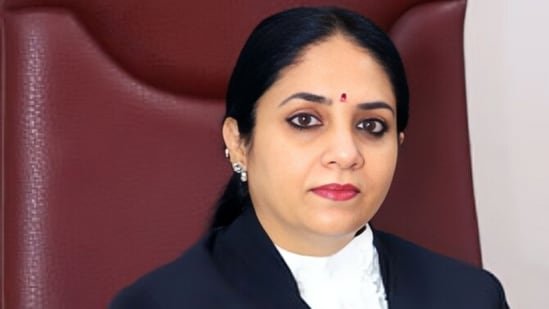
Delhi High Court judge Swarana Kanta Sharma on Monday started delivering her order on whether she would recuse from the Delhi liquor policy case against AAP chief Arvind Kejriwal and others who have expressed “apprehension of bias”. She was reading from the judgment she is to deliver, but the final verdict was not yet out.


What Kejriwal demanded, and why
The controversy arose as Justice Sharma presided over cases linked to an alleged scam in the Delhi excise (liquor sales) policy.
After a trial court discharged Kejriwal and 22 other accused on February 27 this year — concluding that the CBI’s material did not form a case worth going to trial even — the CBI challenged that order before the High Court, and Justice Sharma, at the first hearing of the CBI’s petition on March 9, stayed the trial court’s direction for departmental proceedings against a CBI officer. She also called some of the trial court’s observations “prima facie misconceived”.
This order was passed, Kejriwal later argued in her court, after hearing the CBI for just five minutes and without once hearing his side.
Earlier, when the case was before the trial court, her bench had rejected bail pleas filed by Kejriwal, his fellow AAP leaders Manish Sisodia and Sanjay Singh, and Telangana politician K Kavitha, as the CBI and Enforcement Directorate built a case.
RSS ‘link’ alleged
The AAP leader, in his petition seeking her recusal, raised several objections against the judge. The most politically charged was that Justice Sharma had attended four events organised by the Akhil Bharatiya Adhivakta Parishad, a lawyers’ body affiliated with the RSS, the ideological parent of the BJP, which is AAP’s political rival and the ruling party at the Centre.
“This case is political,” he told the court directly. When Justice Sharma asked whether he thought she followed that ideology, Kejriwal turned the question back on her: “Do you?” She said she only wanted his contentions to be on the record properly.
In his additional affidavit, Kejriwal alleged a conflict of interest, because Justice Sharma’s son is empanelled as a Group A counsel representing the Centre before the Supreme Court, while her daughter is empanelled as a Group C counsel, also appearing as a pleader for the Centre before the Delhi High Court.
Both are allocated work by a “structure” led by Solicitor General Tushar Mehta, who is arguing the CBI’s case before Justice Sharma, he noted.
Kejriwal had moved for a transfer of the case on March 11. When that was rejected two days later, he, Sisodia, and four others filed recusal pleas for the judge specifically.
A former government tax officer and a social activist before entering politics in 2012, Kejriwal appeared in court to argue the plea himself.
His first argument for why the judge should recuse was that a thorough trial court order — arrived at after a review of 40,000 documents — was effectively overturned in five minutes. He also cited the Supreme Court’s ruling in ‘Ranjit Thakur vs Union of India’, arguing that actual bias need not be proved; a reasonable “apprehension of bias” is sufficient grounds for recusal.
What CBI had said in counter
The CBI firmly opposed the plea with Solicitor General Mehta calling it a “dangerous precedent”. He argued that judges routinely address bar association events regardless of political affiliation.
On her children being government-empanelled lawyers, the agency said they had neither dealt with nor assisted in the excise case in any capacity, and are independent practitioners not attached to any senior advocate.
Justice Sharma reserved her order last week, accepted Kejriwal’s additional affidavit, and scheduled her pronouncement for Monday, April 20, after taking some further documents on record.
In the latest part of his presentation of arguments, Kejriwal this week appeared before the judge through video-conferencing, and urged her to take on record his rejoinder to some written submissions filed by the CBI.
The judge said there is no concept of filing a “rejoinder” to the opposite party’s written submissions, but she would allow Kejriwal to tender his pleadings as written submissions instead, so that he did not feel that he was not heard.
“You say you have respect for me. I have respect for every litigant. The rule of court will not be changed for anyone, so I will treat it as written submissions. I am taking it on record. I am giving the indulgence to Mr Kejriwal,” the judge said.
Argument about her children’s work as lawyers for the central government were not disputed by the CBI, Kejriwal said in his latest filing. “Once these facts are admitted, the prosecution cannot be allowed to evade the legal consequences and all insinuations by the CBI against him are wholly irrelevant,” the former Delhi chief minister has asserted.
“Instead of meeting the substance of the conflict-of-interest plea, the CBI has chosen to resort to speculation, imputation of motives, rhetorical alarmism and scandalous allegations against the applicant, all of which are extraneous to the limited issue that arises for consideration. It is very unfortunate that the CBI is willing to malign the entire judiciary in order to have this matter heard before only one Hon’ble judge,” Kejriwal alleged.
S-G Mehta had earlier urged Justice Sharma to initiate contempt action against Kejriwal and the others for seeking her recusal.
Terming the concerns raised by Kejriwal and others as “apprehensions of an immature mind”, the government lawyer had told the court that it was a matter of “institutional respect”; and that Justice Sharma should not succumb to pressure as her recusal on “unfounded allegations” would set a bad precedent.


