






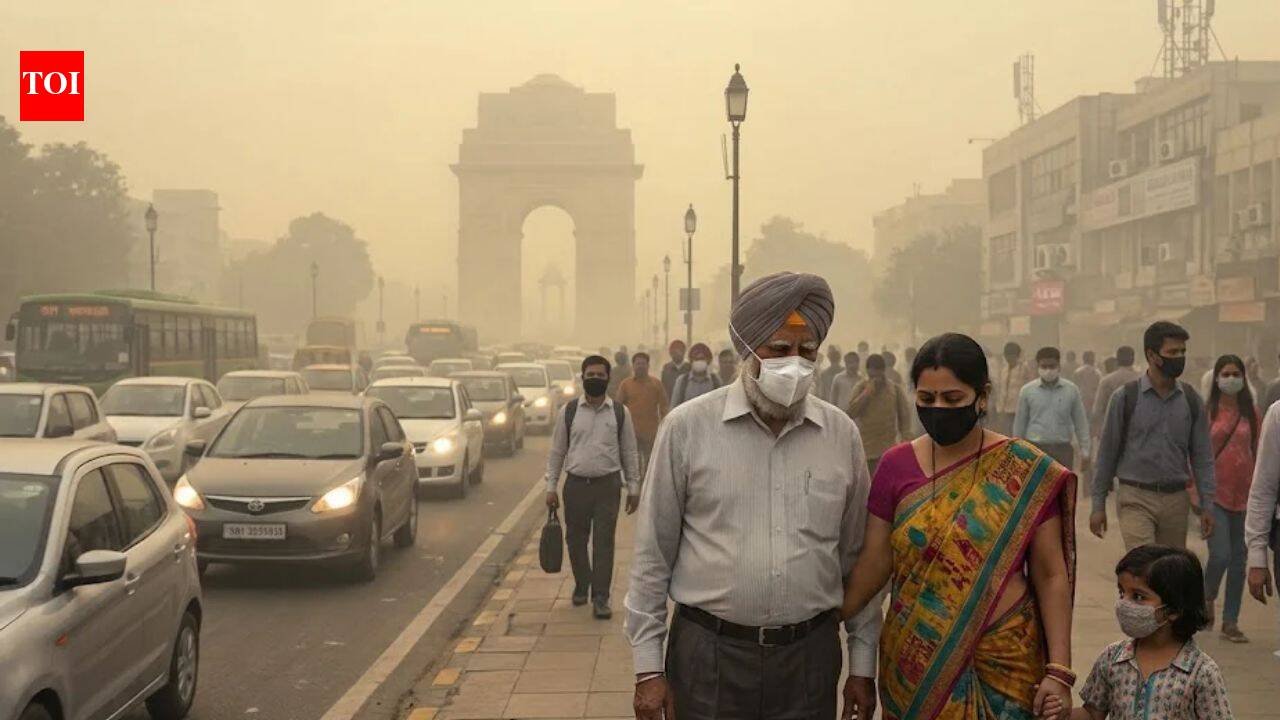
NEW DELHI: What has changed in Delhi’s pollution mix over the past decade? Have cleaner fuels, vehicle technologies and tighter emission norms altered the contribution of different sources?
Specific attention will be given to emissions from vehicles, industries, and other local sources.
Nearly 10 years after the first detailed source apportionment study of Delhi by IIT-Kanpur in 2016, a new assessment is underway to establish how the region’s pollution profile has changed.The high-resolution emission inventory and source apportionment study will provide updated emissions estimates for Delhi and 27 NCR districts using a 500mx500m grid, with each cell covering 0.25 sq km and 2026 as base year. While earlier assessments differed in methodologies, geographical coverage, source-sector classification and base years, this study will follow a common framework, using high-resolution mapping, activity data, emission factors, geographical information, seasonal changes and ground verification by teams to estimate emissions from sources.The study from Jan 1 to Dec 31 will be analysed by mid-2027 and provide future emissions and air quality scenarios for 2030, 2035 and 2040. It is being done by a consortium led by Automotive Research Association of India, Pune, in association with IIT-Delhi, TERI and Indian Institute of Tropical Meteorology, Pune.The first attempt at developing an emission inventory was by CPCB during 2007-2010 for six cities, including Delhi. However, Delhi got its first source apportionment study by IIT-Kanpur in 2016, followed by ARAI-TERI in 2018. Though several studies on pollution sources were done, none was as comprehensive as IIT-Kanpur and ARAI-TERI studies.“Changes in vehicle technology, fuel standards, industrial practices, pollution control measures, urban development, waste management and agricultural activity may have altered emissions and their relative contributions. For example, coal has been banned in NCR, except specified processes, and industries have shifted to cleaner fuels,” SD Attri, member technical, CAQM, said.To address this, in April 2025, CAQM developed a framework for emissions inventory and source apportionment for Delhi-NCR. CPCB, which is funding the project, is implementing the framework through a consortium of four institutes. The new inventory will cover PM10, PM2.5, nitrogen oxides, sulphur dioxide, carbon monoxide, non-methane volatile organic compounds, ammonia, with elemental carbon, organic carbon, methane and hydrogen chloride.“The study will give scenario assessments for 2030, 2035 and 2040 under different mitigation pathways to help evaluate potential changes in emissions and air quality. These scenarios will provide a scientific basis for long-term pollution control planning in Delhi-NCR,” said Attri, who is heading the project review committee which is tracking the progress of the ongoing study.Attri said the 500 m x 500 m resolution divides the region into small geographical cells. It would enable detailed identification of emission hotspots and help distinguish areas with different source profiles. Apart from AI-based mapping using satellite imagery, several teams have been deployed for field verification to improve the identification of smaller sites.For example, vehicular emissions can be estimated using road networks, traffic volumes, vehicle categories and activity patterns. Industrial emissions can be assessed using information on industrial locations, production, fuel consumption and pollution control equipment. Road dust emissions require information on road characteristics, silt loading and relevant activity patterns.“The framework will extend beyond NCR into the wider north Indian domain, allowing regional transport to be examined,” said Attri.IITM’s Decision Support System gives the contribution of various local and regional sources in Delhi’s PM2.5 for only the winter season. However, the estimation isn’t accurate as it relies on a 2021 emission inventory. In future, DSS will use the new emission inventory, once it is prepared.To complement the study, a network of real-time source apportionment super-sites has been proposed in NCR. While IITM’s supersite at New Rajendra Nagar was inaugurated Saturday, DPCC’s supersite at Rouse Avenue will be revived. Four additional supersites have been proposed at Sonipat, Rohtak and Rewari in Haryana and UP’s Greater Noida.


