



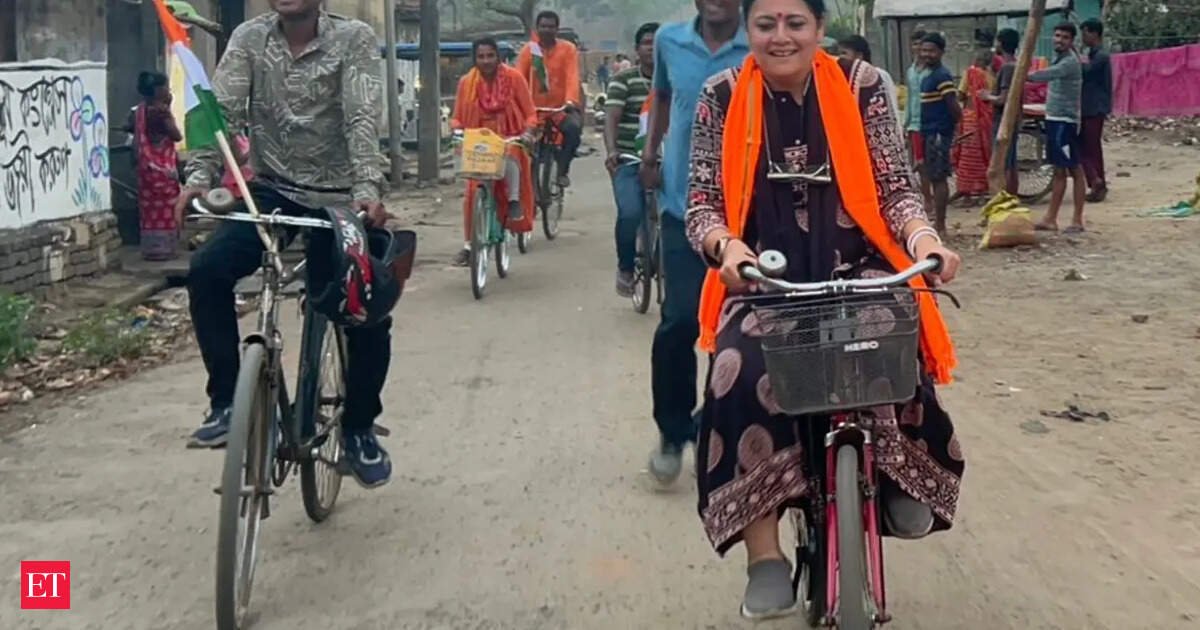
Part of the Asansol Lok Sabha constituency in Paschim Bardhaman district, the urban-industrial seat located in the Raniganj coal belt reflects the structural transition of eastern India’s old mining towns, where industrial slowdown, informal coal networks and demographic shifts are influencing political narratives.
Also read: West Bengal polls: BJP releases fourth list of 13 candidates, replaces one nominee
The BJP, which wrested the seat from the TMC in 2021, is attempting to retain it through a mix of Hindutva mobilisation and governance issues linked to the coal economy.
The ruling TMC is seeking to regain lost ground by rebuilding its traditional Bengali-minority support base and highlighting the various social welfare schemes of the state government.
The BJP has renominated sitting MLA Agnimitra Paul, while the TMC has fielded former MLA Tapas Banerjee, who represented the constituency in 2011 and 2016 before shifting to neighbouring Raniganj in 2021.
The CPI(M) has nominated Shilpi Chakraborty, and the Congress has fielded Souvik Mukherjee.Paul had defeated TMC candidate Saayoni Ghosh in 2021 by 4,487 votes, in what was seen as a significant BJP breakthrough in an otherwise TMC-inclined urban belt.
However, the BJP’s organisational strength in the larger Asansol region faced a setback when TMC candidate Shatrughan Sinha won the 2022 Lok Sabha bypoll by a huge margin.
The constituency’s political discourse continues to be shaped by the long-term decline of formal employment in coal mining.
While the Raniganj coalfields once provided stable employment to thousands of workers, automation and restructuring have reduced direct job opportunities, pushing many into the informal sectors or migration.
At the same time, illegal coal extraction networks continue to provide livelihood to sections of economically vulnerable populations, making enforcement actions politically sensitive.
Political observers said this duality, shrinking formal jobs alongside the persistence of informal mining, has created a complex socio-economic backdrop influencing voting behaviour.
Land subsidence remains another major issue in several parts of the constituency due to decades of mining, both legal and illegal.
Residents in vulnerable zones face risks from underground voids, cracks in buildings and sudden ground collapse, making rehabilitation, compensation and safety measures recurring electoral issues.
“Migrant identity politics, mobilisation of Hindi-speaking voters, subsidence and unregulated mining are not just environmental questions. They affect the livelihoods and safety of thousands of families,” said Susmita Majumdar, a political science professor in nearby Durgapur College.
Asansol Dakshin has a socially diverse electorate shaped by decades of labour migration. Hindi-speaking voters, largely tracing their roots to Bihar and Jharkhand, are estimated to constitute around 35-40 per cent of the electorate.
The BJP is attempting to consolidate Hindu voters across linguistic divides, while the TMC is focusing on its traditional coalition of Bengali voters and minorities.
Political mobilisation around Ram Navami celebrations has added another layer to the campaign narrative this time, observers said.
The BJP has also sought to highlight allegations of coal smuggling, recruitment irregularities and the alleged role of local syndicates as governance issues.
Paul claimed that corruption, illegal mining and subsidence linked to unregulated extraction remain key voter concerns.
“This is a do-or-die election for us. To save the state from demographic change, we need to dislodge TMC from everywhere. Like the rest of the states, we need consolidation of Hindu votes in Asansol Dakshin. We are for inclusiveness, where all communities can live. But Hindus should not feel threatened, and there should not be any appeasement policy by the government,” she told PTI.
The TMC candidate, however, accused the BJP of trying to polarise voters and said his party was focused on development and welfare.
“Our message is to carry forward the development momentum of Chief Minister Mamata Banerjee,” Banerjee told PTI while campaigning in the constituency.
“The BJP cannot counter her social development projects and the improvement in civic amenities in Asansol and the surrounding gram panchayats. The BJP MLA is seldom seen in the area and has faced protests by people for doing little to address their problems,” he alleged.
He also rejected the BJP’s coal smuggling allegations and claimed central agencies should act if there were irregularities.
Though not seen as a principal challenger, the Left could still influence the outcome by cutting into votes.
Given the fragmented social composition and the absence of a single dominant voting bloc, analysts said a close contest is expected, with even small shifts among linguistic or occupational groups could affect the outcome.
The constituency includes several wards of the Asansol Municipal Corporation along with Amrasota, Egra, Ballavpur, Jemari and Tiratgram gram panchayats.
Polling will be held here in the first phase on April 23, with counting scheduled for May 4.


