



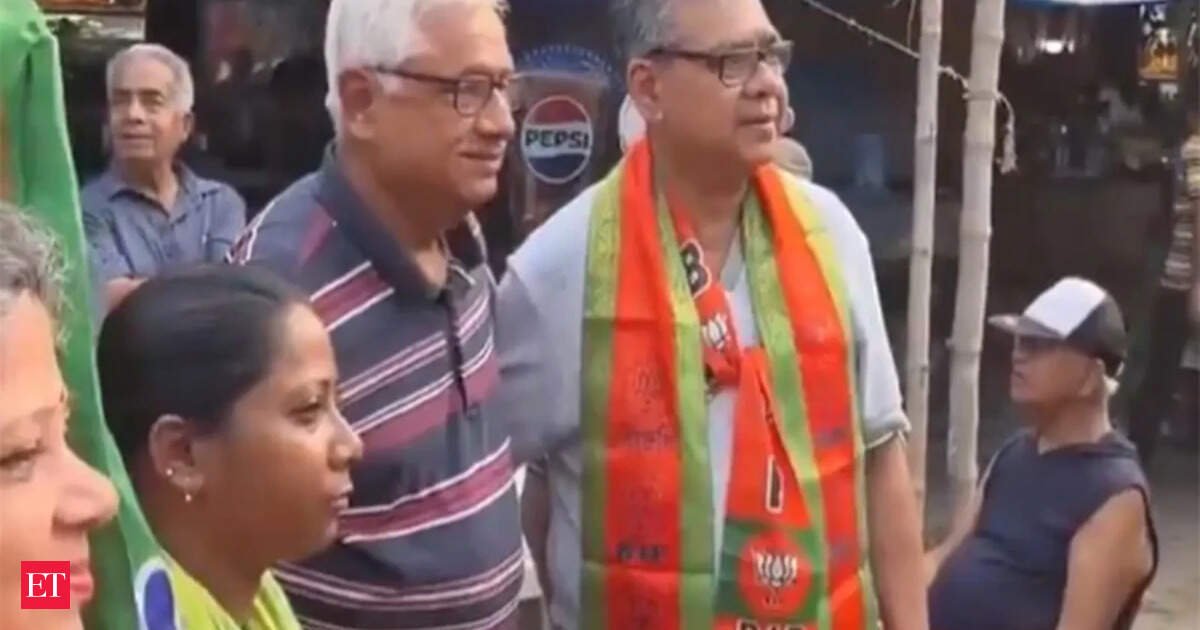
One candidate washed utensils in a village home, while another carried buckets of water for an elderly woman, and the third shaved a voter at a roadside saloon.
Also Read: West Bengal polls: Coal economy, identity politics shape contest in Asansol Dakshin
Across the state, the campaign trail has become less a contest of speeches and more a competition in political intimacy, with every candidate trying to send the same message: “I am not above you, I am one among you”.
In Hooghly’s Goghat, TMC candidate Nirmal Maji, a Kolkata resident, seems determined not to let the familiar “outsider” taunt become a political liability.
In one house, he picked up the cooking ladle and stirred a pot on the stove. In another, he sat on the floor and shared a simple food of dal, fish curry and rice with the family.
“I am trying to prove to people that I am not here as a guest. I want to live among them, eat with them and share their lives,” Maji told PTI.Not far away, in Pursurah, TMC nominee Partha Hazari found his campaign briefly turning into household labour.
Inside a voter’s home, where women were grinding spices on a ‘shil-nora’ (grinding tool made of stones), Hazari rolled up his sleeves and joined in. In another, he crouched beside a tub of utensils, helping wash plates and cooking pots while party workers raised slogans outside.
Also Read: West Bengal polls: BJP releases fourth list of 13 candidates, replaces one nominee
He was recently seen in a voter’s kitchen rolling out rotis on a clay oven after learning that the household had run out of cooking gas.
“People do not want leaders who only arrive with microphones and leave with garlands. They want to know whether we understand their daily struggles,” Hazari told PTI.
Elsewhere, in Arambagh, TMC candidate Mita Bag entered a roadside eatery, fried fritters in bubbling oil, packed those into paper packets and even sold a few to customers.
If TMC leaders were entering kitchens, BJP candidates were taking to saloons, fields and village lanes.
In Narayangarh, BJP nominee Ramaprasad Giri walked into a local saloon during campaigning. A customer was waiting for a shave. Minutes later, the candidate himself picked up the razor and began shaving the man’s beard.
In Durgapur West, BJP candidate Lakshman Ghorui discovered that political outreach can also begin with a bucket.
Campaigning through Nishanhat, he saw an elderly woman struggling to fetch water from a roadside tap. Ghorui stopped, filled two buckets himself and carried those to her house.
“I saw an elderly woman carrying water from far away. At that moment, I thought politics could wait and helped her out,” he said.
In Pursurah, BJP candidate Biman Ghosh took his campaign to a field, where he joined farmers in ploughing.
In a state where politicians are often accused of merely ploughing through promises, here was one literally ploughing a field.
In Chatna, BJP candidate Satyanarayan Mukhopadhyay matched Mita Bag almost item for item by frying fritters at a roadside eatery.
By now, the campaign trail appears to have become a contest not merely of ideology, but of culinary skills.
For decades, West Bengal’s communists prided themselves on ideology, atheism and a carefully maintained distance from overt displays of religion.
Today, with their electoral fortunes reduced to what rivals mock as “zero”, even the comrades appear willing to seek divine intervention.
In Panihati, CPI(M) candidate Kaltan Dasgupta began his campaign not with a Marxist slogan but with prayers at the Chaitanya temple in Mahotsabtala ghat.
Old-timers still remember the debate when Left Front leader and the then state minister, late Subhas Chakraborty, visited Tarapith temple, or when veteran leader Rezzak Mollah went on Haj. Chakraborty had then summed up West Bengal’s enduring political contradiction in a line that has since become folklore: “First Mohammad, then Marx.”
Dasgupta insists the party is merely adjusting to social reality.
“We are not abandoning ideology. But if people begin their day with faith, we cannot begin our campaign by pretending that faith does not exist,” he said.
A Calcutta University sociologist said the new campaign style reflects a deeper change in West Bengal’s political culture.
“The old politics of distance is disappearing. Earlier, leaders stood on a stage, and voters stood below. Now candidates are entering kitchens, courtyards and temples because voters increasingly judge authenticity through intimacy,” he said.
“This is retail politics in its purest form. The visuals of a candidate washing utensils or carrying water can travel much farther on social media than a manifesto. In West Bengal today, optics often reaches voters before ideology does,” a Kolkata-based political analyst said.
Within hours, many of these campaign images had escaped the constituency and taken on a second life online.
Photographs of candidates washing utensils, carrying buckets or frying fritters triggered a flood of memes and sarcastic captions. One post described the campaign as “Bengal’s Got Talent: Election Special”. Another joked that after roads, jobs and water, parties may soon compete over who makes better fritters.
The image of the CPI(M) candidate praying at a temple invited especially sharp barbs, with one meme quipping: “From Das Kapital to Dasavatara.”
Yet, for all the mockery, the parties understand that in West Bengal’s election theatre, the campaign is no longer being fought only with manifestos and speeches.
It is also being fought with ladles, razors, buckets and ‘belans’. And by the time the votes are counted, the winner may well be the candidate who looked least like a politician.


