


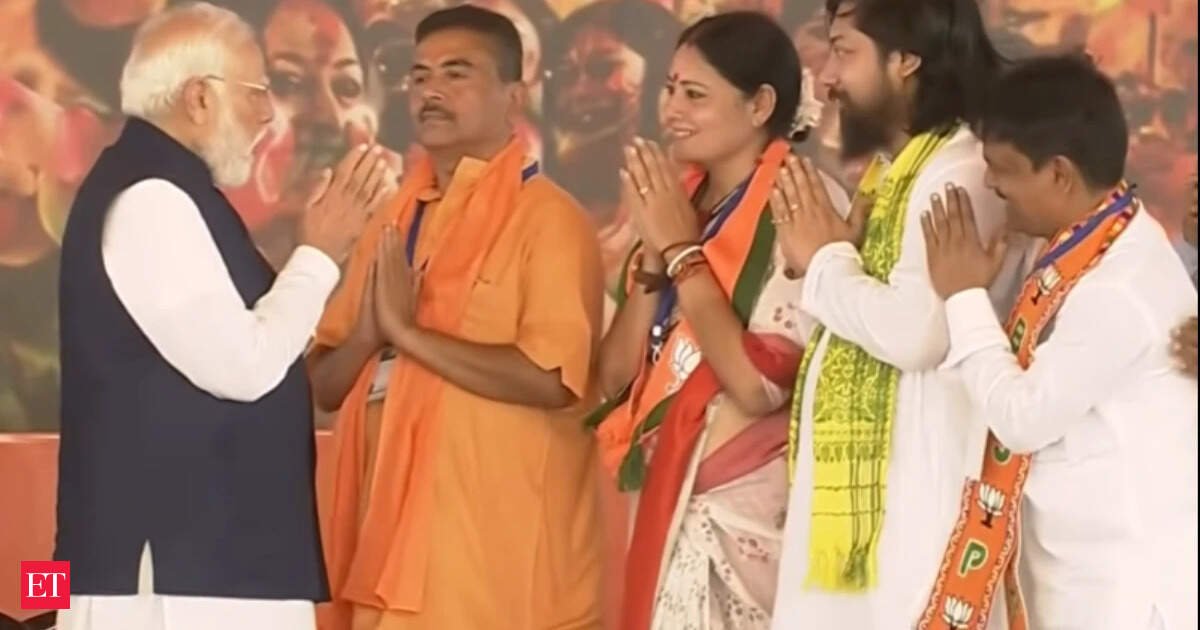
The venue, the iconic Brigade Parade Grounds, was transformed into a sea of saffron this morning.
Also Read | West Bengal Polls: BJP picks Bhabanipur ‘giant killer’ Suvendu Adhikari as chief minister
The timing carried a deliberate weight, as the ceremony commenced at 11 am on May 9, coinciding with Pochishe Boishakh, the 165th birth anniversary of Rabindranath Tagore.
By taking his oath on this culturally poignant day, Adhikari sought to anchor his new administration in the cultural heritage of the land.
The stage was a powerhouse of national leadership, featuring Prime Minister Narendra Modi, Union Home Minister Amit Shah, Defence Minister Rajnath Singh and chief ministers from the 20+ BJP-governed states – all gathering to witness a moment that many analysts once deemed impossible.
Also Read | Jhalmuri, sweets & Rabindranath Tagore: The Bengali factor in BJP’s Bengal oath-taking ceremonyWhile Adhikari was the man of the hour, he was not the only one to take the solemn pledge. A cohort of BJP stalwarts, each instrumental in the party’s meteoric rise in the state, were sworn in as key ministers.
The MLA from Asansol Dakshin, Agnimitra Paul, brought a powerful presence to the stage as her induction served as a realisation of the party’s “Nari Shakti” campaign and a promise of safety for the women of Bengal.
Finally, Dilip Ghosh, the grassroots architect who secured a massive 30,000-vote victory in Kharagpur Sadar, along with BJP leaders Ashok Kirtania, Khudiram Tudu and Nishith Pramanik.
The 2026 surprise
Adhikari’s journey to the Chief Minister’s chair was paved by a performance that has already entered Bengal’s political folklore.
In the 2026 elections, he achieved a historic double victory by holding his home turf in Nandigram while simultaneously decapitating the TMC leadership by unseating Mamata Banerjee in her own bastion of Bhabanipur.
Also Read | Suvendu Adhikari, Mamata’s apprentice who did ‘khela’ on his mentor
His victory margin of over 15,000 votes in Bhabanipur was the final blow to a structure he once helped build.
As a former TMC heavyweight who crossed over in late 2020, Adhikari used his intimate knowledge of the grassroots machinery to outperform his former mentor, transforming from a “defector” to the undisputed face of a new Bengal.
The scale of the mandate has rewritten the record books entirely.
With 207 seats in the 294-member assembly, the BJP secured a thumping majority, leaving the TMC with just 80 seats.
This victory marks the first time since 1972 that West Bengal will be governed by the same party that holds power at the Centre, potentially ending decades of friction between Kolkata and Delhi.
Meanwhile, the 2026 results also defied every prediction.
While exit polls had suggested a narrow race, the actual data revealed a “silent wave” that swept through the Medinipur and Hooghly belts and dominated North Bengal.
Despite the TMC’s extensive welfare net, such as Lakshmir Bhandar, a staggering 92.47% voter turnout, the highest since Independence, indicated that the people were no longer looking for simply reforms, but for a total systemic change.
