


The swearing-in ceremony of the new BJP government was held at Kolkata’s Brigade Parade Ground in the presence of Prime Minister Narendra Modi, Shah and several senior BJP leaders.
Adhikari’s elevation paves the way for the formation of the first BJP government in West Bengal after the party’s emphatic victory in the assembly elections, ending the Trinamool Congress’s 15-year rule in the state.
Adhikari, a former close aide of TMC supremo Mamata Banerjee, who switched over to BJP in December 2020, emerged as the central face of the saffron party’s campaign in Bengal and played a key role in expanding its organisational base across the state.
His political stature rose sharply after he defeated Banerjee in the high-voltage Nandigram contest in the 2021 assembly elections. In 2026, he again defeated Banerjee, this time in her Bhabanipur seat.
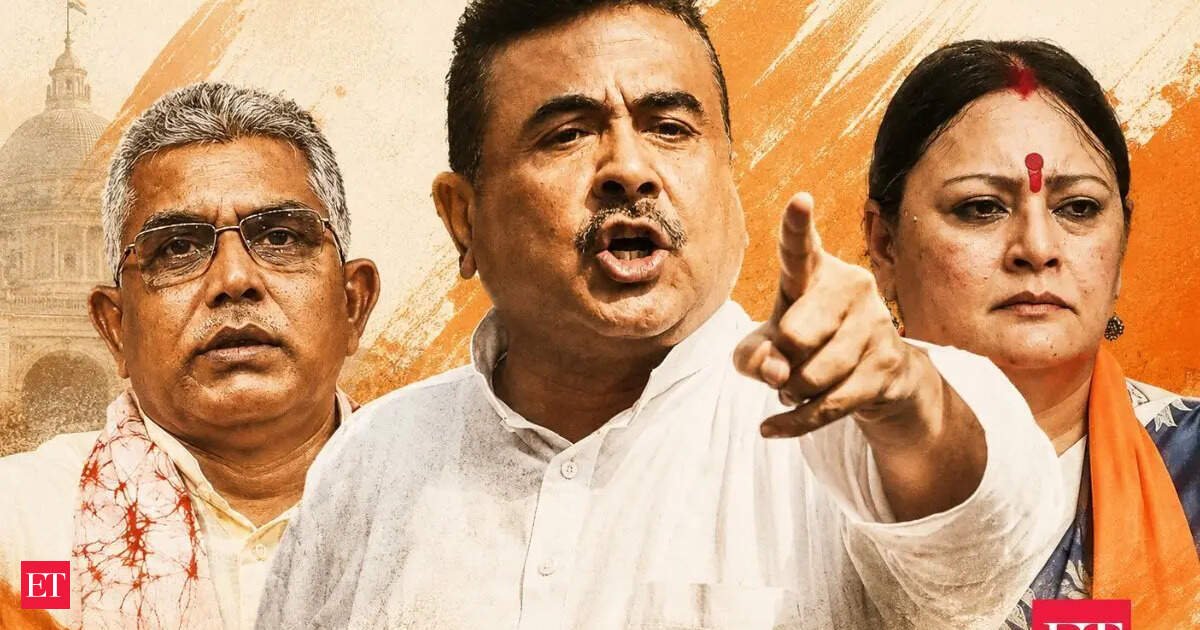
ALSO READ | TMC launches fresh jibe on EC in first reaction as Suvendhu Adhikari becomes West Bengal CMAmong those who took oath with CM Adhikari were Dilip Ghosh, Agnimitra Paul, Ashok Kirtanya, Kshudiram Tudu, and Nisith Pramanik.
Here’s a look at the five ministers:
Dilip Ghosh
A senior BJP leader and former West Bengal BJP chief, Dilip Ghosh started his political career as a full-time RSS pracharak. Considered one of the key faces of the BJP in Bengal, he played an important role in expanding the party’s grassroots network in the state after 2014.
He also represented the Medinipur Lok Sabha constituency as a Member of Parliament.
Ashok Kirtania
Ashok Kirtania is a BJP MLA representing Bangaon Uttar in North 24 Parganas, an area strongly influenced by Matua politics in West Bengal. He has worked in business and has also been active in local organisational politics.
Kshudiram Tudu
Kshudiram Tudu is a tribal leader from Bankura district, representing Ranibandh, a tribal-dominated constituency in the Jungle Mahal region. BJP has relied on leaders like him to strengthen its outreach among tribal communities in West Bengal.
Nisith Pramanik
Nisith Pramanik is one of the BJP’s prominent young leaders from North Bengal. He was earlier associated with the Trinamool Congress before joining the BJP in 2019.
In July 2021, he was appointed Minister of State for Home Affairs and Minister of State for Youth Affairs and Sports in the Modi government, becoming one of the youngest ministers at the age of 35.
Pramanik represents the Rajbanshi community and the North Bengal political base, known for its strong youth appeal and organisational influence.
Agnimitra Paul
West Bengal’s first BJP government has just one woman in the cabinet, and that is 51-year-old Agnimitra Paul, who was sworn in as a minister alongside Chief Minister Suvendu Adhikari on Friday.
A two-time MLA from Asansol Dakshin and BJP’s Bengal vice-president, Paul emerged as one of the party’s key women leaders during the 2026 Assembly election campaign. She retained her seat by defeating TMC’s Tapas Banerjee by over 40,000 votes, further strengthening her position in the state unit.
Before entering politics in 2019, Paul was a well-known name in Kolkata’s fashion industry. She ran her label “Inga” and designed outfits for celebrities such as Sridevi and Hema Malini. Her work often showcased Bengal’s traditional crafts, including Kantha embroidery, and was featured at platforms like Lakme Fashion Week.
Born and raised in Asansol in a middle-class family, she studied Botany before pursuing fashion technology and management. She later transitioned into politics, focusing on women’s empowerment and grassroots mobilisation.
BJP’s Ang, Bang, Kalinga plan
What once looked like an ambitious political dream for the BJP has now become one of its biggest milestones in eastern India. With the party securing power in West Bengal in 2026, the BJP has effectively completed its long-pursued “Anga-Banga-Kalinga” political map, spanning Bihar, Bengal and Odisha.
The Bengal victory is far more than just another electoral success. It represents the culmination of a broader expansion strategy that began after Prime Minister Narendra Modi came to power in 2014. Over the last decade, the BJP steadily pushed into regions where the party once had little organisational presence or ideological influence.
The latest win also signals a major political comeback for the saffron party. After facing setbacks in the Lok Sabha elections and seeing its parliamentary numbers dip, the BJP has managed to regain momentum through decisive state-level victories in the East.
The first major breakthrough came in Odisha in 2024, when the BJP ended the long rule of Naveen Patnaik. That victory was followed by another strong performance in Bihar, where the NDA retained power and BJP leader Samrat Choudhary emerged as a key face in state politics after years dominated by Nitish Kumar.
The Bengal win has now completed the party’s eastern push, delivering perhaps the most politically symbolic victory of them all by defeating Mamata Banerjee and the All India Trinamool Congress in one of the BJP’s toughest battlegrounds.
National machine
Over the past decade, the BJP’s political expansion has dramatically altered India’s electoral landscape. In 2014, the party’s influence was largely concentrated in the Hindi heartland and western India. By 2026, however, the BJP and its allies had expanded across large parts of the country, governing states that together account for a major share of India’s population and geography.
Political observers say the transformation is not just about the number of states under BJP rule, but also about the party’s ability to establish itself in culturally and politically diverse regions that were once considered difficult territory.
Bengal: The final frontier
For the BJP leadership, West Bengal carried both strategic and symbolic importance. Despite rapid gains in previous elections, the state had remained firmly under Mamata Banerjee’s control for over a decade.
The BJP’s breakthrough is being seen as the climax of a sustained campaign led by senior party strategist Amit Shah, who had repeatedly declared that the BJP would one day rule “Anga, Banga and Kalinga”.
That slogan now appears to have turned into political reality.
During one of his campaign rallies in Bengal, Shah had confidently predicted the fall of the Trinamool Congress government, saying that once counting began, it would be “ta ta, good-bye to Didi.” At the time, critics dismissed the remarks as campaign rhetoric. But following the BJP’s victory, those statements are now being revisited as a sign of the party’s confidence in its long-term eastern strategy.
The Bengal victory also builds on earlier eastern gains. The BJP’s rise in Odisha and consolidation in Bihar created the momentum that eventually helped the party breach Bengal — a state long seen as one of the final major barriers to the BJP’s dominance in eastern India.
