



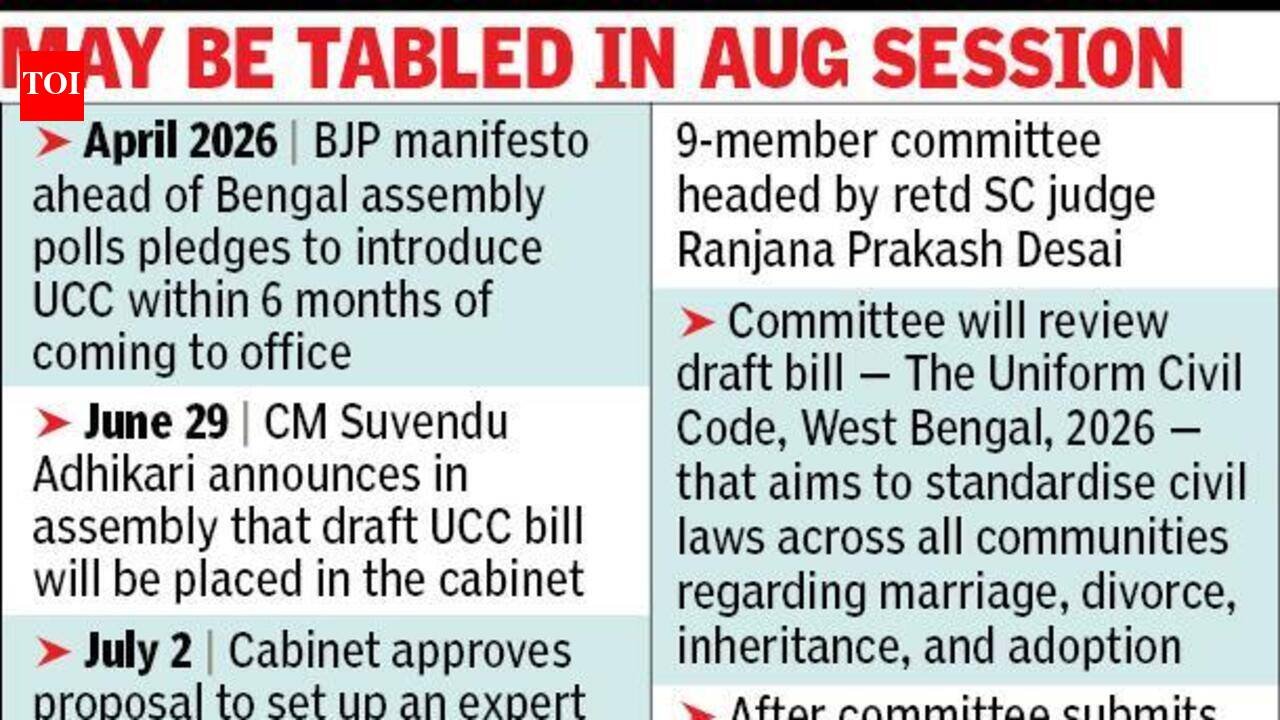
Kolkata: The state administration has constituted a high-level committee, comprising nine members, to prepare the draft Uniform Civil Code (2026) “irrespective of religion, faith or community” that will include laws on marriage, divorce and succession.The state judicial department issued the notification on Friday. Retired Supreme Court judge Ranjana Prakash Desai will chair the committee. The other members include former Meghalaya governor and Bengal BJP veteran Tathagata Roy, resident commissioner Dushyant Nariala, former Uttarakhand chief secretary and Ayodhya’s Ram Mandir Construction Committee member Shatrughna Singh, state home secretary Sanghamitra Ghosh, retired academic Ratna Bhattacharya, former Gour Banga University vice-chancellor Gopalchandra Misra, Calcutta High Court advocate Osman Gani Mallick and former Bengal Sambhag executive director Nirmalya Bhattacharyya. Home secretary Ghosh is the committee’s member-convener.The constitution of the committee follows a decision taken at a state cabinet meeting on July 2.“The committee will begin its work and submit its findings soon. UCC has been implemented in other states. It is one nation; so there will be one law. There cannot be two sets of laws. It is crystal clear,” CM Suvendu Adhikari said on Saturday.The bill is likely to be introduced in the assembly in the Aug session after the committee submits its report. Scheduled Tribes and ancient indigenous communities will remain outside the law’s ambit. The notification states that the move has been initiated keeping in mind Article 44 of the Constitution, which forms part of the Directive Principles of State Policy and envisages a UCC for citizens.Three states — Uttarakhand, Gujarat and Assam — already have a UCC.One of the members of the committee, Roy, said elaborate discussions would precede the formulation of the law. “I initially thought it would be adopted by the Centre, but it was later decided that it would be handled at the state level. There may be some differences between states, but it is unlikely that they will be significant. There may be some administrative variations, but the fundamental principles should remain the same,” he added.(Inputs from Zeeshan Jawed & Debashis Konar)


