



At Weave The Future 4.0, a mountain of discarded clothes confronted visitors even before they entered the exhibition. The mirror in the backdrop, stated that India generates 7.8 million tonnes of textile waste every year. Visitors paused, and, inside Dilli Haat INA, that stark reality gave way to possibility, as artisans showcased garments, crafts and accessories made from fabric scraps and rescued handloom textiles.
At Weave The Future 4.0, a mountain of discarded clothes confronted visitors even before they entered the exhibition; In frame: Giriraj Singh
Organised by the Office of the Development Commissioner (Handlooms), Ministry of Textiles, the six-day exhibition brought together over 100 artisans, and the focus this year was on upcycling, repair or marammat, recycling and reuse of what seems to be waste.
DC (Handloom) Dr M Beena and Amrit Raj, DC (Handicrafts)
‘It’s a reminder that Indians have followed circular design practices for generations’Talking about the fourth edition, Dr M Beena, DC, Handloom, said, “This edition brought together artisans, students, startups, designers, and recycling enterprises to explore collaborative approaches towards addressing the growing challenge of textile waste through upcycling, repair and recycling. It’s a reminder that Indians have followed circular design practices for generations.” Visitors walked through installations highlighting the scale of India’s textile waste, watched demonstrations of yarn being spun from discarded fabric strips, and discovered handcrafted bags, apparel, home décor and accessories made almost entirely from surplus textiles.
Innovative designs, unique artefacts and valuables defined the exhibit, which aimed to promote sustainability. Among them was Diti Mistry’s installation, created using textile waste collected during her travels
Beyond shopping, the exhibition encouraged visitors to rethink their relationship with clothing, recognising that what is often thrown away can become the starting point of something entirely new. Here’s a look at some of them:Delhi-based Arshia Bawa, founder of The Nani Project, sources fabric scraps from local tailors, spins them on a charkha to make a workable yarn and crochets them into new products. “The process effectively brings waste fabric back into use, giving it a second life. I am using the same yarn to make usable products using an endangered craft from Jaisalmer called ply split braiding, traditionally used to make camel belts,” she shared.
Delhi-based Arshia Bawa, founder of The Nani Project, sources fabric scraps from local tailors, spins them on a charkha to make a workable yarn and crochets them into new products.
Poulami, founder of an upcycled textile jewellery brand Maati, said, “I use katrans to make heritage-inspired jewellery, where textile waste, from cotton to silk scraps, are inlaid in wooden frames used to make earrings, necklaces, rings”
Poulami makes upcycled textile jewellery with the brand name Maati
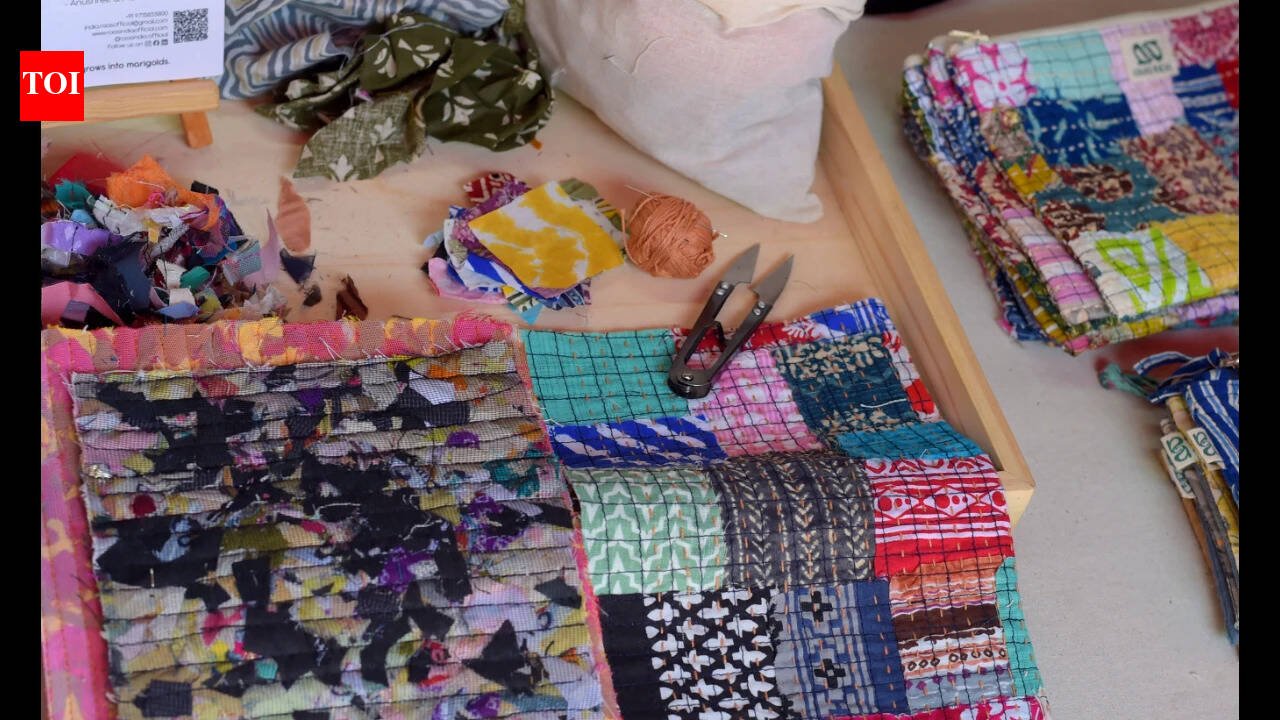
Designer Urvashi Kaur, who was showcasing apparel from her line Renew Project, said, “Mending, repairing and reimagining waste is in the Indian DNA. When you have little means, you innovate to extend the life of resources. So, with this project, the idea is to let people know that so much value is generated by waste. The way we patch the scraps of different textiles, designs and colours, people are loving the craft, the aesthetic of it”
Weave The Future 4.0 showcased multiple opportunities for textile waste mitigation
(Left) Jyoti Panwar’s painting-like textile manipulation art, Munart, transformed scrap threads into intricate designs encased in a delicate layer of organza
Using reclaimed denim, airbags, seatbelts, billboard flex and surplus fabrics, NO MORE is a design-led circular brand that transforms waste into functional bags and accessories rooted in circularity. Talking about the brand, Priyanka Parswani said, “We keep perfectly good materials out of landfills and in use for as long as possible by giving them a second life.” Co-founder Praveen Premkumar added, “Perfectly good surplus fabric and dead stock often end up being discarded simply because warehouses run out of space. We wanted to rescue those materials and turn them into products with a much longer life”
NO MORE is a design-led circular brand that transforms waste into functional bags and accessories rooted in circularity.
One of the key attractions was Marammat, a hands-on workshop organised by Rafooghar that invites participants to repair, stitch and mend fabric rather than discard it


