






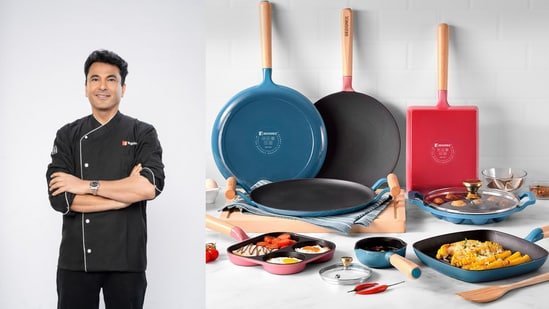


Celebrity chef Vikas Khanna’s fondest food memory of a dish cooked in an Indian iron kadhai is his grandmother’s aloo methi ki sabzi. He reminisced about how methi sabji in cast iron has a different kind of tone and can never taste right in a non-stick or aluminium pan.
During our conversation about cookware and his recent launch with Bergner, he said that Indian cuisine was never meant to impress. It was always about cooking to heal and nourish. But with changing times, everything requires a 2.0 version. Adaptability is the key to evolving and surviving, and this is where kitchens have evolved to more open styles in design, and also where a new essential need has arisen for designer cookware that can make its way to the table directly from the stove. That is where his interest in creating a new and modern range of cookware came from.
Vikas said, “My mother refuses to throw away her pans. Her non-stick pans have burned out and lost their layers and coating, but she claims they still work. This is where a true understanding of cookware and coating is important. I want to be a pollinator of the right information. The truth is, we are overusing old non-stick pans at the cost of our health. We are ready to pay double to eat organically grown food, but we do not have enough information and conversation going around that talks about the cookware we need to use.”
He painted a beautiful comparison of how the tawa in Punjab, which makes aloo parathas, and the dosa pans down south that result in crispy dosas, are all iron and can turn your everyday meal into a memory you will always relish in the stories of the food you ate. These are traditional regional foods from across the country, but the medium remains the same.
“ These recipes are part of traditions. And sometimes you simply do not question traditions because it is a continuation of many generations. I feel people had questions and went looking for answers with solutions, and things changed.” This is where the shift from traditional cookware went to modern quick cooking options, and it is time to bring back the roots, but with a modern twist.
On seasoning a cast-iron pan/wok the right way
Vikas quipped, “It’s not as difficult as we have made it by getting intimidated by rust. Things left unattended will spoil and rust.”
He stressed how important it is to take care of your cookware, no matter what the material, and specifically to love your cast iron cookware with a little extra attention.
- Do not scrub your iron pans with toxic fibres and chemicals.
- Wipe your pans down after washing and leave zero moisture on them.
- Salt seasoning is very important to give it that perfect, ready-to-cook nature. Do not skip this step.
“There is a time when seasoning your cast iron pan correctly can turn it into a non-stick pan, but give you a great result in cooking, unlike a non-stick one. My restaurant has a limited menu of about 16 dishes, out of which 7 are cooked on iron cast pans. The sear an iron pan will give you is unmatched, and a non-stick or steel pan can never do the same job.”
Has Gen-Z changed the way they cook or adapt to cooking at home?
Cooking at home, as per Vikas, should not feel like a chore. A good khichdi or roast is the best way to go for comfort cooking, and Gen-Z has become more conscious of what they eat and has slowly made cooking at home and eating healthy fashionable again. With the increase in AI being used in health so extensively, it has created a strong shift in the cooking mindset.
It is no longer about 10 utensils and cooking a 7-course meal at home. It is about simple, easy recipes and taking them from the stove to the table for a wholesome meal.
AI is here and taking over our kitchens. What is your take on this? Especially since you have just launched a whole range of classic cookware?
He tapped right into the ‘maa ke haath ka khana’ concept and asked, “If you would like to feed your kids. Would you like a machine to do it or would you like to do it yourself?” He said it is a very tender emotion. Between the cook and God. The guest is just a transformative form, changing shape. But the connection you create when you cook a meal is a form of meditation. Switch off your phone and pay attention to creating the meal. The process is truly therapeutic and again, something that is between “You and God”. AI could never give you that connection.
“I cook for four generations who sit at the tables in my restaurant every single day. This is beyond anything a machine can do or create. This emotion that I am feeling is not something that can be replaced.”
The soul of Indian cooking is in the cookware we use, and where does one find it?
Vikas was quick to respond that, “There is a little bit of soul in everything. But the real soul of Indian cooking is in clay. There is something extremely organic about cooking in clay pots. Seasoning them, how the food smells when you cook it in a clay pot. It is so eternal.”
He also added that Kansa and brass are more decorative, while cast iron is old school but needs some maintenance. Every material plays a different role and has been highlighted during different times, regions and cuisines. It is important to pay attention to the little details that every material has to offer.
A memory in cookware
“My dadi’s kadhai is currently at the museum I have made in Manipal. Her grandmother gave it to her when she got married.” He laughed and added, “It did not even have both handles.”
He reminisced about how some forgotten recipes of his grandmom were always cooked only in her kadhai and nowhere else. Even her ‘tawa’, he so fondly remembered. “She would tell me that the day my father was born, someone got her an iron tawa, and it was simply amazing that it worked for so many generations.”
Before I signed off, I just had to ask “Chef, if I got my hands on an iron pan. What is that one dish I need to cook?”
Vikas said, ” Skip the fancy dishes, pick something simple and do it well. Make an omelette, and the pan will do its magic!”


