



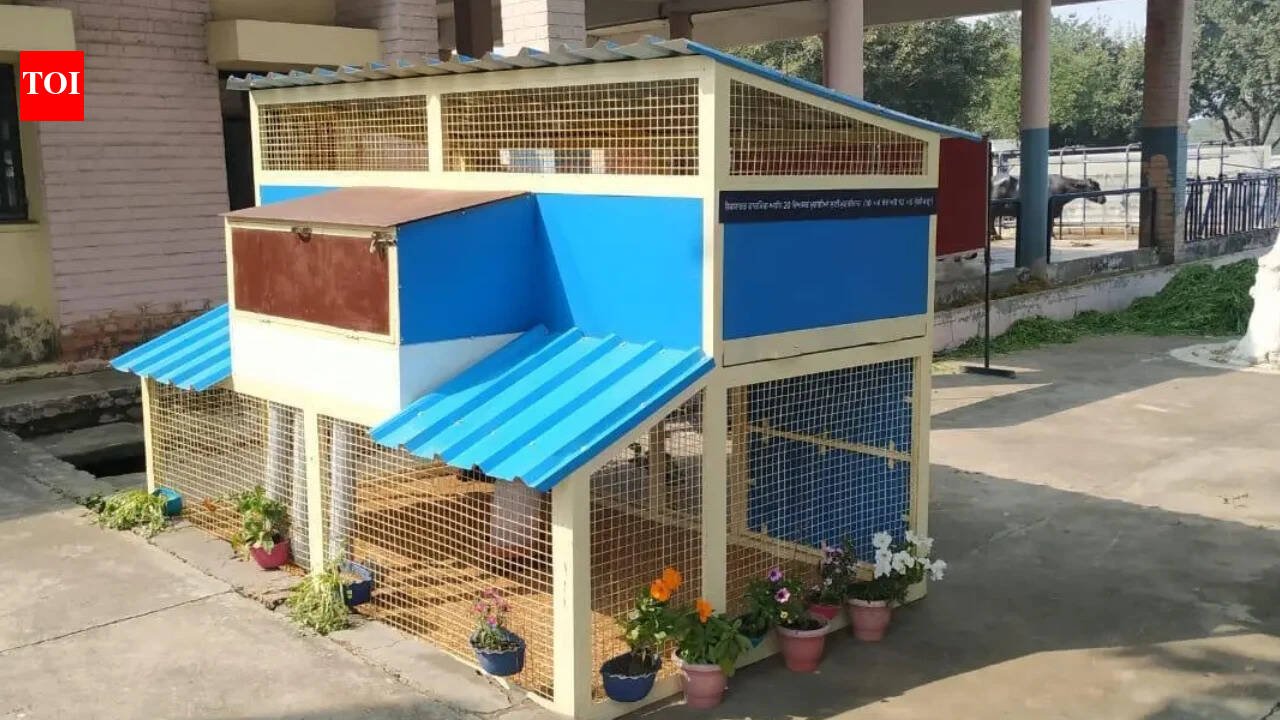
By: Gurvinder SinghLUDHIANA: While backyard poultry farming accounts only for 20% in India, Guru Angad Dev Veterinary and Animal Sciences University has designed a poultry coop, a mix of closed and open space for poultry that can help boost backyard farming in a scientific manner while generating income and supporting livelihoods without much investment.The department of livestock production management at Guru Angad Dev Veterinary and Animal Sciences University has developed a scientific backyard poultry coop design aimed at promoting sustainable and scientific backyard poultry farming in Punjab and other parts of the country. Experts at the varsity said the initiative would expand backyard poultry farming in a scientific manner to improve rural livelihoods, household nutrition and quality poultry production.According to the university experts, backyard poultry farming currently accounts for a fifth of the poultry production in India, while commercial poultry dominates the sector. However, expansion of commercial poultry farming requires heavy capital investment and large infrastructure, making it difficult for small and marginal households. Backyard poultry farming, on the other hand, can be expanded more easily with lower investment while offering multiple social and economic benefits.Speaking about the initiative, Daljeet Kaur, associate professor at the department of livestock production management, who designed and developed the coop, said that the scientific coop has been designed for 20 birds and provides both covered and open spaces to ensure bird welfare and natural behaviour. As per recommended specifications, the covered area of 40 square feet and open area of 60 square feet under the coop is designed to provide each bird 2.5 square feet space along with 3.5 square feet of run space for comfortable housing.The model follows a double-deck system in which birds move to the upper deck during the night for safety, while during the daytime they come down to the run area where they can forage, scavenge and dust bathe naturally. Such systems improve bird comfort and reduce stress while ensuring protection, she said.Medicinal and fodder plants such as mint, tulsi, coriander, patharchat and asparagus can also be grown along the periphery of the run area. Through natural scavenging and foraging, birds can obtain nearly 30% of their feed requirement, thereby reducing feed costs for households.The covered area of the coop includes specially designed nest boxes as hens prefer laying eggs in dark, cool and calm places with soft bedding. The arrangement also makes egg collection easier for families. The upper deck is also fitted with lights as experts recommend providing birds with four hours of additional lighting, two hours before sunrise and two hours after sunset, to improve egg laying.The university recommends improved desi and improved breeds of poultry such as Punjab Brown, Punjab Red and Desi Cross 1 and other dual-purpose crosses were more suitable for backyard farming systems in Punjab. The improved varieties have higher production while improved immunity, serving dual purpose of eggs and meat for family and earning income.She said backyard poultry birds generally require fewer antibiotics and lower inputs compared to intensive commercial poultry farms. Improved backyard breeds possess better immunity and can produce nearly 200 to 250 eggs annually. Though commercial poultry birds may produce 300 to 350 eggs, their management and input costs are also significantly higher.Another feature of the coop is its integrated manure management system. Trays placed at the bottom collect bird droppings, which are then transferred into perforated compost drums for aerobic composting. Around two kilograms of manure generated daily is mixed with paddy straw to maintain a balanced carbon-nitrogen ratio of 20:1.The composting system consists of two connected drums with a capacity of around 120 kilograms each and fitted with handles for rotation. The drums are rotated two to three times daily. Active composting takes place during the first 30 days, followed by curing over the next 30 days, with quality organic compost becoming ready in around 90 days, she added.Apart from income through eggs and poultry meat, the compost can generate an additional value of nearly Rs 6,000 annually for households and can either be used in kitchen gardens and farms or sold commercially.The model has been designed to promote scientific backyard poultry farming that is economical, welfare-oriented and suitable for rural families, especially women, while also improving access to nutritious eggs and meat.While this is a steel enclosure, a similar bamboo structure has also been created with similar benefits, she said.Dr Yashpal Singh, head of the department said that backyard farming has multiple benefits and should be adopted and practiced by farmers scientifically. Farmers or entrepreneurs who want to learn and adopt this model of backyard poultry farming can reach out to the department in groups, he added.


