



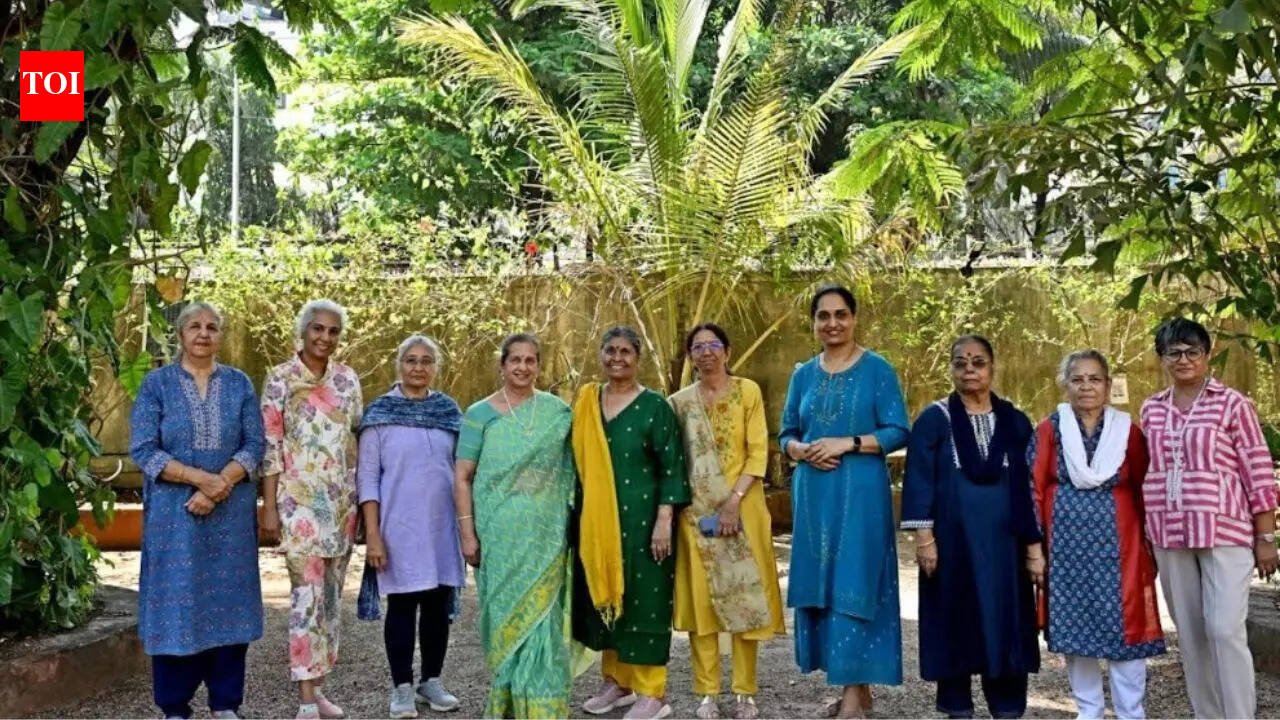
“A tropical rainforest,” says naturalist Vijaya Chakravarty, “is like a multi-storey building. You have the ground cover, the shrubs, the creepers, and, towering above them, the trees.” And every ‘floor’, she continues, motioning up a trunk, forms a distinct ecological niche inhabited by some species or another, from orchids and bromeliads to sunbirds and hornbills.” Chakravarty’s Rainforest 101 takes place in the field—not in the Western Ghats but in the urban heart of Vashi, on the grounds of the Indian Women Scientists’ Association (IWSA). The organisation was formed by 12 women scientists in 1973 to address the challenges faced by fellow women in science, both in the classroom and in the field. It also set out to demystify science for the masses, through public interventions that made the subject accessible and fun.The rainforest demo site sprang from this mission.In 2018, IWSA planted a Learning Garden on its campus to demonstrate how ecosystems work—and the services they provide—through themed clusters of plants, each no larger than the breadth of a young baobab bole.The rainforest site, for instance, is enclosed by a tree ring roughly 7 feet in diameter. At its centre stands a towering Peltophorum pterocarpum (copperpod), surrounded by Schefflera actinophylla (the octopus tree), along with shrubs, grasses, and ground-hugging plants. A chart deciphers its floor plan. A couple of feet away stand other demo ecosystems—the Western Ghats, the Deccan Plateau, and the Coastal Belt—each composed of a mixed bed of plants representing its biogeographical region, like a living line-up of botanical petri dishes.There are butterfly, sensory, and cactus sections; displays devoted to orchids and indoor air-purifying plants (Dracaena trifasciata, or mother-in-law’s tongue); biofuel plants such as Jatropha curcas (the biodiesel plant); and medicinal species like Cissus quadrangularis (the bone-setting hadjod). There are fruiting plants such as Ziziphus mauritiana (ber), prehistoric plants like Zamia furfuracea (the cardboard plant), dye-yielding plants such as Bixa orellana (the lipstick plant), and plants named after musical instruments, like Plumeria pudica (the fiddle-leaf champa). The garden also includes an arboretum and a section devoted to wild food plants.It’s an exhaustive collection of more than 500 species that draws school and college students, neighbourhood children, students of botany and medicine, and even landscapers and architects keen to take a leaf out of IWSA’s book.And a book, in fact, is what the buzz on campus is currently about, as the association launches its latest publication: ‘Creating Learning Gardens & Living Museums: Biodiversity, Conservation & Sustainability’. It is an easy-to-use illustrated guide that’s part primer, part storybook, and an all-round handbook for setting up one’s own biodiverse oasis. Inspired by the Vashi project, Inner Wheel District 314, which supported the book’s publication, created a similar learning garden in Palghar’s Navaze village.“People are told stories or given visual cues to help them remember names and key features,” says Chakravarty, principal designer of the garden and one of the editors of the book. The hadjod, for instance, resembles jointed bones and, in keeping with its name, is prescribed as a cure for arthritis and to speed up the healing of fractures. “Chutneys are made of it, too.”Alstonia scholaris, or the scholar tree, is regarded as the herbal home of Saraswati, the goddess of knowledge. “That’s why Tagore gave each graduating student at Santiniketan a token leaf,” says Priya Jacob, secretary of IWSA. The scarlet seeds of Abrus precatorius (rosary creeper) were once used to weigh gold, because their weight was strikingly consistent.IWSA may have the means with which to measure wealth, but not the stuff itself, as it struggles for capital to keep the garden in the green. “Lack of funds prevents us from hiring a full-time gardener and from buying the material and manure we need to run the place,” says Dr Srirupa Mukherjee, garden coordinator.Garden management is made easier by assigning thematic sections to members. The scientists often pay for expenses out of pocket, but seldom for the plants themselves, some of which arrive via plant swap programmes or are gifted by institutions the women are associated with. The Pterygota alata ‘diversifolia’ (pagal patta), for instance, was gifted by Bhabha Atomic Research Centre.“The tree is a bit like IWSA,” chuckles Chakravarty. “Each leaf is distinct and shaped differently from the other— like the women here.”


