



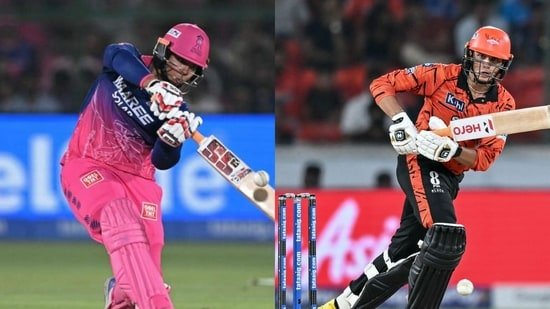
Wednesday night in New Chandigarh is where one of these seasons ends. Both teams arrive having been defined by their opening batter. Both openers have posted over 560 runs this season at strike rates above 200. The Eliminator between Sunrisers Hyderabad and Rajasthan Royals essentially comes down to one question: Does Vaibhav Sooryavanshi winning the powerplay battle against Abhishek Sharma actually matter?
The evidence from their two league meetings suggests it does not – and that is where SRH’s structural edge lives.
What the league encounters revealed
The first meeting, April 13 in Hyderabad, was straightforward. Vaibhav Sooryavanshi was dismissed for a golden duck. Abhishek lasted one ball. Both openers contributed nothing. SRH won by 57 runs on the back of Ishan Kishan‘s 91 off 44 and a bowling performance that demolished RR’s top order before the powerplay ended.
The second meeting, April 25 in Jaipur, is the one that carries analytical weight. Sooryavanshi played perhaps the innings of the IPL 2026 season – a 37-ball century, four sixes off Praful Hinge in the opening over, 103 runs of pure demolition. Abhishek replied with 74 off 31. SRH won with nine balls to spare.
That is the sentence that defines this Eliminator. Sooryavanshi fired, and RR still lost.
Also Read: Sachin Tendulkar vs Vaibhav Sooryavanshi: When genius got faster
The asymmetry in what each opener means to their team
Sooryavanshi is a powerplay weapon. Seventy-three per cent of his 583 league-stage runs – 430 – came in overs 1 to 6. He faces almost no balls beyond the twelfth over. When he goes, RR need someone else to rebuild from wherever the score stands. In the April 25 match, that someone was Yashasvi Jaiswal and Riyan Parag. They made runs. They still fell 58 short of where SRH ended up.
Abhishek Sharma‘s distribution is entirely different. His 563 runs this season are spread across all four phases – 369 in the powerplay, 126 in the middle overs, 52 in overs 12 to 16, and a further contribution in the death. His dot ball percentage of 30.0% compares to Sooryavanshi’s 34.3%. His average of 43.3 edges Sooryavanshi’s 41.6. When Abhishek bats deep, he does not hand the innings over to the next batter; he carries it.
The structural consequence of this is not subtle. Sooryavanshi winning the powerplay sets up RR for a competitive total, but does not guarantee the outcome. Abhishek winning the powerplay sets up SRH for both a competitive total and a platform that Kishan and Heinrich Klaasen can build from with confidence.
What RR need to happen against that
The only scenario in which RR win this match comfortably is Sooryavanshi firing and Abhishek failing. When Sooryavanshi scored 103, and Abhishek scored 74, SRH won anyway. That is the arithmetic RR are working against.
If Sooryavanshi is dismissed early, as he was first ball in Hyderabad, RR’s middle order is exposed to a bowling attack anchored by Pat Cummins, whose middle-overs economy rate of 5.66 this season is the competition’s best among bowlers with a minimum of fifty balls in that phase. Eshan Malinga and Sakib Hussain add genuine depth behind him.
The venue adds one variable worth watching. Mullanpur’s square boundaries are among the competition’s larger ones, which constrains the pull and leg-side flick – Sooryavanshi’s two most productive scoring zones at 408 and 369 strike rate respectively.
Jofra Archer, with the season’s third-highest bowling score among seamers, is RR’s only genuine counter to SRH’s batting depth once the powerplay is done.
The data says SRH. The venue says RR have earned the right to say otherwise. But the opener matchup, which is really what this match is about, says SRH – because the one time Sooryavanshi won it outright, Abhishek matched him, and then Kishan finished the game.


