



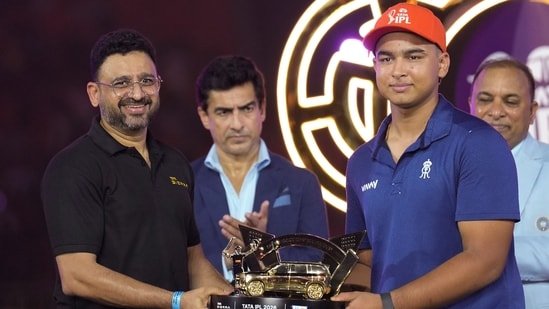
The awards ceremony at the end of an IPL season is usually a ritual of distributed glory. One player takes the batting honours. Another claims the bowling prize. Someone else walks away with the MVP. IPL 2026 did not follow that script. Vaibhav Sooryavanshi walked to the stage five times and left with ₹55 lakh in prize money, a Tata Sierra, and the quiet understanding that this tournament had, in every measurable batting sense, belonged to him alone.
The Orange Cap was the most straightforward of his five awards, and in some ways the most extraordinary. Sooryavanshi finished the season with 776 runs with a strike rate of 237.31. He did not reach that tally through patient accumulation or situational calculus. He reached it by dismantling bowling attacks from the first over, converting Powerplay overs into something opponents had no reliable answer for. The ₹10 lakh that came with the Orange Cap was the league’s formal acknowledgement of a truth already evident to every captain who had set a field against him.
The Most Valuable Player award, worth ₹15 lakh, extended that recognition beyond raw accumulation. Sooryavanshi won the MVP with 436.5 points, a metric that attempts to capture overall match influence rather than merely counting runs. The gap between him and the next contender reflected how thoroughly he had dominated the tournament’s terms of engagement.
What made Sooryavanshi’s 2026 season different from every great IPL campaign before it
Most iconic IPL seasons have been defined by a single, dominant quality. Virat Kohli‘s 2016 was by sheer, relentless volume. Chris Gayle’s peak years by the primal terror of his presence at the crease. David Warner’s best campaigns were marked by an almost mechanical consistency that opponents could see coming and still not stop. Each of those seasons owned one lane completely.
Vaibhav Sooryavanshi‘s 2026 collected nearly all of them at once.
The Super Striker of the Season prize, worth ₹10 lakh and a Tata Sierra, exists precisely to separate genuine sustained aggression from a short purple patch. It requires a minimum ball threshold before a player becomes eligible. A strike rate of 237.31 across a full IPL campaign is not an aberration. It is a redefinition of what sustained T20 batting can look like.
The Sixes record tells a version of the same story in a different language. Chris Gayle‘s single-season sixes benchmark had quietly calcified into received wisdom about what was achievable. Sooryavanshi dismantled it. His final tally of 72 sixes across the tournament earned him the Super Sixes of the Season award and another ₹10 lakh. Along the way, his 12 maximums against Sunrisers Hyderabad became the most sixes by an Indian batter in a single IPL innings, eclipsing a record that had stood since 2010.
The Emerging Player of the Season prize of ₹10 lakh carried the oddest weight. In the ordinary grammar of that award, “emerging” implies potential, a player whose best years are still theoretical. That part holds for him, but Sooryavanshi dominated the other categories so brilliantly that by the end of the tournament, it was difficult to imagine him as an emerging talent.
A 36-ball century against Sunrisers Hyderabad was the third-fastest in IPL history. In Qualifier 2 against the Gujarat Titans, he became the fastest player to reach 1,000 IPL runs by balls faced. The numbers keep arriving in that register, each one a record, each one belonging to a 15-year-old from Bihar who spent two months reordering the assumptions IPL cricket makes about what an opener is allowed to do.
The ₹55 lakh is, in the end, an accounting exercise. What it cannot fully register is the shape of the season itself, a tournament that tried, repeatedly, to find an answer to Sooryavanshi, and consistently ran out of time before it could. Notably, the Royals bought Sooryavanshi for ₹1.10 crore at the auction. The left-handed batter won half of that price on the podium itself.


