



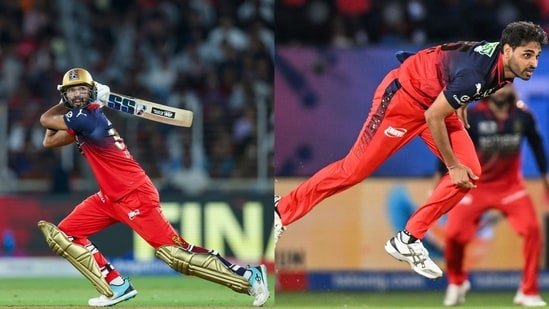
Royal Challengers Bengaluru’s IPL 2026 season will be remembered through its loudest names. Virat Kohli’s final knock. Rajat Patidar’s captaincy. The big nights, the playoff surge, the trophy-clinching moments that lodge easily in memory because they arrived with light, noise and consequence.
But title seasons are rarely built on front pages alone. They are built, in equal measure, by players who quietly protect the performance balance sheet, who make the auction table look smarter than it first appeared, who return more than their price across enough matches to reshape the arc of an entire campaign.
For RCB in 2026, that hidden layer had two names: Devdutt Padikkal and Bhuvneshwar Kumar.
Together, they formed one of the most efficient value pockets in the squad. Padikkal came in at ₹2 crore. Bhuvneshwar at ₹10.75 crore. Their combined cost was ₹12.75 crore. Their rating-adjusted season worth, through the model, rose to ₹38.24 crore, leaving RCB with roughly ₹25.5 crore in measurable surplus.
This was not a glamorous pairing. It was not a marketing partnership. It was something far more valuable: roster architecture working quietly in the background.
Padikkal turned ₹2 crore into a season-shaping asset
Devdutt Padikkal‘s season was RCB’s cleanest efficiency win.
At ₹2 crore, he did not need to emerge as one of the tournament’s central figures to justify his price. A stable top-order value was all that was asked of him. Instead, he produced a worth of ₹19.43 crore and walked away with a profit of ₹17.43 crore on the ledger, the kind of auction return franchises dream about and rarely admit they depend on.
The numbers behind that return were built on tempo as much as volume. Padikkal made 464 runs from 275 balls, averaging 33.14 at a strike rate of 168.73. He was not a passive accumulator content to rotate strike. He gave RCB acceleration without charging them for it.
His Powerplay work was the engine of that contribution. Of those 464 runs, 245 came in the first six overs at a strike rate of 176.26, thrust that reduced pressure on the middle order before it even arrived at the crease. When Padikkal was in full flow, RCB were not building their innings from caution. They were entering the middle overs with leverage already banked.
That mattered enormously in a side where Kohli, Patidar and the finishers carried heavier narrative weight. Padikkal’s role was never to own the innings. It was to advance it sharply before the bigger names took control. He fulfilled that brief, repeatedly.
His best performances told the story plainly: 61 off 26 in Match 1, 55 off 27 in Match 34, 50 off 29 in Match 11, 34 off 13 in Match 39. Fast, disruptive, market-beating innings from a player whose auction price sat far below his output.
The fielding layer completed the picture. Thirteen catches and 75.93 fielding impact points elevated him from a batting bargain into a fuller squad-value win. In a league where expensive players often need one strong discipline just to break even, Padikkal gave RCB a batting surge, top-order coverage and catching reliability at ₹2 crore.
His final was poor. One run off four balls, negative impact, a small entry in the loss column. But one bad evening cannot erase a season. By the time the trophy night arrived, Padikkal’s value had long been banked.
Bhuvneshwar gave RCB control where control costs most
Bhuvneshwar Kumar‘s is a different kind of story.
He was never a low-cost miracle. At ₹10.75 crore, he carried a serious auction price, and his efficiency was never going to register as dramatically as Padikkal’s. But his role demanded more. His pressure points were sharper, his bowling zones more unforgiving, and his absolute impact across the season was larger.
Bhuvneshwar took 28 wickets in 63 overs, conceding 501 runs at an economy of 7.95, with an average of 17.89 and a strike rate of 13.00. Those are strong numbers in any format. Split by phase, they become something more significant.
In the Powerplay, he claimed 17 wickets in 34 overs at an economy of 6.94, elite new-ball work by any modern standard. He was not simply keeping things tidy at the top. He was dismantling innings early, forcing opponents to rebuild before they could attack. At the death, nine wickets in 18 overs at an economy of 8.50, a rate that represents premium restraint in a phase where damage limitation alone is considered a success. Bhuvneshwar delivered wickets there too.
That dual-phase value made him structurally indispensable. He was not a middle-over passenger being hidden by favourable match-ups. He was absorbing overs in the two most dangerous bowling zones in T20 cricket and still generating a positive return in both.
His worth settled at ₹18.81 crore, yielding a profit of ₹8.06 crore for RCB. The return is smaller than Padikkal’s in rupee terms, but the cricketing weight is heavier. Bhuvneshwar’s final impact score of 1503.04 placed him ahead of Padikkal’s 1329.44. In pure influence terms, he was the bigger player across the season.
His best spells carried genuine match consequence: 4/23 in Match 54, 3/5 in Match 39, 3/28 in Match 42, 3/26 in Match 26. And when the final arrived, he delivered again, taking 2/29 for a positive return on the biggest night of the season.
That distinction matters. Padikkal owned the better value story. Bhuvneshwar owned the better title-closing story.
Two different efficiencies, one title-winning balance
What makes this pairing worth examining is that they solved entirely different problems.
Padikkal solved price efficiency. He gave RCB a top-order batter who returned nearly ten times his auction cost, protected the budget and expanded the batting ceiling simultaneously.
Bhuvneshwar solved phase efficiency. He gave RCB wickets in the Powerplay and control at the death, protecting match structure and handing Patidar reliable overs in the most dangerous passages of every game.
Together, they reveal why RCB‘s season worked beyond the obvious names.
A title campaign cannot survive on stars alone. Stars win individual nights. Efficient players win seasons. Padikkal and Bhuvneshwar gave RCB two distinct forms of surplus, one financial, one tactical, both measurable and both consequential.
One turned ₹2 crore into a ₹19.43 crore season. The other converted a senior bowler’s price into 28 wickets and phase-specific control in the zones where T20 matches are most often broken.
That is the real hidden story of RCB’s campaign. Not the loudest headline. Not the easiest memory to carry out of the tournament. But one of the clearest, most verifiable reasons the squad held its shape across fourteen rounds.
RCB’s title was powered by Kohli’s farewell innings, Patidar’s leadership and the obvious match-winners. But beneath that noise sat a quieter truth: Padikkal and Bhuvneshwar contributed ₹25 crore worth of hidden efficiency to the cause.
In a tournament where a single misjudged auction decision can quietly poison an entire season, that was not background value. That was championship infrastructure.
Method note
The analysis draws on a performance-value model designed exclusively by the author. The model converts match impact into rating-adjusted monetary worth by combining batting, bowling, fielding, role difficulty, match context and season-level output. Auction price serves as the cost base for each player.
The monetary figures are model-based estimates, not official IPL valuations or franchise accounting data. They are designed to measure performance efficiency and cricketing return on auction investment.


