


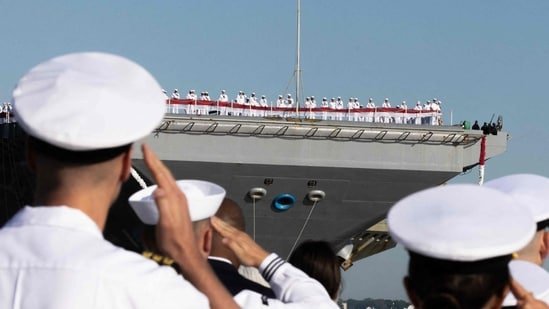
The USS Gerald R Ford, the United States Navy’s most advanced aircraft carrier and the largest warship in the world, docked at Naval Station Norfolk, Virginia, on Saturday, completing an 11-month deployment that stands as the longest operational carrier deployment since the Vietnam War.

The ship’s return, accompanied by destroyers USS Bainbridge and USS Mahan, was marked by a ceremony attended by defense/war secretary Pete Hegseth, who addressed crews across all three vessels.
The USS Ford departed Virginia’s coast on June 24, 2025, and spent 326 days at sea — a figure that breaks the post-Vietnam record for carrier deployments.
The only longer deployments in US naval history were the 1973 deployment of USS Midway at 332 days and the 1965 deployment of USS Coral Sea at 329 days.
Approximately 5,000 sailors reunited with their families for the first time since last summer.
Where Ford served: Maduro operation, Iran war
The Ford first entered the Mediterranean Sea before being rerouted to the Caribbean in October 2025 as part of what the Pentagon described as the largest naval buildup in that region in generations. There, the carrier participated in Operations Southern Spear and Absolute Resolve, which culminated in January 2026 with the capture of Venezuelan President Nicolás Maduro.
The Ford then repositioned toward the Middle East/West Asia as tensions with Iran escalated sharply, participating in the opening days of the Iran war — Operation Epic Fury — from the Mediterranean Sea.
In early March, it transited the Suez Canal and entered the Red Sea to press the campaign closer to Iranian territory.
Fire during Iran war
A fire broke out in one of the carrier’s laundry spaces in March 2026, injuring two sailors and displacing more than 600 crew members from their sleeping quarters. The ship was forced to divert to the Greek island of Crete for repairs, temporarily interrupting combat operations.
Separately, the carrier experienced persistent problems with its onboard sanitation systems throughout the deployment, with reports of roughly one sewage-related maintenance issue per day over an extended period.
A Pentagon testing assessment also raised questions about the ship’s “operational effectiveness” under sustained real-world conditions.
Speaking aboard the USS Bainbridge, Hegseth praised the crews: “You didn’t just accomplish a mission, you made history… You made a nation proud.”
Chief of US Naval Operations Admiral Daryl Caudle, who announced the return date during a House Armed Services Committee hearing earlier in the week, called the sailors “extraordinary”.
What return to US means for ongoing war
The Ford’s return does modestly reduce American naval firepower in the Iran war theatre at a sensitive moment, as diplomats continue pressing Iran toward a negotiated settlement.
However, the carrier does not leave a vacuum; the USS Abraham Lincoln has been operating in the region since January 2026, and the USS George HW Bush arrived in the area in recent weeks. That means a two-carrier US presence, still significantly above the US Navy’s typical peacetime deployment.
At the peak of the war, the US maintained three carrier strike groups in the region simultaneously, which was a concentration of naval power unseen since 2003.
Strain for Ford, fleet
The more consequential question may be long-term readiness.
The Ford itself now faces an extensive maintenance period. US officials have acknowledged that the record-length deployment will affect the ship’s maintenance schedule and its timeline to redeploy.
The broader carrier fleet is also under strain, with USS John C Stennis currently undergoing a delayed and over-budget refueling overhaul, and USS Harry S Truman scheduled to begin its own overhaul in June. That means two nuclear carriers will be out of service simultaneously for a period, news agency AP reported.
As the Trump administration continues pressing Tehran toward a negotiated settlement, American naval dominance in the theater remains intact for now, but the strain accumulating across the fleet suggests that dominance carries a mounting price.
