



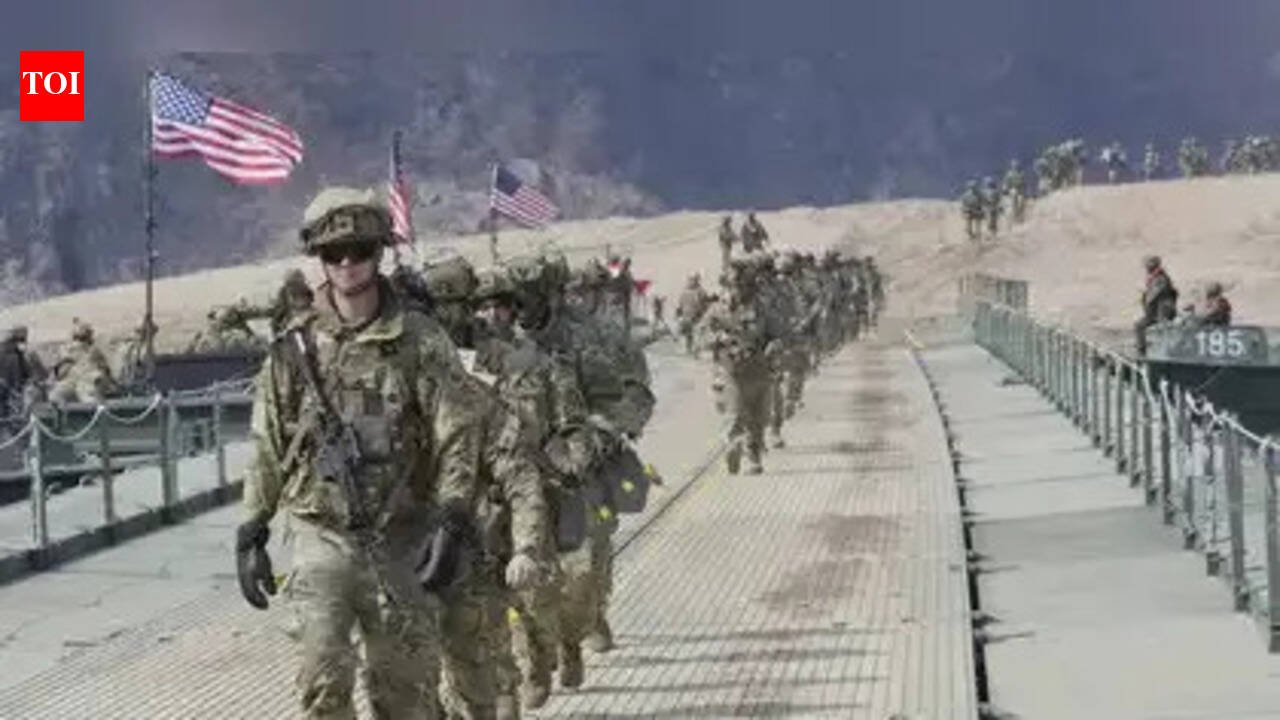
Driving the newsA wave of complaints from US service members alleges that military commanders have linked the war with Iran to biblical end-times prophecy – including references to Armageddon and the return of Jesus, according to reporting by veteran journalist Jonathan Larsen on his Substack newsletter.The Military Religious Freedom Foundation (MRFF) says it has received more than 110 complaints from troops across the US armed forces. The reports involve over 40 units across at least 30 military installations, according to Larsen’s reporting. Some complaints describe commanders framing the war as part of God’s plan and invoking biblical prophecy during official briefings.
Zoom inAccording to a complaint described in Larsen’s Substack, a commander speaking to non-commissioned officers linked the war directly to biblical prophecy.The complaint says the commander told officers that President Donald Trump had been “anointed by Jesus to light the signal fire in Iran to cause Armageddon and mark his return to Earth.”Another email from a service member described similar messaging delivered to troops in a unit currently outside the Iran combat zone but in Ready-Support status.The non-commissioned officer (NCO) said the commander encouraged leaders to relay a religious interpretation of the war.The NCO wrote that the commander “urged us to tell our troops that this was ‘all part of God’s divine plan’ and he specifically referenced numerous citations out of the Book of Revelation referring to Armageddon and the imminent return of Jesus Christ.”The email said the message was sent to MRFF on behalf of 15 troops, including at least 11 Christians, one Muslim and one Jewish service member.The NCO warned that the remarks could damage unit cohesion.The complaint said the statements “destroy morale and unit cohesion and are in violation of the oaths we swore to support the [C]onstitution.”According to Larsen’s reporting, MRFF is withholding the identities of complainants to prevent retaliation from the Defense Department.Why it mattersThe allegations highlight concerns about religious messaging inside the US military at a time when the country is engaged in a rapidly expanding conflict with Iran.MRFF president Mikey Weinstein told Larsen that the organization has been overwhelmed by complaints since the attacks on Iran began.He said the foundation had been “inundated” with messages from troops describing similar rhetoric from commanders.Weinstein argued that introducing religious ideology into official military communication could violate constitutional protections as well as the Uniform Code of Military Justice.He said, “Any military members seeking to take advantage of their subordinates by advancing their blood-soaked, Christian nationalist wet dreams upon the flames of this latest non-Congressionally sanctioned attack against Iran, should be swiftly, aggressively and visibly prosecuted.”According to Larsen’s reporting, the group says such complaints frequently arise when conflicts involving Israel erupt in the Middle East.Weinstein said the MRFF receives similar reports about Christian end-times theology whenever it “blows up with Israel in the Middle East.”
The big pictureThe controversy unfolds amid broader debate about the growing influence of evangelical Christianity in US politics and military culture.Larsen’s report notes that defense secretary Pete Hegseth has promoted religious gatherings within the Pentagon and the White House.
- Monthly prayer meetings have been broadcast within the Pentagon.
- Hegseth attends a weekly White House Bible study led by preacher Ralph Drollinger.
- The Bible study emphasizes theological arguments for supporting Israel.
- Hegseth has also spoken openly about faith during government prayer events.
At one gathering, he said, “This is … I think, exactly where we need to be as a nation, at this moment, in prayer, on bended knee, recognizing the providence of our lord and savior Jesus Christ.”Critics say the growing visibility of Christian nationalism inside national security institutions raises questions about whether religious ideology is influencing military messaging or strategy.Supporters counter that faith has long played a role in American political life.Between the linesThe religious controversy emerges as the Trump administration faces mounting questions about why the US launched the war against Iran.Reporting by Politico and the Financial Times suggests the White House has struggled to present a consistent explanation for the conflict.Officials have cited multiple justifications for the attacks, including nuclear threats, ballistic missile development and the defense of Israel.Secretary of state Marco Rubio said the administration acted pre-emptively to avoid future attacks.Rubio told reporters, “We knew that if we didn’t preemptively go after them before they launched those attacks, we would suffer higher casualties.”But critics argue that the rationale for the war has shifted repeatedly since the strikes began.Democratic congressman Jake Auchincloss told the Financial Times that the administration had offered several explanations in quick succession.He said President Donald Trump had presented “four different rationales for the war in the last 72 hours.”
What they are sayingPolitical allies and commentators within the MAGA movement have also raised concerns about the administration’s messaging.According to a Politico report, some Trump allies fear that a prolonged conflict could undermine support among voters who backed the president’s promise to avoid new Middle Eastern wars.A former Trump administration official told Politico that rising casualties could change the public narrative.The official said, “I don’t put a timeline, I put a bodycount.”Republican strategist Matthew Bartlett also warned that questions about the war’s purpose could intensify if the conflict drags on.He said, “A significant, if not majority of the base, will be with him no matter what he does, but there are growing voices in this coalition.”Conservative communications executive Vanessa Santos told Politico that political support depends heavily on how quickly the war ends.She said, “MAGA is not anti-force; It is anti-forever war.”What’s nextThe future of the US- Iran conflict may depend on two factors: How long the war lasts and whether the administration can articulate a clear strategy.President Donald Trump himself has offered shifting timelines for the conflict.At times he has suggested the fighting could end within weeks, while at other moments he has warned it could continue indefinitely.Trump said, “Whatever it takes.”Meanwhile, the war is already reshaping the geopolitical landscape. The conflict has destabilized oil markets, disrupted regional shipping routes and triggered retaliatory strikes across the Middle East.As the fighting intensifies, the allegations of religious rhetoric within military briefings could add another layer of controversy to a war that remains politically and strategically unsettled.(With inputs from agencies)


