



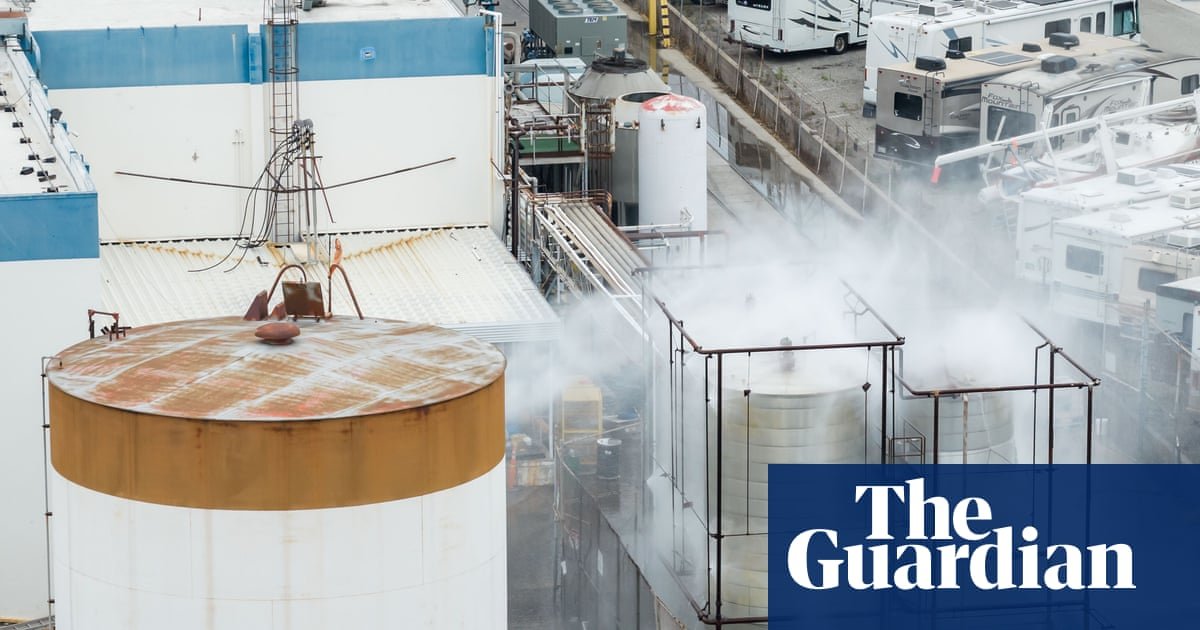
For several tense days last week, tens of thousands of southern California residents were left wondering whether a 7,000-gallon chemical storage tank would either explode or spill out into the streets.
The episode cast in sharp relief the risk of chemical spills and explosions that lurk behind every corner of modern life. The methyl methacrylate that recently left the city of Garden Grove teetering on the edge of disaster is just one of many toxic chemicals commonly found in American cities.
Oil refineries process petroleum products whose combustibility is precisely what makes them so valuable. Refrigerated warehouses across the country rely on the cost-effective refrigerant ammonia, which is both corrosive and flammable. The paper industry uses hydrogen sulfide, a compound whose accidental release has killed six workers in three separate incidents over the last three years, according to the Chemical Safety Board (CSB).
But despite being surrounded with industrial hazards, the risk of a catastrophic incident is not as high as it would seem.
Chemical disasters remain extremely uncommon, according to a review of recent CSB investigations. The CSB investigated just five major chemical spills or explosions in 2025 and 2024.
Those are tiny numbers considering that the Occupational Safety and Health Administration (Osha) oversees some 12,000 industrial sites that handle hazardous chemicals in its risk management plan, said Stephen Kmiotek, a professor of chemical engineering at Worcester Polytechnic Institute.
“Almost any place you look, any industrial site that you can think of, there are tanks with any number of hazardous chemicals in them,” Kmiotek said. “The risk of a tank failure is really very, very low. They’re made to very exacting standards. The risk to the general populace is really very low.”
Today’s standards stem in part from the long shadow that the Bhopal incident cast over the global industry. In 1984, the Union Carbide India Limited pesticide plant leaked 40 tons of methyl isocyanate gas, killing 3,800 people immediately and exposing at least 100,000 others in what is widely regarded as the worst chemical disaster in history.
The global outcry over the Bhopal incident drove major reform in the United States, including an overhaul of Osha regulations for industrial sites and the passage of the Clean Air Act Amendments of 1990 that eventually resulted in the storage tank requirements in place today.
When disasters do strike, they can have severe consequences. The Garden Grove near-miss highlighted the fact that hazardous industries are often embedded within thickly populated cities and towns.
An explosion Tuesday at a paper mill in Longview, Washington, has left at least nine people dead, with two additional workers still missing. The explosion was caused when a chemical tank holding a caustic alkaline solution called white liquor ruptured, with some of the contents spilling into a nearby drainage ditch.
Still, Kmiotek likened the risks of chemical disasters in the United States to airline crashes: extremely unlikely events that attract major attention when they eventually occur because they’re so horrific.
“It’s kind of like with airplanes,” Kmiotek said. “Their safety records are very, very good. Unfortunately, when something bad happens, it’s often really, really bad.”
People wanting to know which hazardous chemicals are stored in their areas can get a list at their local fire department, Kmiotek noted.
“With chemicals, we don’t understand them,” Kmiotek said. “And so they’re scary.”


