



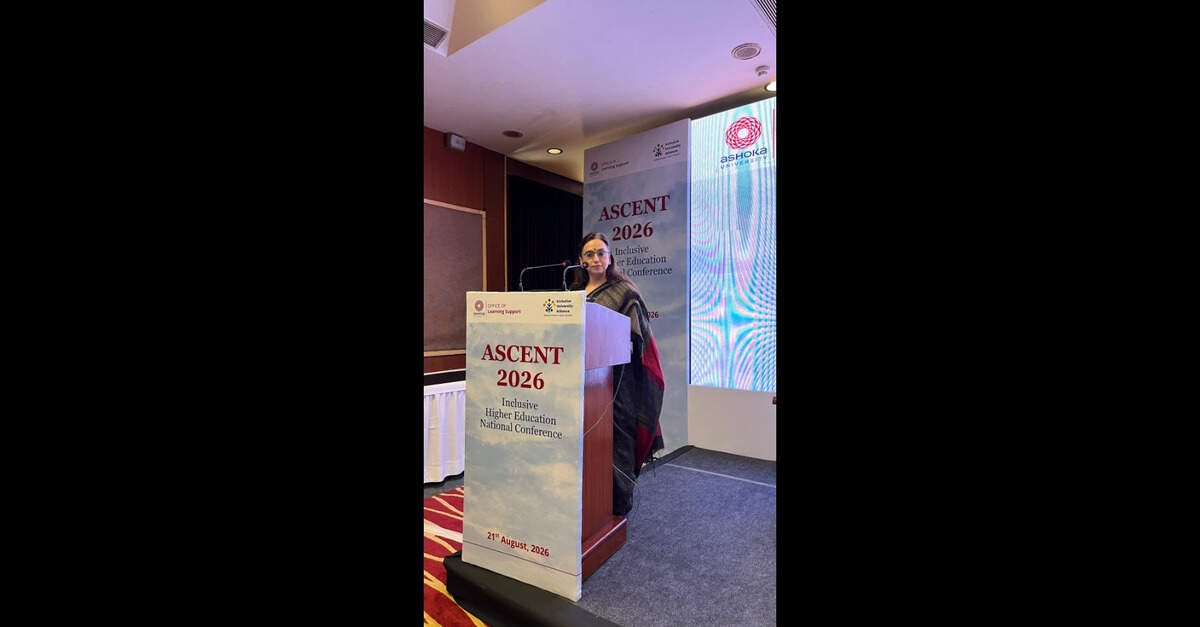
The 5% reservation for students with disabilities in higher education institutions must be implemented in practice and not remain a provision on paper, Manmeet Kaur Nanda, Additional Secretary, Department of Empowerment of Persons with Disabilities (DEPwD), Ministry of Social Justice and Empowerment, said at Ashoka University‘s ASCENT 2026 conference in New Delhi.
Speaking at the Inclusive Higher Education National Conference organised by Ashoka University, Nanda called on higher education institutions to move beyond policy commitments and focus on implementation, outlining a six-point roadmap for making campuses more inclusive and accessible for students with disabilities.
Her recommendations included audited accessibility, implementation of the 5% reservation, reasonable accommodation by default, stronger assistive technology and support, greater sensitivity among faculty and administrators, and periodic accessibility and social audits.
“The 5% reservation must be implemented in reality, not just on paper,” Nanda said.
She also stressed that accessibility should go beyond physical infrastructure to cover university websites, learning management systems, examination portals and course materials.
The conference brought together policymakers, higher education leaders and inclusion practitioners to discuss measures to make higher education more accessible and equitable for students with disabilities.
AI, assistive technology among focus areas
Professor Vinay Kumar Pathak, President of the Association of Indian Universities (AIU), called for greater attention to the realities of students with disabilities outside metropolitan centres.
Pathak proposed developing a status paper covering Tier 2, Tier 3 and Tier 4 cities, villages and communities that are often left out of conversations on inclusion.
“We should develop a status paper covering Tier 2, Tier 3 and Tier 4 cities, villages and communities often left out of the conversation,” Pathak said, adding that policies developed for higher education need to work on the ground for students across different social and geographic contexts.
He also called for greater use of artificial intelligence and other technologies to develop assistive solutions and said AIU would work with Ashoka University to advance the inclusion agenda.
The conference featured sessions on inclusive classrooms, social inclusion and institutional policy frameworks. Discussions covered faculty approaches, classroom environments, reasonable accommodation and the potential of AI to make teaching and learning more accessible and personalised.
A separate session examined social inclusion as a foundation for academic inclusion, focusing on belonging and campus environments and their role in enabling meaningful academic participation.
The final session focused on institutional systems and policy frameworks, including challenges in implementing inclusion policies and the need for practical mechanisms to translate them into institutional practice.


