


Ahmedabad: If you are living in a core city area, the only winged visitors you may be observing are rock pigeons, crows, mynas, doves besides parakeets and starlings occasionally. If you are lucky and have a garden, maybe a few sunbirds might visit you, or you may hear the distant calls of koel.
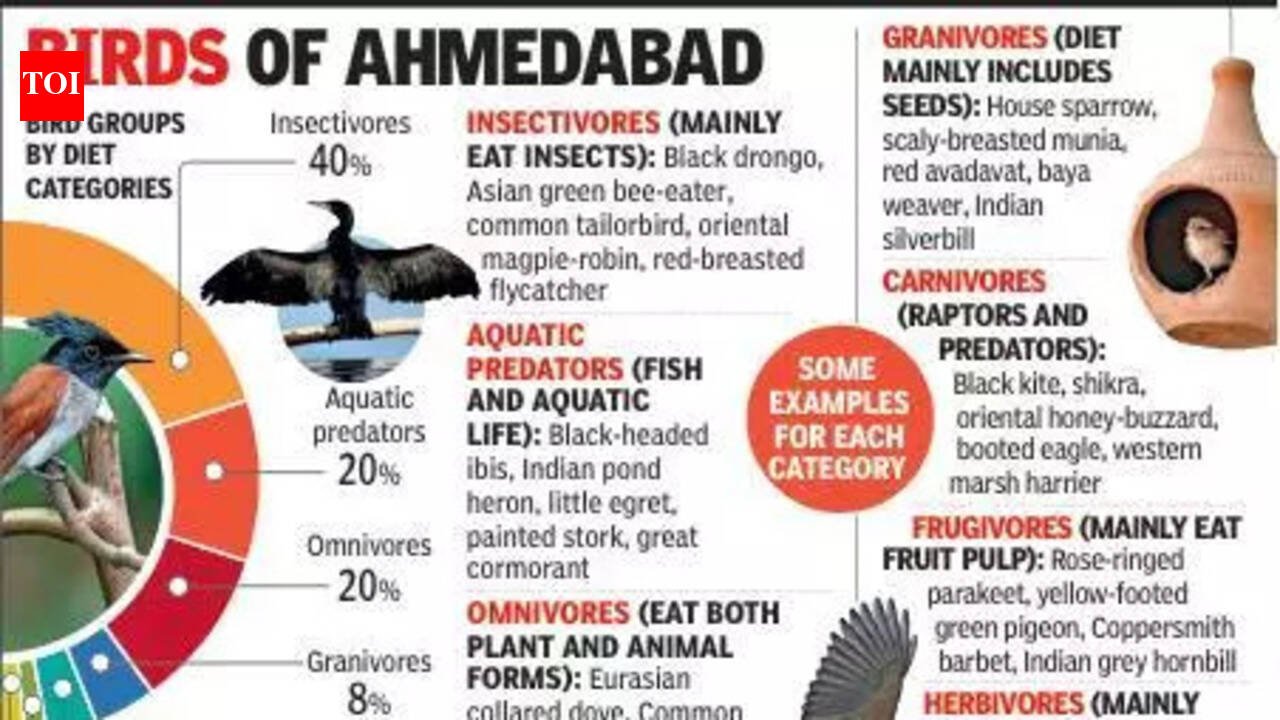
The soundscape of rich diversity is drowned in the hum of urbanity, indicating a recent publication, ‘An Atlas of the Birds of Ahmedabad’.The publication by Ankitha Jayanth, Devvratsinh Mori and Shomen Mukherjee is a joint initiative by Bird Conservation Society Gujarat, eBird India, Bird Count India and The Community Ecology and Conservation Biology Lab (CoCo) at Ahmedabad University. It was recently made available online by the varsity.Mori, one of the authors of the report, told TOI that the exercise, initiated by scores of volunteers after training and workshops in 2024 and 2025, resulted in the identification of 181 species in the city and its immediate periphery.“These account for about 33% of the bird species found across the state. Out of the total, about 69% or 124 were resident birds, 25% or 45 were migratory, and the remaining 6% or 11 were local migratory birds generally found in other parts of the state. A higher number of species were found on the outskirts of the city, as the interior of the city was uniformly rich, with about 20-40 bird species per 3.3 sq km squares,” said Mori. The city and periphery were divided into 61 such squares for classification by experts.Experts said that the rich biodiversity is missing from the urban jungle due to shrinking habitat and food base for the birds, air and noise pollution, lack of safe nesting sites, and lesser availability of water. For example, according to the map, only about 10% of the city areas recorded a significant population of house sparrows that were once a very common sight in households.Experts added that about 21% of the areas — all in the city periphery or fringes — recorded 60 or more species. Some of the reasons for the phenomenon include relatively greener space due to trees, farmlands and open grounds, and a relatively less dense built environment and residences.Out of the total species, 40% were found to be dependent on insects as food, followed by 20% each as aquatic predators and omnivores. The remaining 20% included those that eat fruits, grains and plants, and birds of prey.Experts see the results in the context of the need for conserving green spaces and fragile ecosystems, and advocate better awareness, especially for the next generation, to connect with nature.


