






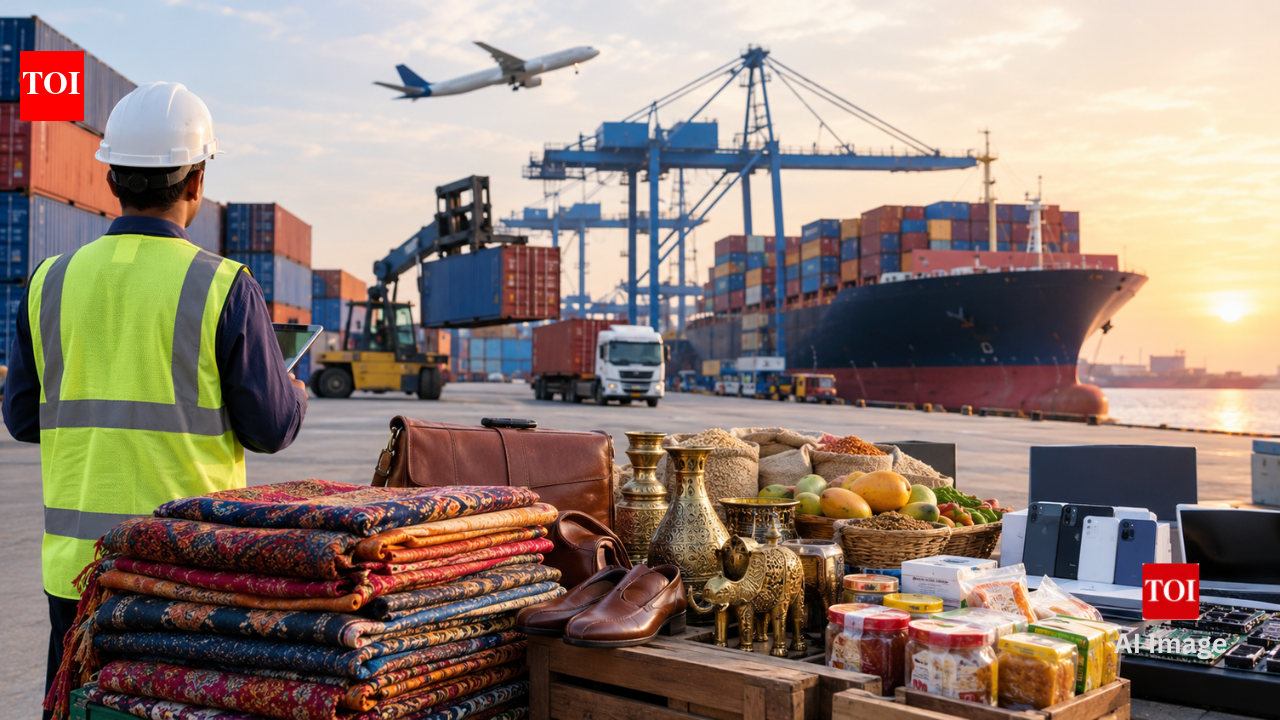
LUCKNOW: Uttar Pradesh has been steadily strengthening its position in India’s export economy during the tenure of the Yogi Adityanath government.The transformation is visible not only in the rise in export value, but also in the widening of the exporter base, expansion of district-level participation, emergence of new product categories and the creation of infrastructure intended to connect local manufacturing clusters with international markets.The scale of this change is reflected in national assessments.The NITI Aayog Export Preparedness Index 2024 placed Uttar Pradesh fourth among large states, with a score of 62.09, and identified it as a “Leader” state under the index framework.The report recorded merchandise exports of about Rs1.72 lakh crore in FY2024. It also identified electronics, leather and footwear, agriculture and food processing, and textiles and apparel among the state’s core export sectors.The state’s export journey has consequently moved beyond a handful of traditional clusters.Noida-Greater Noida’s electronics ecosystem, Moradabad’s metalware, Bhadohi’s carpets, Agra’s leather products, Varanasi’s textiles, Kanpur’s leather and engineering products, Lucknow’s emerging pharmaceuticals and medical devices, and the state’s agricultural and processed-food products are increasingly part of a wider export ecosystem.
From traditional clusters to an export-oriented economy
When the Yogi government took office in 2017, Uttar Pradesh already possessed a substantial industrial and handicraft base.The challenge was to connect these local strengths more effectively with national and international markets.One of the most visible interventions was the One District One Product (ODOP) programme, launched in January 2018.The objective was to identify the distinctive product associated with each district, strengthen production and skills around it, improve packaging and branding, facilitate finance and create market access.According to Invest UP, ODOP had by 2024 become an important component of the state’s export ecosystem, with ODOP products accounting for about half of the state’s reported exports in that year.Invest UP states that ODOP-related exports amounted to approximately Rs 93,000 crore out of Rs 1.86 lakh crore in exports.This approach effectively linked export promotion with district-level economic development.Instead of treating exports purely as the domain of large factories, the policy framework increasingly brought artisans, MSMEs, food processors, handicraft producers and small manufacturers into the export chain.The result is an export strategy that increasingly attempts to take products from the district to the domestic market and from the domestic market to the world.
Export value reaches a new scale
Official Government of India data underline the expansion of Uttar Pradesh’s merchandise exports over the longer term.A ministry of commerce state-wise series shows Uttar Pradesh exports rising from about US$26.58 billion in 2020-21 to US$51.14 billion in 2024-25, although year-to-year comparisons are affected by global trade conditions and commodity prices.The state’s own Export Promotion Policy 2025-30 places the combined goods-and-services export base at around US$21 billion for FY2024 under its policy definition and sets a target of US$50 billion by 2030.The policy focuses on increasing the exporter base, encouraging MSMEs and first-time exporters, improving infrastructure and expanding the state’s participation in international markets.These figures come from different statistical and policy frameworks and therefore should not be treated as directly interchangeable.Together, however, they indicate the scale of the state’s export ambitions and the importance that the government has attached to exports as a driver of economic growth.
A new policy architecture for exporters
The export transformation has been supported by successive policy measures.The UP Export Promotion Policy 2020-25 sought to establish the state as a major export hub through infrastructure development, capacity building and institutional support.It included measures such as a single-window mechanism, a dedicated GST cell for exporters, support for GI products and a B2B exchange intended to facilitate online trade by smaller enterprises.The newer Export Promotion Policy 2025-30 carries this approach further.It proposes increasing exports from the policy’s FY2024 base of US$21 billion to US$50 billion by 2030. It also seeks a 50 per cent increase in registered exporters, with particular emphasis on MSMEs, startups, ODOP units and first-time exporters.The policy also places emphasis on export-oriented infrastructure, logistics, testing, certification, market development and fulfilment capabilities.Exporters are to receive support for areas such as international certifications, trade fairs, digital marketing, export credit insurance and e-commerce.This represents an important change in approach.Export growth is increasingly being viewed not simply as a matter of production capacity, but as an ecosystem involving quality, certification, finance, branding, logistics, digital commerce and international market intelligence.
Uttar Pradesh’s strength in diverse product categories
Uttar Pradesh’s export basket is unusually diverse.NITI Aayog’s 2024 assessment identifies electronics, leather and footwear, agriculture and food processing, and textiles and apparel as core sectors.It also identifies defence and aerospace, renewable-energy equipment, organic food products and medical devices as emerging areas.The diversity provides a degree of resilience because the state’s export performance is not dependent on a single industry.The traditional export clusters remain important.Moradabad’s brass and metalware, Bhadohi’s carpets, Agra’s leather products, Varanasi’s textiles and handicrafts, Kannauj’s perfumes and numerous agricultural products continue to connect local production with international consumers.At the same time, the Noida-Greater Noida region has developed into an important electronics manufacturing centre.NITI Aayog notes that the corridor contributes around half of India’s mobile-phone production and contains electronics manufacturing infrastructure and SEZs. The agency also identifies electronics as one of the state’s principal export strengths.Thus, Uttar Pradesh’s export story increasingly combines traditional craftsmanship with modern manufacturing.
Electronics and technology add a new dimension
Perhaps the most significant structural change has been the emergence of electronics as an export-oriented industry.Noida and Greater Noida have attracted major investments in mobile-phone and electronics manufacturing, creating supply chains involving components, assembly, packaging, logistics and related services. This has expanded the geographical and technological character of Uttar Pradesh’s exports.The growth of electronics also demonstrates how industrial policy can change the composition of exports.Products associated traditionally with Uttar Pradesh, such as handicrafts, carpets, leather and textiles, continue to have global markets, but they are increasingly accompanied by high-volume manufactured products.The next stage could involve greater participation in electronics components, semiconductor-related manufacturing, engineering products, artificial intelligence and technology-enabled services.
Agriculture moves closer to global markets
Agriculture remains another major pillar of the export economy.Uttar Pradesh has a large production base in sugarcane, cereals, fruits, vegetables and other agricultural commodities.The state government’s agriculture export framework has sought to build clusters, improve post-harvest handling, establish export facilitation centres, strengthen packaging and encourage international buyer-seller interactions.This has implications beyond farmers themselves.Agricultural exports create demand for grading, sorting, cold chains, food processing, packaging, warehousing, transportation and certification.Products such as mangoes, processed foods and other region-specific agricultural commodities therefore have the potential to create a broader rural export economy.The export ecosystem also complements the state’s ODOP approach, because several district-specific products are agricultural or food-processing products.
The liquor-export surge in 2026
A particularly notable recent development has been the rapid growth reported in Uttar Pradesh’s bottled liquor exports under the state’s three-year Excise Export Policy 2026-29.According to the figures provided by the Uttar Pradesh government, bottled liquor exports from the state reached US$5.52 million in July 2026, compared with US$2.91 million in July 2025, a reported increase of 89.7%. During the same period, India’s overall export growth in the relevant comparison was reported at 25.7%.The official figures also indicate that Uttar Pradesh’s share of national bottled-liquor exports increased from 8.3% to 12.5% in July, placing the state third nationally in that category.Whisky exports reportedly grew 78.8%, while vodka exports doubled. Export volume was reported to have risen by 230% compared with 90% nationally.For April-July 2026, the state reported bottled-liquor exports of US$18.3 million, against US$11.7 million during the corresponding period of the previous year, an increase of 56.4%. The state reported an additional foreign-exchange earnings of about US$6.6 million during these four months.These are state-reported figures for the specific excise/bottled-liquor export segment, rather than a measure of Uttar Pradesh’s entire merchandise-export performance.
The wider industrial impact of new export activity
An important aspect of the 2026 liquor-export expansion is its potential effect on associated industries.According to the state government’s account, new units are being established by United Breweries in Unnao and Mount Everest Breweries in Hardoi.Woodpecker GreenAgri Nutrients has established a unit in Farrukhabad, while Allied Blenders and Distillers has revived a closed unit in Moradabad. Kian Distillery has applied for a beverage distillery and brewery in Gorakhpur.The economic linkages extend to sugar mills, molasses, grain, glass bottles, packaging, labels, caps, warehousing and transportation.The reported overseas shipment of 25,000 quintals of molasses from Basti, generating around US$500,000 in foreign exchange, illustrates how export opportunities can extend into upstream agricultural and industrial supply chains.The policy also contains safeguards relating to outstanding sugarcane-price recovery certificates, linking eligibility for policy benefits with payment obligations.
Logistics becomes central to the export strategy
For a landlocked state, logistics is particularly important.Uttar Pradesh has therefore increasingly focused on road, rail, freight corridors, airports, inland logistics and multimodal connectivity.NITI Aayog’s EPI 2024 assessment lists 23 ICDs, CFS and AFS facilities, two air-cargo terminals, 228 industrial zones and more than 12,000 km of national highways among the state’s infrastructure assets.It also highlights the strategic significance of the Eastern and Western Dedicated Freight Corridors, the Yamuna Expressway and the Delhi-Mumbai Industrial Corridor.Improved logistics can reduce the disadvantage faced by a landlocked state by lowering transportation time and improving access to ports and international markets.The state has also been increasing the number of export routes and operational ports connected with its export ecosystem.The liquor-export figures supplied by the government, for example, indicate that export lines increased from 29 to 39 and operational ports from seven to 10 during the recent policy period.
MSMEs at the heart of the export strategy
The most significant feature of Uttar Pradesh’s export model is the emphasis on MSMEs.Invest UP states that MSMEs account for nearly 45% of the state’s exports, with engineering goods, handicrafts, carpets, textiles, leather, processed food and electronics among the important categories.This is critical because export-led development cannot be sustained only through a few large industrial projects. The participation of smaller firms allows export activity to spread across districts and employment-intensive sectors.District Export Promotion Councils, Zila Niryat Bandhu mechanisms, capacity-building programmes and export-oriented banking support are designed to address the practical difficulties faced by smaller businesses.
Global recognition of Uttar Pradesh’s export preparedness
The improvement in export infrastructure and policy capacity is reflected in the Export Preparedness Index.Uttar Pradesh ranked fourth among large states in the 2024 edition, with a score of 62.09. The state had ranked seventh overall in the 2022 edition, while its landlocked-state position also improved.NITI Aayog identifies several strengths: strategic trade corridors, workforce availability, electronics manufacturing, industrial clusters and a large number of GI-tagged products.At the same time, it identifies areas requiring further attention, including testing and certification infrastructure for food products, air-cargo capacity and export insurance penetration.These observations are important because export growth is not only about increasing the value of shipments.Sustaining global competitiveness requires meeting international standards consistently, delivering on time and managing financial and market risks.
Export transformation: from export growth to global competitiveness
The Yogi government’s export strategy is now entering a new phase.The objective is no longer simply to increase the volume of goods leaving the state, but to build an ecosystem capable of supporting sustained international competitiveness.The 2025-30 Export Promotion Policy’s US$50-billion target, wider participation of MSMEs and startups, stronger support for services exports, international certification, e-commerce and export infrastructure are intended to create this next layer of growth.At the same time, the state will need to address the gaps identified by NITI Aayog, particularly testing and certification capacity, air-cargo infrastructure, export insurance and last-mile connectivity.The larger transformation is therefore visible in three interconnected shifts: local products are being connected to global markets; traditional industries are being joined by new-age manufacturing; and export promotion is increasingly being integrated with district development, MSMEs, agriculture and infrastructure.From carpets and brassware to mobile phones, from leather and textiles to processed foods and emerging technology sectors, Uttar Pradesh’s export basket is becoming broader and more sophisticated.The export performance of recent years, together with the institutional and infrastructure changes underway, shows that the state is seeking to make exports a central component of its long-term economic strategy under the Yogi government.


