



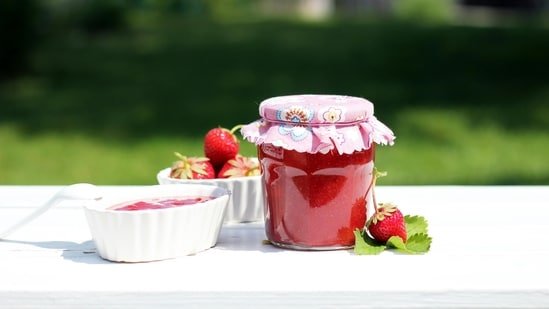
If you’ve been on social media lately, chances are you’ve come across the simple strawberry chia seed jam that’s winning over health enthusiasts. Packed with fibre, naturally sweet, and free from added sugar, it’s already considered a wholesome alternative to store-bought spreads. But what if this already healthy recipe could be made even better?
Dr Karan Rajan, a UK-based surgeon and popular health content creator, has shared an easy way to upgrade your regular strawberry-chia seed jam. In an Instagram video posted on April 8, he explains how swapping just two ingredients can significantly boost both your gut health and overall wellbeing.
How to make strawberry-chia seed jam?
A simple strawberry and chia seed jam recipe has been doing the rounds on social media – and for good reason. It involves gently cooking frozen strawberries over medium heat, mashing them with a fork until soft and pulpy, and then stirring in chia seeds. Once combined, simply transfer the mixture into a jar and let it chill in the fridge. In no time, you have a fresh, naturally sweet, and nutrient-rich strawberry chia seed jam ready to enjoy.
A simple upgrade
Dr Rajan recommends two simple swaps that can make this jam even more beneficial for your gut health. First, replace chia seeds with basil seeds, and second, opt for a mix of frozen berries instead of just strawberries. He explains that this upgraded combination offers a broader range of nutrients and can better support gut health as well as overall wellbeing.
Swap chia seeds with basil seeds
Despite both being high in fibre, Dr Rajan explains that basil seeds contain a higher concentration of soluble fibre that gets fermented by your gut microbiome into anti-inflammatory short-chain fatty acids. He points out that chia seeds, on the other hand, are higher in insoluble fibre, which adds bulk but does not really feed your microbiome.
The surgeon explains, “Basil seeds are closer to 50/50 soluble to insoluble, meaning more fermentation in your colon and better fuel for your microbes and gut lining. Plus, basil seeds gel less aggressively than chia seeds, so a less gloopy sensory profile. Also, basil seeds actually have more fibre: two tablespoons of chia seeds are around 10 grams of fibre, whilst two tablespoons of basil seeds are closer to 14 grams of fibre.”
Use mixed berries instead of strawberries
Using a mix of berries instead of just one introduces a wider spectrum of polyphenols. Dr Rajan highlights that different polyphenols are metabolised by different strains of gut bacteria, leading to the formation of a diverse range of bioactive compounds and ultimately supporting greater microbial diversity in the gut.
He explains, “Your second upgrade is using mixed frozen berries instead of strawberries. Different berries contain different polyphenols: anthocyanins in blueberries, ellagitannins in raspberries, and quercetin in blackberries. These polyphenols get metabolised by different gut bacteria into different bioactive compounds. So, more variety equals more microbial diversity.”
Why choose frozen berries?
Dr Rajan recommends using frozen berries as they often retain the highest antioxidant content. Harvested at peak ripeness and immediately frozen, they preserve their nutritional profile far better over time – unlike fresh berries, which can gradually lose nutrients during storage and transport.
He explains, “Frozen berries are recommended because they are often cheaper, picked at peak ripeness, and flash frozen, which preserves the polyphenol content more than fresh berries that may sit in transport for days. The more diverse your polyphenol intake, the more diverse your microbial ecosystem can become; it’s like giving your microbiome a variety pack instead of just one flavour.”
Note to readers: This article is for informational purposes only and not a substitute for professional medical advice. It is based on user-generated content from social media. HT.com has not independently verified the claims and does not endorse them.


