





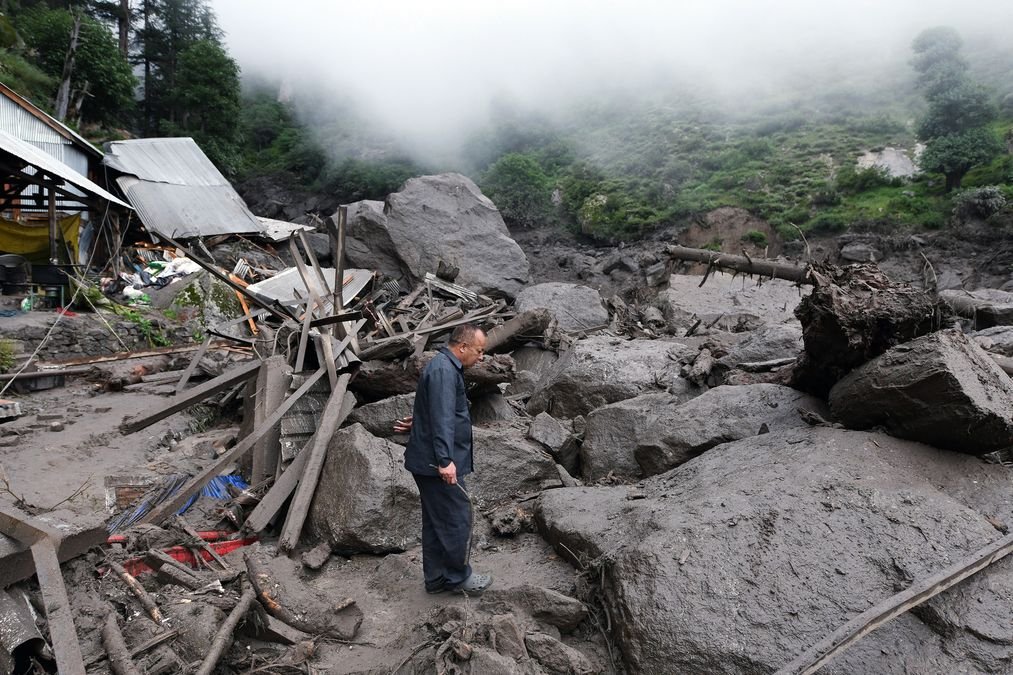
Srinagar, Aug 17: Unplanned development, indiscriminate slope cutting, and changes in land use are emerging as major factors exacerbating the impact of extreme weather in the Chenab Valley and Pir Panjal areas of the Jammu region, where nearly 35 cloudburst and flash-flood incidents have been recorded since June 1.
Almost 35 people have died in extreme weather conditions in Jammu region alone. Pir Panjal and Chenab Valley have historically been vulnerable to cloudbursts, flash floods, and landslides because of their steep slopes, narrow valleys, and complex terrain. Environmentalists and weather experts believe that growing human intervention has significantly increased the exposure of settlements and infrastructure to such hazards.
Independent weatherman Faizan Arif said the Chenab Valley and Pir Panjal had not suddenly become vulnerable, but the level of exposure had increased considerably.
“These regions have always been naturally prone to extreme weather because of their rugged terrain, steep slopes, narrow valleys and complex topography. What has changed considerably over the past few decades is our exposure to these hazards,” Arif said.
He added, “Rapid, and in many places unplanned construction, development along rivers and streams, road widening, cutting of mountain slopes, changes in land use and encroachment into naturally vulnerable areas have disturbed the landscape’s ability to cope with intense rainfall.”
“An extreme rainfall event that may have caused limited damage in the past can now have much greater consequences because there are more roads, buildings, settlements and infrastructure in vulnerable locations,” he added.
Arif said mountains have come under pressure while slope-cutting constructions have weakened the natural defences. He said the unusually high number of incidents this year should not simply be attributed to a sudden increase in cloudbursts.
“What we have clearly seen this year is an unusual frequency of weather spells and intense rainfall events, which has contributed to more flash floods and landslides,” he said.
The weatherman said relatively frequent Western Disturbances, availability of moisture and interaction with monsoonal moisture had contributed to favourable conditions for intense rainfall over the Himalayan region. “The complex terrain forces moisture-laden air to rise, and when atmospheric instability and other favourable conditions are present, this can produce very intense, localised convection and rainfall,” he said.
Climate expert Dr Touseef Ahmad Bhat, popularly known as the ‘Tree Man of Kashmir’, said the vulnerability of the mountain regions was being compounded by the weakening of natural ecological buffers.
“The problem is not rainfall alone. It is what happens when intense rainfall meets a landscape whose natural resilience has been compromised,” Bhat said. “Forests, vegetation and natural drainage systems helped regulate the movement of water, but their disturbance could rapidly increase runoff and slope instability.”
He added: “We cannot treat the Chenab Valley and Pir Panjal like plains. Development has to respect the carrying capacity of the mountains.”
Senior environmentalist Dr Tanveer Ahmad Khan said the region was facing multiple pressures simultaneously. “Extreme rainfall is only one part of the problem. Deforestation, road construction, slope cutting, unplanned settlements and pressure on natural water channels are weakening the ecological buffer of the mountains,” he said.
Khan said development projects needed to take cumulative environmental and hydrological impacts into account. “A road, bridge or building may be structurally sound under normal conditions, but if it alters a stream, blocks drainage or destabilises a slope, it can become part of the hazard during an extreme rainfall event,” he added.
Dr Afreen Khurshid, a PhD researcher associated with the Environmental Studies Department at the University of Kashmir, said changes in land use were directly relevant to the region’s growing vulnerability.
“When vegetation is removed, and natural drainage is altered, the ability of soil and the landscape to retain and regulate water is reduced. During intense rainfall, that water can rapidly move downstream as destructive runoff,” Dr Khurshid said.
She called for greater scientific monitoring of mountain catchments, saying inadequate rainfall and hydrological data from remote areas made it difficult to assess how individual catchments respond to intense precipitation.
“We need much denser rainfall and hydrological monitoring in the mountains,” the researcher added.


