


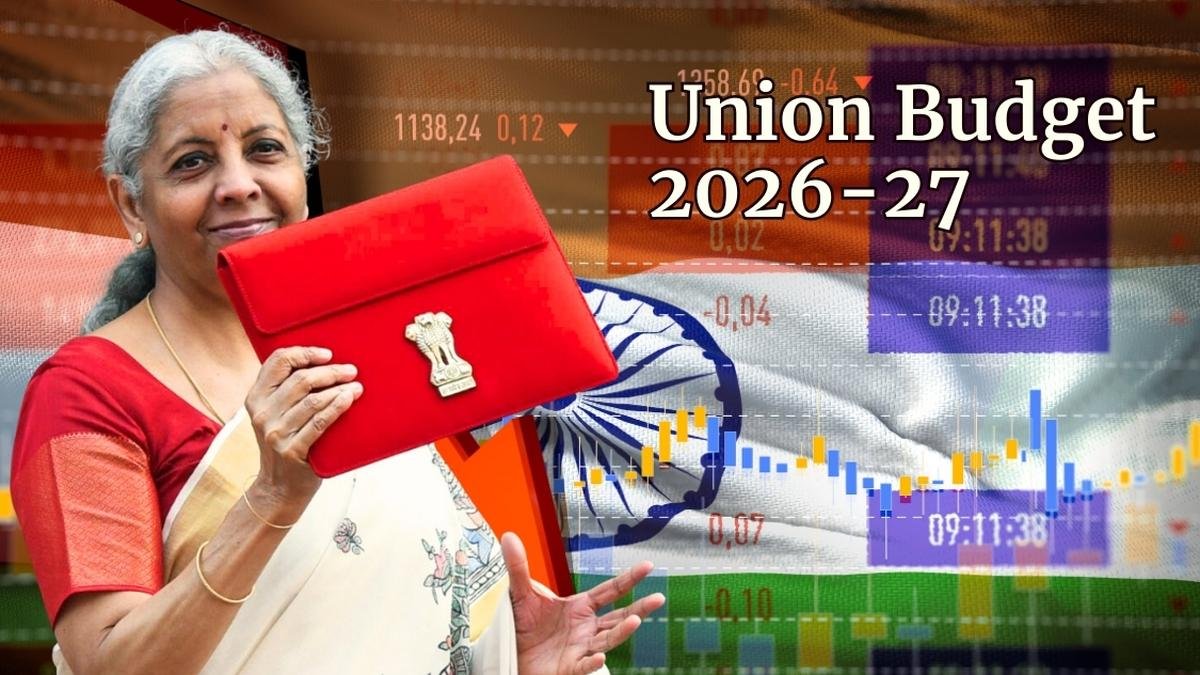
Union Finance Minister Nirmala Sitharaman
Union Finance Minister Nirmala Sitharaman presented her ninth Union Budget in Parliament on Sunday (February 1, 2026), outlining the Centre’s planned income and expenditure for 2025-26, along with projections for the fiscal deficit.
Also read: Union Budget 2026 Live updates
This was the first time in India’s history that the Union Budget was presented on a Sunday.
Here are the key numbers from the Budget.
Revenue and Capital receipts
The Budget Estimates for 2026-27 project non-debt receipts at ₹36.5 lakh crore, while total expenditure is pegged at ₹53.5 lakh crore. The Centre’s net tax receipts are estimated at ₹28.7 lakh crore, reflecting an improvement over the Revised Estimates for 2025-26, when non-debt receipts stood at ₹34 lakh crore and net tax receipts at ₹26.7 lakh crore.
Revenue and Capital expenditure
Revenue expenditure for FY27 is estimated to be ₹41.25 lakh crore compared to FY26’s ₹38.69 lakh crore.
Capital expenditure or capex is estimated to be ₹12.22 lakh crore, which is at 4.4% of the GDP. It is 10% higher than the ₹11.11 lakh crore budgeted capex announced in FY26. This is the “highest-ever capital expenditure and works out to be 4.4% of GDP”, according to Ms. Sitharaman’s statement at a post-budget conference in New Delhi.
Trend in capital expenditure
Capital expenditure or capex, is the money spent by the government on development or to acquire, or to upgrade machinery or assets.
The capital expenditure was 2.5% of GDP in 2021-22 and around 4% of GDP in 2024-25. The government’s capital expenditure was ₹2.35 lakh crore in 2015-16.
Deficit trends
The fiscal deficit in BE 2026-27 is estimated to be 4.3 % of GDP. In RE 2025-26, the fiscal deficit has been estimated at par with BE of 2025-26 at 4.4% of GDP.
Debt trends
The debt-to-GDP ratio is estimated to be 55.6% of GDP in BE 2026-27, compared to 56.1 % of GDP in RE 2025-26.
Where does the money come from?
Borrowings and other liabilities form the largest source of funds for this Budget, accounting for 24% of total inflows, unchanged from the previous year. Income tax is the second-largest contributor at 21% (down from 22% last year), followed by GST and other taxes at 15%, compared with 18% in 2025-26. Corporation tax also makes up a significant share at 18%. The remaining budgetary resources come from non-tax revenue, Union excise duties, customs duties, and non-debt capital receipts.
Where does the money go?
In the Budget, 22% of expenditure (unchanged from last year) is allocated to States’ share of taxes and duties, followed by interest payments at 20%. Central sector schemes account for 17% of total spending. Defence receives 11%, while Finance Commission and other transfers and centrally sponsored schemes get 8% and 7%, respectively. Pensions account for 2% of government expenditure, while the remaining 7% is spent on other items.
Published – February 01, 2026 05:28 pm IST


