



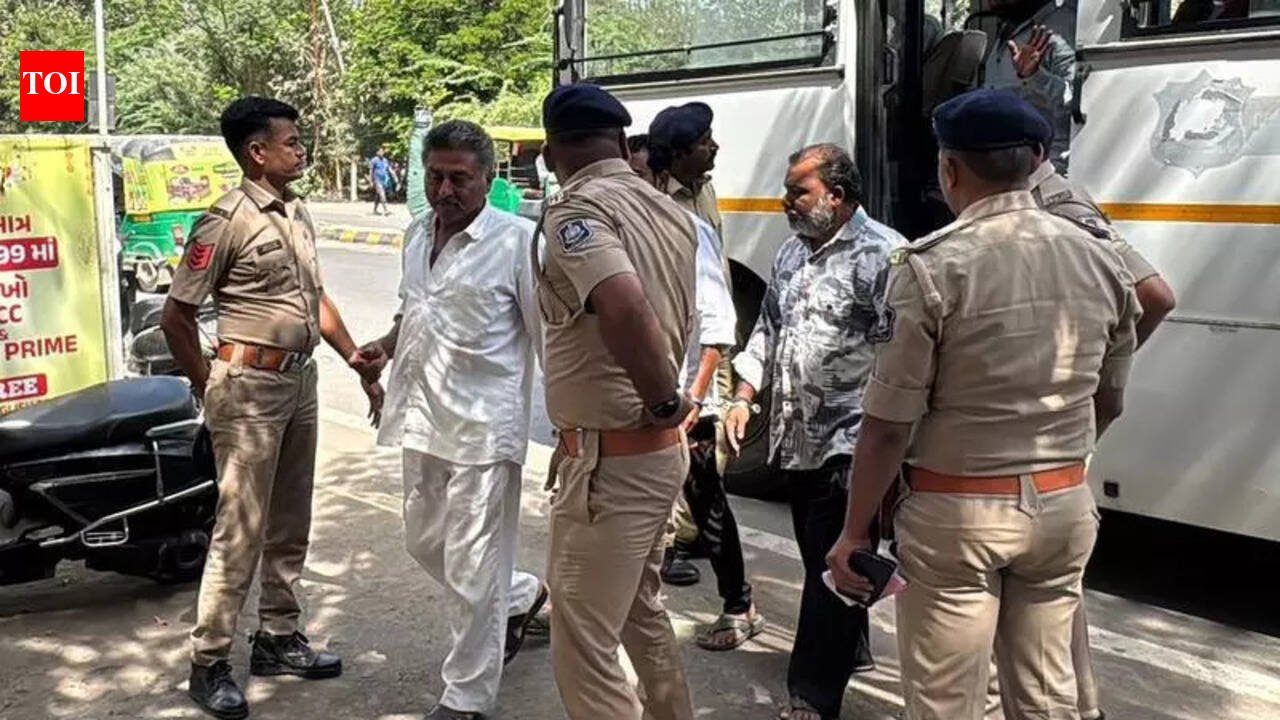
Rajkot: The five men convicted in the Una flogging case of 2016 were on Tuesday sentenced to five years’ rigorous imprisonment under the Scheduled Castes and Scheduled Tribes (Prevention of Atrocities) Act, 1989.J J Pandya, special judge (atrocity), Veraval, acquitted 35 accused, including four police officials, after the prosecution failed to prove charges against them. The court also refused to consider the charge of attempted murder.They were convicted under IPC Sections 323, 324, 342 and 504 pertaining to causing hurt, causing hurt with dangerous weapons, wrongful confinement, and intentional insult provoking breach of peace, district govt pleader Ketansinh Vala said.Those convicted are Ramesh Bhagwan Jadav, Rakesh Rasik Joshi, Nagji Dahya, Pramodgiri Rameshgiri Gauswami and Balvantgiri alias Bali Gauswami. As all of them have spent more than five years in jail as undertrials, they won’t be incarcerated, said Vala.The incident took place on the morning of July 11, 2016, near a quarry in Mota Samadhiyala village of Una Taluka. The victims, identified as Balu Sarvaiya, his sons Vashram and Ramesh, and other relatives, including Ashok and Becharbhai, were engaged in their traditional occupation of skinning a dead cow. According to the prosecution, a mob of ‘Gau Rakshaks” (cow vigilantes) arrived at the scene in a car and motorcycles. Despite the victims’ desperate pleas that the cow was already dead and that skinning animal carcasses was their family’s traditional livelihood, the mob falsely accused them of slaughtering live cows. The accused assaulted the Dalit family using iron pipes, wooden sticks, and belts. Female family members, including Kunvarben, who rushed to intervene, were also brutally beaten and subjected to casteist slurs.The attackers then forced the half-naked victims into their vehicles, tied them to the back of the cars with ropes, and paraded them towards Una. The victims were publicly beaten near the bus stand before being brought to the local police station.Attempted murder charge rejectedThe court refused to consider attempted murder charge, stating that if the accused intended to kill the victims, they were big in numbers, possessing weapons like pipes and sticks, and the victims and witnesses were not powerful enough to face them. The court noted that it was not proved that the injuries sustained by the victims were sufficient to cause death.There were dozens of witnesses who were shopkeepers in Una, having shops on the road where the victims were paraded, but they did not support the prosecution’s case. Some witnesses stated that they saw four people being tied behind a vehicle, but they did not know if they were being beaten, abused, or hurled with casteist slurs. There was only one witness who testified before the court that he identified Pramodgiri, who was beating the victims.The prosecution heavily criticised the role of the local police, highlighting their sheer negligence and failure to act in time, but this could not be proved during the trial.The perpetrators recorded the assault on their mobile phones, and the videos quickly went viral across social media. The visuals of the flogging triggered massive protests across Gujarat and the entire country.Court raps victimsThe court came down heavily on the victims while examining provisions for compensation under BNSS Section 395, observing that the objective of the law is victim rehabilitation and must be applied after assessing the social and economic status of the victims as well as their conduct.The court pointed out several contradictions in the statements and actions of the complainant and his family. It noted that the complainant’s father, Balubhai, had initially gone to Gir Gadhada hospital in an ambulance for treatment. However, four days later, he claimed that he had suffered a head injury, lost consciousness, and regained it only in a government hospital—an assertion the court found to be unsubstantiated.Despite medical records indicating no life-threatening injuries, the statements of four brothers and their father were recorded on the 7th of the incident, where they described their condition as critical. The court further noted that diagnostic reports—including sonography, X-ray, and CT scans—conducted at Rajkot’s PDU Hospital on July 26, 2016, were normal, and the victims were discharged the same day.However, the very next day, three of the victims sought treatment at Ahmedabad Civil Hospital, where they complained only of pain. Subsequent tests, including X-rays, ECG, MRI, and brain CT scans, also returned normal results. The court observed that despite recovery, the victims appeared to have deliberately sought admission and projected their condition as serious, including through the media.According to the charge sheet, the incident triggered widespread unrest within the Dalit community, leading 23 individuals to attempt suicide by consuming poison, of whom one died.“Thus, due to the complainant’s conduct, sensitive members of the Dalit community were driven to take extreme steps, resulting in the loss of a life and causing immense grief to a family. Around 74 other offences linked to the incident were also reported. It appears that the victim made no effort to understand the suffering caused within his own community,” the court observed.The court noted that the complainant’s testimony should be recorded at the time of the beginning of the trial, but he appeared before the court on Oct 12, 2023. His brother Becharbhai Ugabhai alleged that he was paraded and deposed on Jan 1, 2026. Despite this, the complainant has spread through all platforms and media that they have been deprived of justice in court for many years. They claim that justice is delayed and have attempted to damage the court’s reputation.Gandhiji’s autobiography for victimsA copy of Satya Na Prayogo (My Experiments With Truth), the autobiography of Mahatma Gandhi, will be provided to the complainant and victims as part of compensation, as directed by the court to Veraval District Legal Services Authority. “To improve the overall condition of the complainant and victims, and to help them cope with mental trauma and face injustice within the framework of law, the thoughts of Mahatma Gandhi remain relevant today,” the court observed.The court noted that even if the conduct of the complainant and victims is viewed with leniency, financial compensation can offer only temporary relief and cannot bring about lasting improvement. It observed that monetary assistance cannot adequately compensate for financial loss or measure the extent of mental trauma suffered.The government has already paid Rs 3 lakh to each victim, while political parties and organisations have collectively extended Rs 21 lakh. Despite this, the complainant and victims have continued to endure significant physical and psychological distress.


