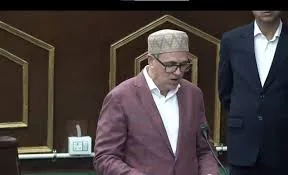
Srinagar, Feb 9: Chief Minister Omar Abdullah on Monday said that the government is making necessary arrangements to hold elections to urban local bodies and panchayats in the Union territory at the earliest, but said the post of state election commissioner is presently vacant.
In a written reply to a question of Congress MLA Tariq Hameed Karra in the Legislative Assembly, Abdullah said the superintendence, direction and control of preparation of electoral rolls and conduct of elections under the J&K Panchayati Raj Act, J&K Municipal Act and J&K Municipal Corporation Act, 2000, rests with the State Election Commission (SEC).
“The Commission (SEC) is making necessary arrangements for holding panchayat and urban local bodies elections at the earliest. However, the position of state election commissioner is lying vacant at present,” he said, adding that the report submitted by the Jammu and Kashmir Local Bodies Dedicated Backward Classes Commission for determining the quota of reserved seats is under examination, and further steps will be taken accordingly.
On the question of delimitation of Panchayat Halqas and ULB wards, Abdullah said that, as per Section 2(J) of the Panchayati Raj Act, 1989, Panchayat Halqas were last delimited before the 2018 General Panchayat elections through notifications issued in 2017. Fresh delimitation is not proposed at present as population figures from the new census are not yet available.
He further said delimitation of 77 urban local bodies (ULBs) has been taken up as per instructions of the housing and urban development department, adding that the process has been completed for 72 ULBs and is underway for the remaining five.
CM Abdullah informed the House that the term of panchayats and block development councils (BDCs) expired on January 9, while the district development council (DDC) term will end on February 24. He said the tenure of the Srinagar municipal corporation ended on November 5, 2023, while the term of Jammu’s civic body also ended in the same month on November 14.
Abdullah said that the maximum number of wards in a Municipal Corporation is fixed at 75 under Section 6 of the J&K Municipal Corporation Act, while Section 10(1) of the J&K Municipal Act, 2000, sets the criteria for fixing ward numbers in Municipal Councils and Committees based on population.
He emphasised the importance of stable and effective Panchayati Raj Institutions (PRIs) for governance and development. It said relevant statutory and procedural provisions are under continuous review, and any amendments necessary to strengthen decentralised governance, improve institutional efficiency, and enhance service delivery will be considered.
He further noted that the three-tier Panchayati Raj system has been fully operationalized, with elections held for 4,291 Sarpanchs and 33,597 Panchs at the village level, while Block Development Councils have been established with 276 elected Chairpersons. At the district level, District Development Councils, created through a 2020 amendment to the Panchayati Raj Act, replaced earlier planning bodies with directly elected representatives.
To improve functional efficiency, the government has constructed 600 Panchayat Bhawans with full internet connectivity and undertaken capacity-building initiatives, training over 7.25 lakh participants between 2022 and 2025 in governance, planning, and financial management. Support staff, including Panchayat Secretaries and Assistants, have been recruited to assist PRIs in day-to-day functioning.
He said amendments to the J&K Panchayati Raj Act, 1989, have ensured reservations for women, Scheduled Castes, Scheduled Tribes, and Other Backward Classes across all three tiers of PRIs. Flagship initiatives such as the Back to Village (B2V) programme have been implemented to strengthen citizen engagement and grievance redressal. Digital platforms such as eGramSwaraj have been introduced for online accounting, payments, and monitoring of works, while Panchayats have been empowered to conduct social audits. Under the SVAMITVA scheme, drone-based mapping is being carried out to provide records of rights to rural households.