



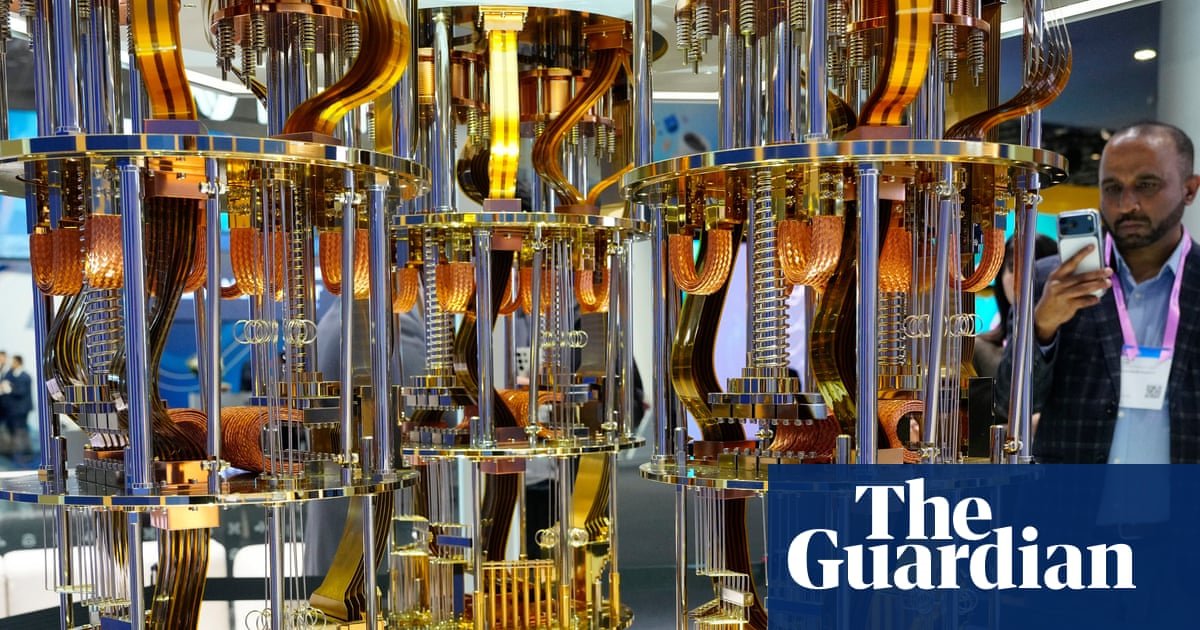
The UK will not let quantum computing talent slip through its fingers and must learn lessons from US dominance of the AI race, the technology secretary has said, as the government announced a £1bn quantum funding pledge.
Liz Kendall said the government hoped to retain homegrown quantum startups, engineers and researchers rather than lose them to competing countries, with the US stealing a march on its western rivals in AI.
“I do look at what’s happened on AI,” said Kendall. “I do think we need to learn the lessons and make sure we give our brilliant scientists, spinouts and startups the ability to stay here and make it happen. And that requires a government that is bold and ambitious and confident in these technologies of the future.”
She added: “Too many people feel they have to move to the US in order to get the funding and support they need to grow and scale their company.”
DeepMind, a groundbreaking AI firm co-founded by Nobel laureate Demis Hassabis, is still based in London but was bought by Google in 2014 for £400m, while major Silicon Valley names such as Meta have been offering vast sums to elite-level talent. The UK remains a major producer of AI talent but some of its biggest AI operations are bases for US companies such as ChatGPT developer OpenAI, Anthropic and Palantir.
Speaking to the Guardian at the National Quantum Computing Centre (NQCC) outside Oxford, Kendall said the government did not want to take a “back seat” on quantum. The UK has produced a number of quantum startups including Quantinuum, a US-UK firm that recently achieved a $10bn (£7.5bn) valuation.
“I want to be at the front of the grid and leading,” she said.
Kendall attended the NQCC with the chancellor, Rachel Reeves, as part of a funding announcement for quantum computing, which uses principles of quantum physics to process information.
The government, in a policy driven by science minister Patrick Vallance, is providing £1bn to help companies design large-scale quantum computers for use by scientists, researchers, the public sector and businesses. A further £1bn, already announced, will support companies and researchers in putting quantum into action in fields such as finance, pharmaceuticals and energy.
Kendall said the UK wanted the money, jobs and security that would come with building a domestic cutting-edge quantum computer by the beginning of the next decade. Last year Google announced it had developed an algorithm enabling a quantum computer to operate 13,000 times faster than a classical computer.
However, fully fault-tolerant quantum computers, capable of realising some of the tasks that augur major scientific breakthroughs, are still some way off as they would require machines capable of hosting hundreds of thousands of quantum bits – the term for a unit of information in a quantum computer.
Classical computers encode their information in bits – represented as 0 or 1 – which are transmitted as an electrical pulse. A text message, email or even a Netflix film streamed on a smartphone is a string of these bits.
In quantum computers, however, the information is contained in qubits. These qubits, encased in a modestly sized chip, are particles such as electrons or photons that can be in several states at the same time, a property of quantum physics known as superposition.
This means qubits can encode various combinations of 1s and 0s at the same time, and compute their way through vast numbers of different outcomes, which is not possible with classical computers. However, they have to be kept in a highly controlled environment, such as one free from electromagnetic interference, or else they can be easily disrupted.
Nonetheless, quantum computers could in theory help design new chemicals, drugs and alloys. Quantum computing could result in a much more efficient representation of chemical compounds, for instance, allowing accurate prediction of what a complex molecule might do and paving the way for new drugs and materials.


