



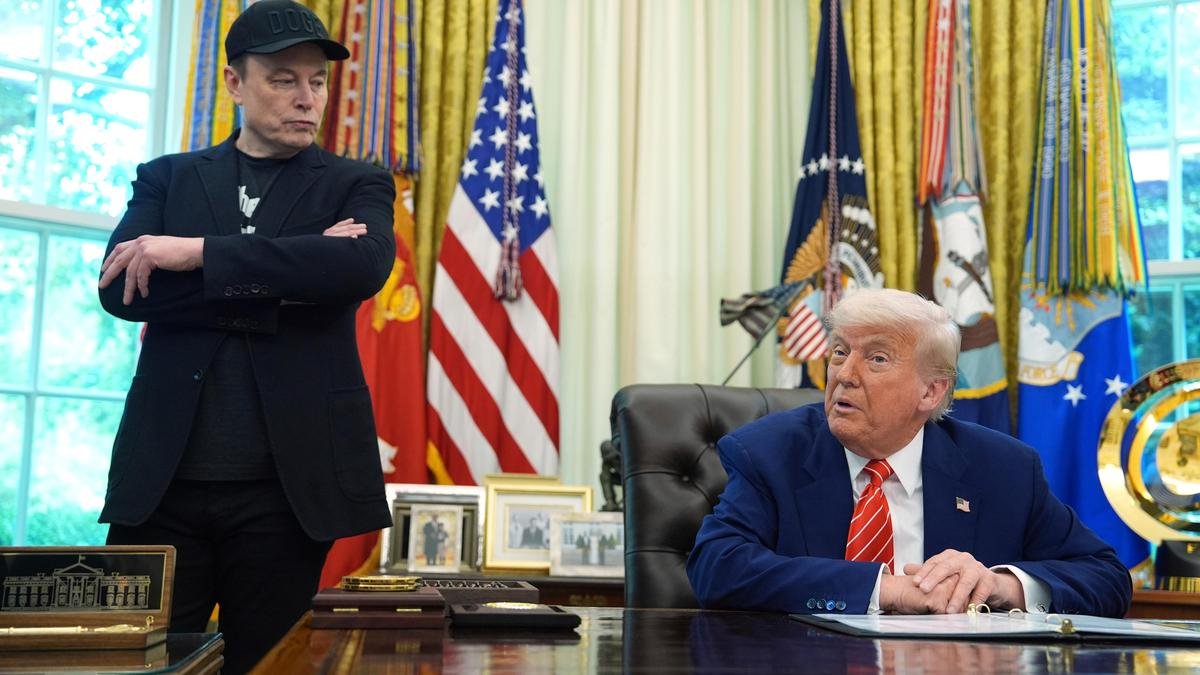
U.S. President Donald Trump. File.
| Photo Credit: AP
The U.S. Court of International Trade (CIT) has ruled that the 10% temporary tariff President Donald Trump imposed on all U.S. trade partners, including India, was “unauthorised by law”, striking a further blow to his attempts at using tariffs as tools to advance his policy priorities.
However, while the ruling sets a precedent, it does not translate into immediate relief for exporters around the world. The court on Thursday (May 7, 2026) provided relief to only the plaintiffs — two small companies in the U.S. and Washington State — with the tariff remaining on all other importers.
The U.S. government is expected to appeal the judgment at the federal level, which could extend the process by several months.
Mr. Trump had, on February 24, 2026, used Section 122 of the Trade Act of 1974 to impose a 10% tariff on imports from around the world for 150 days. This was in response to the U.S. Supreme Court striking down his country-wise reciprocal tariffs, which were based on the International Emergency Economic Powers Act (IEEPA) of 1977.
Limited relief
The CIT, in a 2-1 decision, ruled that, although the U.S. Congress had originally passed Section 122 to give the President the authority to address balance of payments deficits, this did not include the trade deficit and current account deficits cited by Mr. Trump when he levied the 10% tariff.
The court ordered the U.S. government to stop collecting the tariff from the plaintiffs — Washington State, spice importer Burlap & Barrel, and toy maker Basic Fun! — and to refund the amount collected. It stopped short, however, of ordering the same for all U.S. importers.
“The CIT did not issue a universal injunction or give relief to anyone other than the named plaintiffs,” Peter E. Harrell, visiting scholar at Georgetown Law School’s Institute of International Economic Law, said in a social media post following the ruling.
“Other companies may well now decide to sue, though many will probably hold off while this decision winds its way through the appeals process,” Mr. Harrell noted.
Tariffs still a threat
This ruling comes days after the U.S. government started paying refunds to U.S. importers who had paid the reciprocal tariffs that were eventually struck down by the Supreme Court.
The U.S. government has also launched a number of investigations under Section 301 of the Trade Act of 1974 regarding fair trade practice and labour rights violations by several of the U.S.’s trade partners, including India. If these investigations find violations, they would empower the U.S. to once again levy tariffs on the relevant countries.
The investigations are expected to conclude in July, which is when the 10% tariff is set to expire.
Impact on trade deal
Sources in the government said the CIT ruling strengthened India’s negotiating position with regard to the Interim Agreement on trade between India and the U.S., as well as a larger Bilateral Trade Agreement between the two countries. However, they added that the matter was too nascent for any real impact to be felt on negotiations.
The two countries announced the Interim Agreement in February, under which India was to receive lower tariffs than its competitor nations. However, the signing of the deal was indefinitely postponed following the U.S. Supreme Court’s decision to strike down the reciprocal tariffs.
While negotiations have resumed, the deal currently lies in limbo, with Indian government officials publicly saying that it cannot go ahead until the U.S. finalises the tariffs it is levying on other countries. That is, India is still pushing for preferential access over its competition, which can be established only once all tariffs are known.
Published – May 08, 2026 09:24 pm IST


