






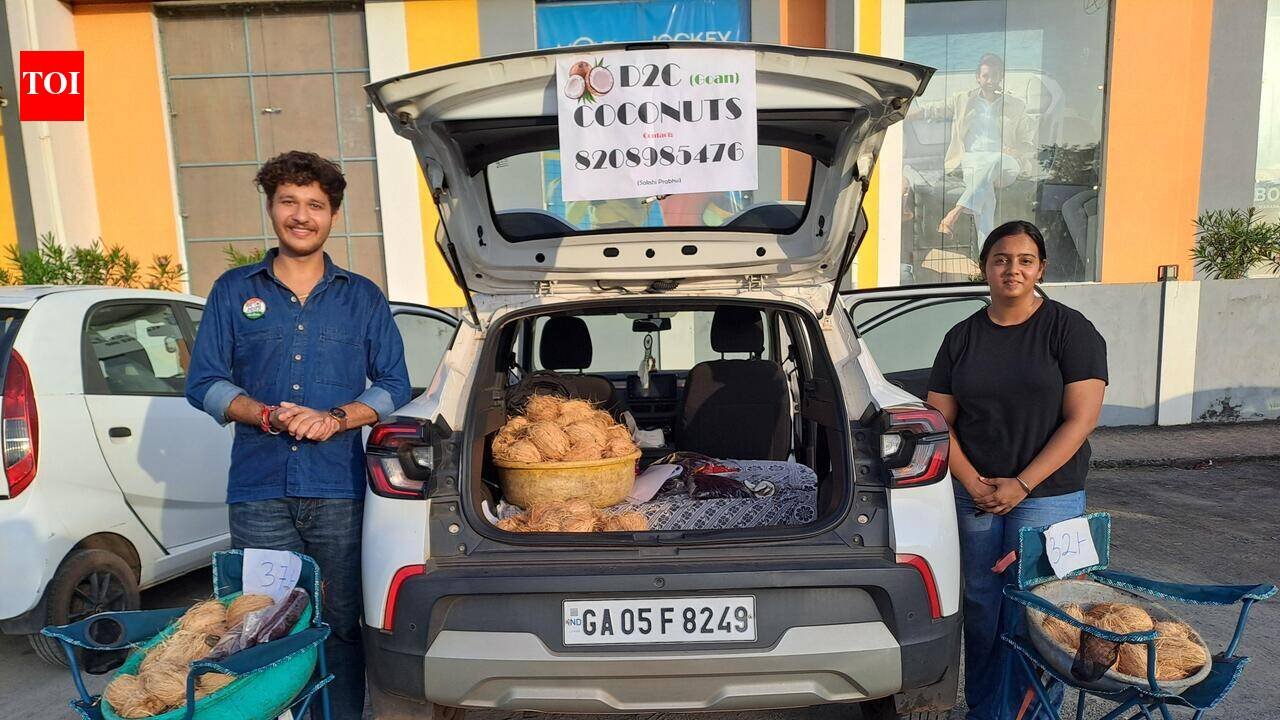
Colva: On a festive-season evening, two young techies parked a car by the roadside in Benaulim in South Goa, opened its boot and waited.Inside were coconuts, a staple diet of Goans, neatly stacked and priced at Rs 37 apiece.The price was deliberate. At a time when a coconut can cost consumers anywhere between Rs 45 and Rs 70, Sakshi Prabhu from Ponda and Badal Sardana from Rajasthan were hoping their modest roadside experiment would help the coconut travel directly from the farm to the consumer.A NIT Goa graduate who completed her BTech last year and now works for a multinational company, Sakshi has seen that journey up close. Her father, Suresh, owns a farm where coconuts, arecanuts and other produce are grown. For years, the family followed the conventional route — sell the produce to agencies, which supply vendors, who eventually sell it to consumers.“We sold the coconut at Rs 24 while the end customer bought it for Rs 40,” she said. “I realised that the farmer does not make much of a profit, whereas the agencies who act as middlemen get the icing.”So, with Badal, a fourth-year BTech student at BITS Pilani K K Birla Goa Campus, she decided to try something radically simple: Remove the middleman.The experiment comes at an interesting moment when coconuts have become increasingly scarce and expensive this festive season, prompting govt to even plan imports of 55,000 coconuts from neighbouring states.The idea has already found some early supporters. Friends and acquaintances have bought about 100 coconuts from Sakshi.But their first attempt at taking the experiment to the streets offered a very different lesson. They had parked near a mall in Benaulim, expecting shoppers to be tempted by the unusually low price.But nobody bought a coconut.For many entrepreneurs, that might have been the end of the experiment. For the two techies, it became market research.They watched, listened and tried to understand why.The answer, they felt, was as much about geography and culture as price. Many households in the Salcete belt either did not need coconuts for the Ganesh festivities or had coconut trees and access to their own produce.So, the duo began thinking about their next location — areas with a predominantly Hindu population who would stock up for the festivities.For Sakshi, however, this experiment is about more than finding customers for coconuts. It is also about finding a different way of looking at work.Despite having stepped into the corporate world, she remains closely connected to her family’s farm.Corporate life, she says, can be rewarding but relentless.“Corporate life is very hectic and, at some point of time, one wants to ease off from hectic, high-pressure jobs,” she says.She sees agriculture differently — not as an occupation people leave behind for better-paying careers, but as a sector that can become profitable if young people bring new ideas into it.There may be no guarantee that every roadside stop will produce a sale. But for two young people experimenting with an old crop in a new way, even an unsold coconut has something to teach.Technology, market research and direct-to-consumer models, she believes, could change the equation.Sakshi hopes eventually to develop an app or digital platform that would allow farmers to connect directly with consumers, cutting out unnecessary layers between the person who grows the produce and the person who buys it.The car boot is only the beginning.Their larger bet is that if farmers can get a better share of what consumers pay — and consumers can get a fairer price — everyone may have something to gain.And perhaps, one coconut at a time, farming can become a little more attractive to the next generation.For now, though, the idea has four wheels, a boot full of coconuts and a Rs 37 price tag.


