



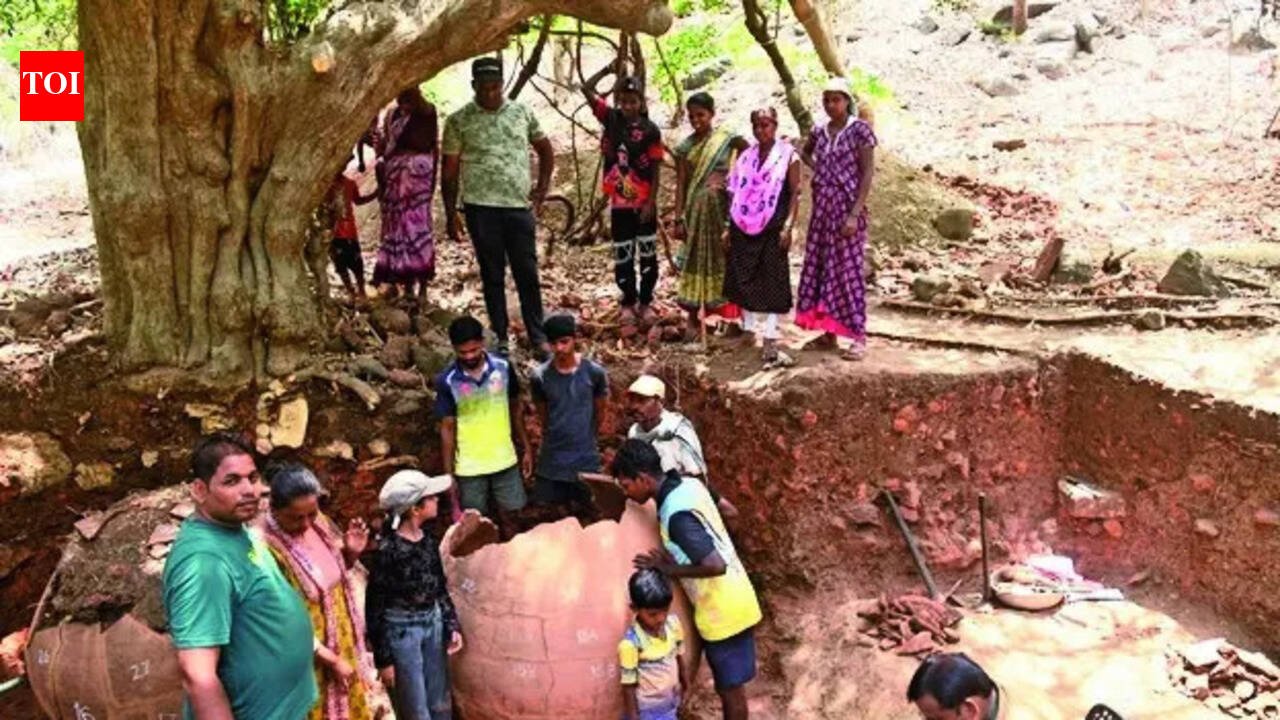
Deep within one of two massive storage jars excavated at Elephanta this year, the Archaeological Survey of India (ASI) stumbled upon twin treasures on April 17.Two copper plates tracing to two dynasties of western India — the Chalukyas of Navasarika and the Traikutakas — were found near a structure interpreted as a warehouse, adding weight to the island’s maritime past.In his office at Sion Fort on Thursday, superintending archaeologist Abhijit Ambekar drew back a blue velvet cloth to unveil the antiquities that have kept ASI officials busy for two months as they cleaned and conserved the fragile finds. One of them — bearing a unique seal — has not yet yielded all its secrets.Together with earlier discoveries — a stepped reservoir, Mesopotamian jars and what may have been a carnelian bead workshop — “the plates provide fresh evidence that Elephanta was an important port as well as a thriving cultural centre over the centuries,” Ambekar said.Sporting a bluish-green patina typical of ancient copper, the plates were soaked in sodium carbonate and sodium bicarbonate before conservators periodically brushed away centuries of encrustation. Gradually, the Sanskrit inscriptions — written in Brahmi script — became legible.“The first inscription belongs to the Chalukyas of Navasarika (modern Navsari), a branch of the Early Chalukyas who governed parts of southern Gujarat, northern Konkan and the Nashik region during the seventh and eighth centuries CE,” said archaeologist Abhijit Dandekar.Based on the legible reading of the seal, the inscription is believed to belong to Jayashraya Mangalarasa, one of the most important rulers of the Navasarika branch, he said. The dynasty was founded by Dharashraya Jayasimhavarman, son of the celebrated Badami Chalukya ruler Pulakesin II.The discovery strengthens the argument that it was the Navasarika Chalukyas, rather than Pulakesin II himself, who controlled Elephanta and developed its trade links with Gujarat, Konkan and the Arabian Sea, Dandekar said.The second copper plate, bearing a distinctive horn-like seal, belongs to Maharaja Indrasena of the Traikutaka dynasty, according to ASI. “In 1864, physician, antiquarian and former Sheriff of Bombay Dr Bhau Daji Lad brought the forgotten Traikutakas to light through the study of a copper plate discovered at Kanheri by Dr James Bird. More than a century and a half later, the ASI has announced the discovery of another copper plate of the same dynasty from Elephanta, opening a new perspective on the island’s geo-political role and maritime networks,” said Ambekar.


