






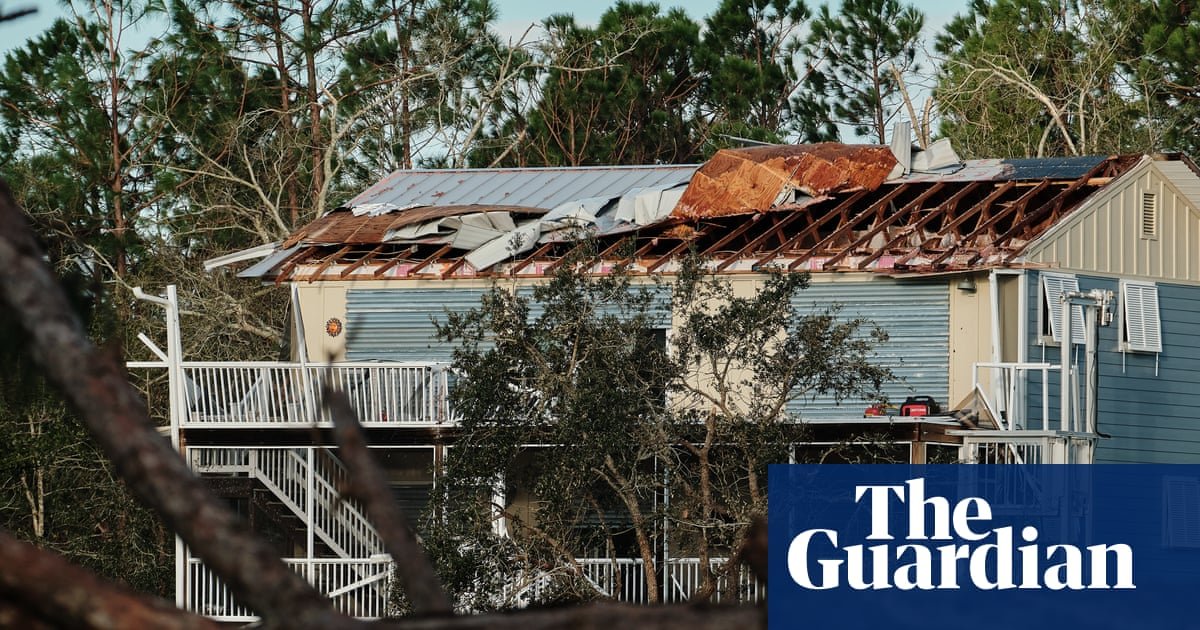
Two people have died amid Isaias after it made landfall late on Friday on Florida’s panhandle as a category 2 hurricane, according to authorities.
Both of those deaths occurred after trees fell on homes, one in Escambia county, Florida, and another in Birmingham, Alabama, as the storm moved in inland, local officials said.
Meanwhile, though it had weakened on Saturday to a post-tropical cyclone, Isaias still posed flooding and tornado threats as it moved inland, forecasters and officials warned.
More than 868,000 customers furthermore were without power across Florida, Alabama and Georgia on early Saturday as those in the path of the storm began the cleanup process, according to PowerOutage.us.
Although storm surge and tropical storm warnings associated with Isaias had been discontinued, the National Hurricane Center (NHC) warned there would still likely be “considerable impacts” associated with Isaias across much of southern Alabama, Florida’s panhandle and south-western Georgia.
“Flash, urban and river flooding is possible across the region,” the NHC said in a Saturday-morning advisory, adding that there was a considerable potential for flash flooding and landslides across the southern Appalachians. “A risk for tornadoes will persist … through [Saturday] afternoon across parts of the eastern Florida panhandle, Georgia and the Carolinas.”
Isaias through Sunday is expected to produce rainfall amounts of 4-8in across southern Alabama, Florida’s panhandle and Big Bend regions, and south-west Georgia. Localized totals up to 15in are possible, particularly within rain bands across the Florida panhandle and Big Bend.
Across much of the remainder of the south-east US, rainfall amounts of 2-5in are expected, and localized higher amounts up to 10in are possible, especially across the southern Appalachians and coastal Carolinas.
Isaias made landfall near Destin, Florida, on Friday as a potent category 2 hurricane. It was an atypically late-forming first Atlantic hurricane of the season and lashed the US Gulf coast with heavy rain, fierce winds and life-threatening flooding.
The hurricane’s maximum sustained winds were 105mph (169km/h), and it was predicted to dissipate on Sunday.
Isaias’s winds were so intense they sounded like “a train whistle”, Tim Mowry told the Associated Press after enduring the storm as his home in Pensacola, Florida.
Mowry described losing power on Friday afternoon but said could rely on a generator. He said his son tried to drive to his home after his place about 15 minutes away lost power but had to turn around because downed trees and power lines blocked the road.
All things considered, Mowry said he was “really fortunate” with respect to how he fared during Isaias.
Crestview, Florida, resident Ashley Weeks told the news station WEAR that a tree from her backyard fell on top of her house, damaging the the roof near her daughter’s bedroom and turning the ceiling into piles of debris.
It was “just scary – everything, my whole life is in the house”, Weeks said. “We heard a loud … like a bomb went off in the house. It was so loud. And I got up and [saw] the tree through the roof, and it was – freaking out.”
Alabama’s governor, Kay Ivey, warned of “possible spinoff tornadoes” and asked residents to “prepare for the worst”.
“Right now, we are worried about strong winds, heavy rain and possible spinoff tornadoes in certain parts of the state,” Ivey said. “As we approach the weekend and any travel plans, make sure you have reliable information as conditions develop. We often hear in emergency management: Hope for the best. Prepare for the worst.
“That is the approach we need with this particular storm system.”
Florida’s governor, Ron DeSantis, said in an interview with Fox News on Saturday morning that his administration had not received any reports of fatalities yet in the state. He attributed that to likely heightened preparation and previous experience with other tropical storms and hurricanes.
“We’re a peninsula in the middle of a tropical part of the world,” DeSantis said. “We’ve gotta deal with these things,” DeSantis said.
And while the stronger El Niño seemed to limit the number of hurricanes in the Atlantic for the year so far, Isaias forming in October with maximum sustained winds of 105mph marked a stark contrast from historical trends.
The National Oceanic and Atmospheric Administration (Noaa) predicted a quiet year in terms of hurricanes at the beginning of a season that officially begins annually on 1 June. Noaa anticipated between three and six hurricanes, well below the average of seven. An August forecast from Noaa cut the expected number to between two and six.
Isais is one of the two latest-forming Atlantic hurricanes on record, tying a record set on 8 October 1905. Otherwise, the second-latest date for the first Atlantic hurricane was 11 September – in 2002 and 2013.
None of the eight previous named storms of the 2026 Atlantic season intensified above tropical storm status.
The Associated Press contributed reporting


