



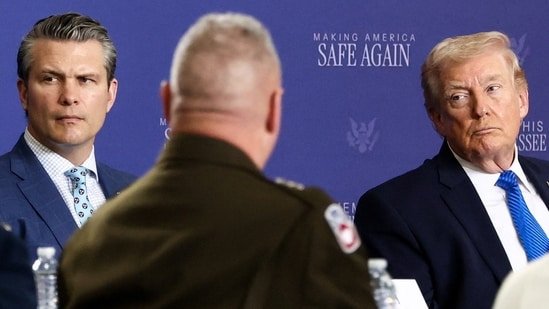
Pakistan has emerged as one of the mediators, and US defence secretary Pete Hegseth as a possible scapegoat, amid hopes that the US-Israel war on Iran could indeed be “winding down”, after President Donald Trump said on Monday that his government was engaged in “productive” talks with Tehran. Fighting, though, showed no signs of slowing as of Tuesday, while Iran altogether denied there were any talks.


Inside America, though, there is already talk of pinning responsibility for who actually started the war, which is in its fourth week and not exactly going as per Trump’s “swift and decisive” claim made on Day 1, February 28.
On Day 24, Monday night, Trump pointed towards his defence/war secretary Hegseth at an event in Tennessee, and said: “Pete, I think you were the first one to speak up and you said, ‘Let’s do it’, because you can’t let them have a nuclear weapon.
This was just hours after Trump paused, by five days, his threat to bomb Iran’s energy infra if it did not reopen the Strait of key oil trade route Hormuz. He even said talks were on between US envoys — apparently including his son-in-law Jared Kushner and businessman friend Steve Witkoff — with a “respected” Iranian leader, but he said it was not the Supreme Leader, Ayatollah Mojtama Khamenei.
In the next sentence, he said he and the Ayatollah could together control the Strait of Hormuz.
Iranian officials, meanwhile, insisted that Trump had backed down “following Iran’s firm warning” to hit infra in Gulf countries like Saudi Arabia and UAE that have US bases.
However it may have happened, the relative thaw amid the hostilities in West Asia led to massive movement in the financial markets.
Oil prices dropped as supply fears eased. This also led to massive payoffs for some entities that bet on a crude-oil rate plunge, just before Trump’s Truth Social announcement made it happen. This even led to talk of insider info being leaked or used to make a 100-million-dollar profit. More on that in just a bit.
First, more on the “talks” that Trump spoke of and Iran denied. And who’s reported to be mediating.
Islamabad to host talks?
Pakistan Army chief Field Marshal Asim Munir spoke to President Trump on Sunday; and this was followed by a phone call between Pakistan Prime Minister Shehbaz Sharif and Iranian President Masoud Pezeshkian the next day. The Financial Times and Axios reported that senior officials from Egypt, Pakistan and Turkiye engaged Trump’s envoy Witkoff and Iran’s foreign minister Seyed Abbas Araghchi to pass messages about finding a possible ramp-off.
Along with Saudi Arabia, Turkiye and Egypt, Pakistan is reported to be part of the “STEP” group working on both sides for an end to the conflict, at least for now.
Also read | Uncertainty around Pakistan’s role in mediating between US and Iran
Pakistan capital Islamabad could even serve as the venue for possible talks between the Iranian side and a US team comprising Vice President JD Vance, besides Witkoff and Kushner, HT has reported. This could help Pakistan further strengthen its credibility with Trump’s America. “If the parties desire, Islamabad is always willing to host talks,” Pakistan Foreign Office spokesman Tahir Andrabi told the newspaper Dawn.
Egypt’s foreign minister Badr Abdelatty discussed “potential negotiations” between the US and Iran in a phone call with Witkoff, the ministry said on Tuesday. Abdelatty also spoke with the foreign ministers of Turkey, Pakistan, Oman, Saudi Arabia, UAE, France and Cyprus, the ministry added.
While Trump said many things about the “talks”, the White House officially did not go further than his varied hints.
“These are sensitive diplomatic discussions and the US will not negotiate through the press. This is a fluid situation, and speculation about meetings should not be deemed as final until they are formally announced by the White House,” White House spokesperson Karoline Leavitt said on the pointed possibility of a Vance-Witkoff-Kushner meeting with Iranian officials in Islamabad.
Hints amid denials from Iran’s side
While Iran may have denied any talk for the record, American news outlet CBS cited an unnamed senior Iranian foreign ministry as saying that Tehran has “received points from the US through mediators and they are being reviewed”.
Iran’s foreign minister Abbas Araghchi has been discussing the conflict with some of his counterparts since Monday, his office has confirmed. He has spoken to officials from Azerbaijan, Egypt, Oman, Pakistan, Russia, South Korea, Turkey and Turkmenistan. Indian PM Narendra Modi also spoke to President Masoud Pezeshkian over the weekend, though details were not shared on a proposal, if any, for mediation.
Iran’s Parliament Speaker Mohammad Bagher Ghalibaf, who emerged as a likely representative from Iran’s side, still said no negotiations have taken place as of Monday.
A former commander of the Islamic Revolutionary Guards Corps (IRGC), Ghalibaf even alleged that Trump’s remarks were aimed at manipulating financial and oil markets.
That brings us back to the financial bit.
Market manipulated?
Just before Trump announced a five-day pause at least on his plans to target energy sites in Iran, trades were made on two counts in the US markets. One, trades of around $1.5 billion were placed on a possible upward swing in the stock market, NDTV has reported.
That upward swing actually happened, as markets felt some relief after hearing of a thaw.
This was not the only mega trade that came just before Trump posted on Truth Social that the US had held talks with Iran and would halt planned strikes on Iranian power plants.
The other bet was on sale of oil futures, worth about $192 million, anticipating a drop in crude prices once supply fears ease, the NDTV report further said. The fears indeed eased after Trump made his announcement/claims.
S&P 500 futures jumped more than 2.5%. Oil prices plunged. It generated, by some estimates, over $100 million in the oil-price trade alone. But with uncertainty returning around the claim of talks, oil rose back up, and markets dropped a shade too — the latest leg of the rollercoaster ride since the start of the war.
The death toll has risen to more than 1,500 in Iran; more than 1,000 in Lebanon where Israel claims to be pursuing Iran-backed military group Hezbollah; at least 15 in Israel, and 13 US military personnel. Millions in Lebanon and Iran have been displaced, news agency AP reported on Tuesday.
Notes of caution
As violence persists, a member of Iran’s Parliament has warned that his nation must stay cautious.
“Trump, (Israeli PM Benjamin) Netanyahu and the like are inherently liars and their nature is to create division. We must think wisely. Their nature is to sow discord so that they can make people distrust officials and believe that such actions have taken place, whereas no such action has occurred,” Esmail Kowsari, a member of the Parliament’s national security and foreign policy committee, told Iran’s semi-official news agency Fars.
Even in Washington, the Trump administration got a warning about Israel from Joe Kent, who resigned last week in disgust over the war and said it was started under “pressure” from Israel and its “lobby” in America.


