



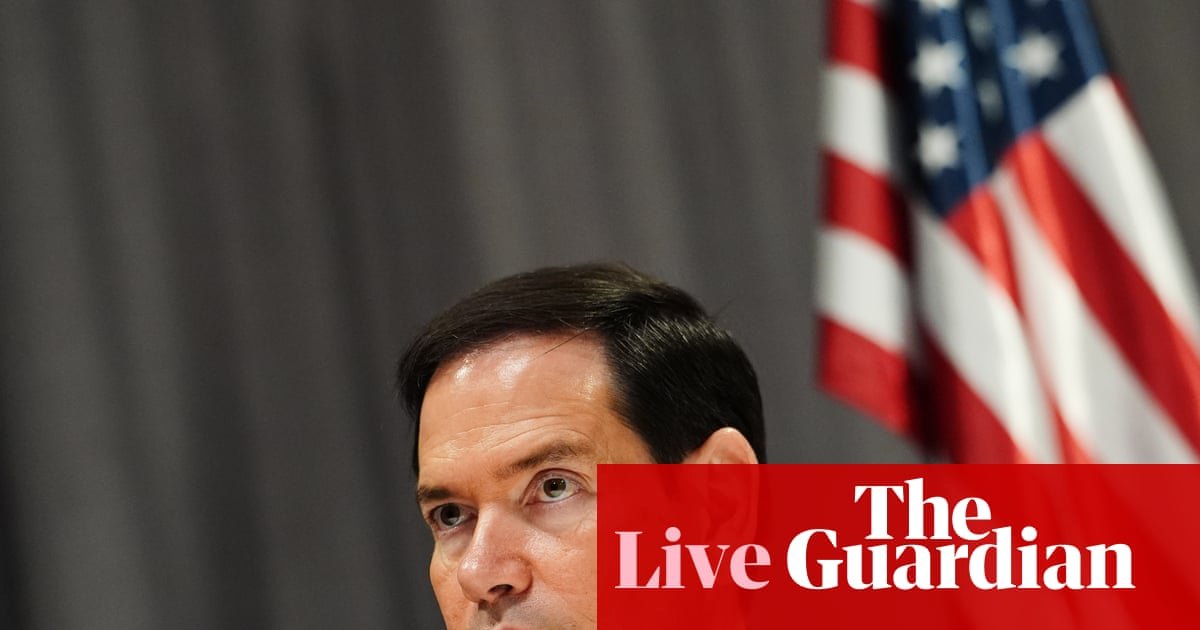
Trump’s ‘disappointment’ with Nato will be discussed at ‘one of the most important summits in history of Nato’ in Ankara, Rubio says
Rubio begins with thanks to Sweden for hosting the ministerial meeting.
But that’s where the niceties end as says the upcoming Ankara summit will be “one of the more important leaders’ summit in the history of Nato,” as the leaders will have to respond to Trump’s “disappointment” with the alliance’s “response to our operations in the Middle East.”
“That will have to be addressed, that won’t be solved or addressed today. That’s something for the leaders level to discuss.”
He notes the US announcement on Poland, but adds “the United States continues to have global commitments that it needs to meet in terms of our force deployment, and that constantly requires us to reexamine where we put troops.”
“This is not a punitive thing, it’s just something that’s ongoing, and it was pre-existing,” he says.
He says there’s plenty of scope to work with Nato on defence industrial base.
Key events
Asked about potential further US troops reductions in Europe – with the journalist using the example of Italy – Rutte says it’s important that the US is “pivoting” “over time, … in a structured way,” and generally he can’t even really tell us too much as it’s a US decision.
“The overall deterrence and defence in Europe has to stay the same, because we are facing the Russian threat, we all acknowledge this,” he stresses.
The rest of his answer is essentially waffling very general.
And that wraps up the press conference.
Asked about Russian shadow fleet ships, he again says it’s all confidential and he can’t say too much about it, but insists the renewed push to counter the fleet makes “the Russians take note of this, and that it is big, big irritant to them.”
Rutte gets also asked if Rubio leaves Sweden less disappointed about the allied behaviour over the last few months when it comes to Nato’s response to the Iran war.
Again, he launches into a very lengthy and complex answer, outlining the US frustrations with Nato, but insists most of them have been addressed, and the Europeans “heard” the US points.
Rutte gets asked if he has any update on the planned – or potential – US changes to its readiness to respond to a potential crisis, after suggestions the US could lower its contribution to Nato’s readiness forces, the Nato Force Model.
He gives a really complicated answer, but effectively it boils down to: something is changing behind the scenes, but I can’t tell you what it is.
“What is playing out now, at the moment, at the level of policy directors, is US contribution to the Nato Force Model, so that is a process now ongoing, but hey, we are prepared for this,” he says.
He says it’s obvious the US needs to make sure it has “all the capabilities and all the key enablers are everywhere where we need them” and that leaves more space for European and Canadian allies.
But overall, he says, “this is highly classified, because we don’t want to make anyone any wiser.”
“This is nothing new. Everybody knew this was happening, and it has nothing to do with the fact that the US wants to equalise the burden. It has to do with the fact that they cannot be everywhere at the same time.”
He then gets pushed on this answer and whether he can confirm that there is something changing. He deflects the question, and says it’s all “highly classified.”
Zelenskyy invited to join Nato summit in Ankara, Rutte confirms
Asked about Ukraine, Rutte praises their fight against Russia, and notes that “there are even reports that Ukraine is in net terms regaining territory, not massively, but at least it’s stabilising, and potentially even moving now in the right direction.”
“I would not be too happy if I was Putin today – I would never be happy if I was Putin – but particularly not the last couple of weeks, because things are not going in the right direction.”
He confirms that Ukraine’s Volodymyr Zelenskyy will be invited to join the summit in Ankara.
“I invited him already … He will be there, like in The Hague.”
Rutte gets asked about the meeting today and how it turned out after some pretty fierce disagreements between the members in recent months.
Ever an optimist, he insists it was “a very good meeting,” while cheekily adding that as “this is a democratic alliance, we will always have debates.”
But he stresses “the difference is huge” if you compare to where Nato was two years ago.
He adds that the alliance still needs to keep changing, and “we have to make sure that the summit in Ankara really delivers.”
Asked if Europe should prepare to defend itself without the US, he rejects the premise of the question.
“We are not preparing for that last part of your question,” he says, but also repeats his lines on making Nato stronger through stronger European element.
“What you will see over the coming years is a more equal, as a shift, a credible shift, where the Europeans take this bigger responsibility with the United States firmly anchored in the transatlantic relationship,” he says.
On Ukraine, Rutte just repeats his key lines from yesterday, stressing the need to keep supporting and funding Ukraine and its purchases through the Prioritised Ukraine Requirements List.
On Iran, he criticises its actions in regard to the strait of Hormuz, echoing Rubio’s earlier call for all countries to oppose their attempts to restrict freedom of navigation.
And we’re going to Q&A.
Nato’s commitment to Article 5 ‘ironclad’ with ‘absolute’ resolve to defend ‘every ally,’ Nato’s Rutte says
Rutte begins by repeating his usual lines on investing in defence, “producing the capabilities we need,” and continuing support for Ukraine.
He makes a point by saying that increased defence spending is one thing as member states gradually build towards the 5% GDP target agreed last year in The Hague, but “it isn’t an end in itself.”
He stresses the need to build industrial defence capacity so “we become more capable, so that we can further strengthen our armed forces and ensure they have the equipment they need to deter any adversary and defend every ally.”
He then turns to the issue of making Nato “not only stronger, but also fairer,” which is a diplomatic phrase for Europe taking more responsibility for its defence.
But among growing provocations from Russia, he very pointedly repeats his warning to adversaries:
“I know some have been questioning that [transatlatic] bond, and perhaps even questioning the resolve of this alliance to remain united in the face of an adversary, so let me be crystal clear.
Allies’ commitment to Article Five is ironclad. Our resolve and ability to defend every ally is absolute. Were anyone to be foolish as to attack us, the response would be devastating.”
Rutte briefing media after Nato talks in Sweden
Here we go – Rutte is here to brief us on today’s Nato talks.
As always, you can watch along, but I will bring you all the key lines here.
‘Full-on summer heat’: western Europe braces for unusually high temperatures
Jon Henley Europe correspondent and Sam Jones in Madrid
In other news, a large swathe of western Europe is bracing for the first significant heat event of the summer, with temperatures forecast to rise to more than 10C above the norm and new monthly records for May expected to be set in possibly hundreds of places.
Temperatures across Portugal, Spain, France and the UK were expected to exceed 30C (86F) on Friday and into next week, reaching 32C in Paris and London and 35C in south-west France, with highs of up to 38C in the Guadiana and Guadalquivir regions of Spain.
“Both maximum and minimum temperatures are likely to reach unprecedented levels for the season in multiple regions, particularly the south-west, during a premature heat event that will be intense and last several days,” said Météo-France.
The French national weather forecaster said records were almost certain to be set for the highest May temperature recorded in France (30.5C in 2025), and the highest average temperature across the country on a day in May (22.8C in 2017).
It said the exceptional temperatures, likely to exceed previous records by three or four degrees in some cities such as Nantes and Brest, were caused by a heat dome, with hot air from Morocco trapped under the high pressure of a powerful anticyclone.
Météo-France said the temperatures expected in Brittany in particular were “quite remarkable so early in the pre-summer season”, and likely to exceed existing records by as many as three or more degrees.
It said climate breakdown meant that Europe, the world’s fastest-warming continent, could expect such exceptional heat events “more and more often and more and more prematurely, and to be more and more intense”.
Jakub Krupa
We are expecting to hear from Nato’s secretary general Mark Rutte and Sweden’s foreign minister Maria Malmer Stenergard in the next half hour as the Nato ministerial meeting in Helsingborg is expected to wrap up shortly.
I will bring you all of that when they show up.
One dead, nine injured in explosion at MOL petrochemical plant in Hungary
Meanwhile, Hungary’s health minister Zsolt Hegedűs confirmed that nine people were injured, including two seriously, in an explosion at a MOL plant in Tiszaújváros (9:50).
One person also died at the scene.
Hegedűs said that no toxic substances were released to the environment and there is no broader threat to the public.
Protests at new US consulate after Trump envoy says time for US ‘to put its footprint back’ on Greenland
Miranda Bryant
Nordic correspondent
In other news, hundreds of people protested against the opening of a new US consulate in Nuuk in Greenland yesterday after comments by the US special envoy that it was time for Washington “to put its footprint back” on the Arctic territory.
Many Greenlandic politicians, including the prime minister, said they would not attend the official opening on Thursday.
Protesters carried Greenlandic flags and signs that read “USA Asu” (Stop USA) and shouted “Greenland belongs to Greenlanders” outside the Greenlandic parliament before shouting “go home” outside the US consulate.
The US special envoy, Jeff Landry, arrived in Nuuk uninvited with a delegation including a doctor, who caused fury by saying he was there to “assess the medical needs of Greenland”. Landry briefly attended a business conference with the US ambassador to Denmark, Kenneth Lowery, and left Nuuk on Wednesday night.
During his visit, Landry told Agence France-Presse he thought it was “time for the US to put its footprint back on Greenland”.
He said:
“Greenland needs the US. I think that you’re seeing the president talk about increasing national security operations and repopulating certain bases in Greenland.”
Meanwhile, negotiations between the US, Greenland and Denmark are continuing, despite the fact Copenhagen is without a fully functioning government amid record-long coalition talks.
While Greenland’s prime minister, Jens-Frederik Nielsen, reiterated this week that the largely autonomous territory – a former Danish colony that remains part of the Danish kingdom – was not for sale, he also said Greenland was “obliged to find a solution” with the US.
Nato shooting down drone over Estonia sends message to Russia, Romanian minister says
Meanwhile, Romanian deputy defence minister Sorin Moldovan said at the Globsec Forum in Prague that the shooting down of a drone in Estonian airspace earlier this week sends a clear message to Russia that incursions into Nato airspace will not be tolerated.
Speaking before the summit kicked off, German foreign minister Johann Wadephul said Berlin will spend more than 4% of the country’s GDP on defence this year and is on its way to the new target of 5%, Reuters reported.
Germany will suggest intensifying defence cooperation with Ukraine with the goal to speed up production, Wadephul said.
Rubio’s tone on Trump’s ‘disappointment’ suggests fireworks in Ankara – snap analysis
Jakub Krupa
Going by Rubio’s tone on Trump’s disappointment with Nato and how this is something that will have to be discussed by the leaders in Ankara, it’s clear we will be hearing a lot about it in the coming weeks.
Calling it “one of the most important summits in the history of Nato” is Trumpesque in its style, and sounds almost like a warning.
‘Some slight progress’ in talks with Iran, Rubio says
Rubio then goes into Iran in a bit more detail, saying there has been “some slight progress” in talks with Teheran.
“I don’t want to exaggerate it, but there’s been a little bit of movement, and that’s good. The fundamentals remain the same. Iran can never have a nuclear weapon, it just cannot.”
He says the US needs to “address the issue of the highly enriched uranium,” and restore the freedom of navigation in the strait of Hormuz.
“Iran is trying to create a tolling system. They’re trying to convince Oman, by the way, to join them in this tolling system in an international waterway. There is not a country in the world that should accept that.”
He says the the US has a draft UN resolution it’s working on with Bahrain, with “the highest number of co-sponsors of any resolution ever before the Security Council.”
“Unfortunately, a couple of countries on the Security Council are thinking about vetoing it. That would be lamentable. We are you doing everything we can, though, to achieve the sort of global consensus that’s necessary to prevent this from happening, and we’re trying to use the United Nations. Let’s see if the United Nations still works.”
He says that “almost every country” represented at Nato has signed as a co-sponsor, and he hopes the remaining few “soon will.”
He then ends on a slightly upbeat note, saying he is hoping for “a good meeting today” to “set the groundwork for the leaders to meet in about six weeks.”
And that ends his briefing.


