



Trump ally pledges to ‘work with people’ he disagrees with after Arizona primary win
Hello and welcome to the US politics live blog.
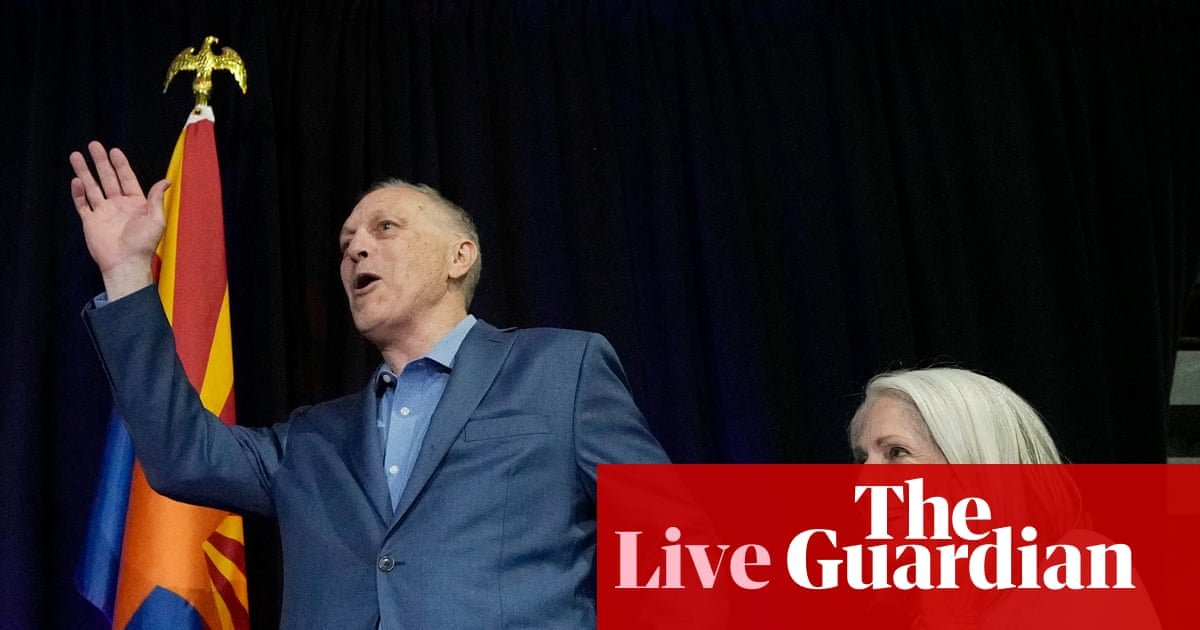
Andy Biggs – a hard-right congressman endorsed by Donald Trump – won the Republican nomination for Arizona governor, saying he will “work with people that don’t necessarily agree with me”.
He will now challenge the incumbent Democrat, governor Katie Hobbs, in a race that is expected to be among the most fiercely contested in the country this fall.
Biggs, a former chair of the House freedom caucus who was a central figure in the effort to overturn Trump’s election defeat, trounced fellow congressman David Schweikert, by appealing to the party’s deeply conservative base.
“Let’s make this the year that we turn Arizona red again,” Biggs said.
Schweikert argued during the campaign that Biggs would continue a decade of Republican backsliding. However, he struggled to raise money and did not even return to Arizona for Election Day, remaining in Washington as the House passed a government funding bill .
Biggs rejected Schweikert’s claim that he’ll be another Republican judged by voters to be too extreme.
“I am a conservative – and a principled conservative – but I work with people that don’t necessarily agree with me on every issue,” Biggs told a reporter after his victory speech.
Throughout the campaign, Biggs and Schweikert offered constrasting visions for reclaiming the governorship. Schweikert, who gave up his toss-up congressional seat to run for governor after eight terms, argued that Biggs’ hard-right politics and unswerving embrace of the president had allowed Democrats to make gains in once-ruby-red Arizona.
Read the full story here:
In other developments:
-
As he wages war on Iran to prevent that country from enriching uranium, Donald Trump has reportedly approved a deal with Saudi Arabia to have US firms build a civilian nuclear energy program in the kingdom, which could include a uranium enrichment facility, US officials told the Wall Street Journal. The deal, which the administration plans to submit to Congress in the coming days, does not include safeguards to stop materials being used in nuclear weapons programs, Reuters reports.
-
The US-Israeli war on Iran has cost the Pentagon $37.5bn so far, defense secretary Pete Hegseth told the Senate Appropriations Committee on Tuesday.
-
“Benjamin Netanyahu is a war criminal, the architect of a horrific genocide against the Palestinian people,” New York mayor Zohran Mamdani said in a video statement in which he called the International Criminal Court warrant for the Israeli prime minister’s arrest justified but admitted that he lacks the legal authority to enforce it.
-
Donald Trump announced a new package of tariffs on Tuesday, this time on generic drugs made overseas, to begin in 2028.
-
The Senate intelligence committee on Tuesday advanced the nomination of Jay Clayton to serve as the US intelligence director, despite criticism from Democrats.
-
The Trump administration paused more than $1bn in Medicaid funding to California and Minnesota, two states run by elected Democrats, citing “suspected fraud and noncompliance”.
Key events
Donald Trump will begin his day in Washington, before traveling to Dover, Delaware at 11am ET for a dignified transfer for the three US service members who were killed in the Middle East during Iranian strikes over the weekend.
The president will then travel to Marietta, Georgia, where he’ll deliver a speech at a local high school at 3pm ET.
A federal appeals panel has reversed a lower court decision ordering the release of pro-Palestinian activist Mohsen Mahdawi, opening the door to the re-arrest of a student protest organizer whom the Trump administration has spent more than a year trying to deport.
Tuesday’s ruling from the second US circuit court of appeals in New York City overturns a previous decision by a federal judge in Vermont, which likened the government’s efforts to expel him and other activists to McCarthyist repression.
In their unanimous decision, the panel found that the judge had overstepped his authority by intervening in Mahdawi’s case before it had moved fully through the immigration court system.
The ruling mirrors a separate appellate panel’s decision earlier this year against Mahmoud Khalil, a former classmate of Mahdawi’s at Columbia University.
As with the ruling against Khalil, the appeals court did not weigh in on the merits of Mahdawi’s claim that he was unconstitutionally targeted for criticizing Israel. He can seek a review from the federal courts over those claims once he has exhausted his options in the immigration courts, the panel wrote.
Sam Levin
The Trump administration has repeatedly accused immigrants and protesters of “weaponizing” their vehicles to “assault” federal immigration agents, a claim used to justify arrests and deadly shootings by officers.
But a Guardian review of 26 cases that the Department of Homeland Security (DHS) has promoted as evidence of a surge in “vehicular attacks” reveals most of those claims have fallen apart under scrutiny, with the accusations consistently disproven by evidence or rejected in court. Only one of the 26 cases has resulted in an assault conviction, according to court records and information shared by prosecutors.
The findings come as DHS and Immigration and Customs Enforcement (ICE) are facing intense scrutiny over the back-to-back fatal shootings of Lorenzo Salgado Araujo in Texas and Joan Sebastián Durán Guerrero in Maine. In both cases, ICE officers killed the men during attempted traffic stops, with DHS arguing the men had endangered officers and the public with their vehicles – claims that witnesses have rejected.
DHS has repeatedly claimed its officers have faced a “3,300% increase in vehicle attacks” under Donald Trump’s second term, but has not provided evidence to support that figure and has not responded to requests for a list of cases.
To better understand how the government’s vehicle assault allegations have been adjudicated over time, the Guardian reviewed the most detailed list DHS has put out: a February press release asserting agents have experienced “more than 180 vehicle attacks” since Trump took office. The 2,100-word release provided summaries of 23 incidents from across the country from June 2025 to January 2026, saying it was a “non-exhaustive list”.
The Guardian looked at records for each case and contacted local and federal authorities and immigration and defense attorneys for more details. We identified 26 people accused in the cases of using their vehicles to threaten, assault or injure immigration officers. Five of them were shot by officers during the encounters, one fatally.
Venezuela’s Nicolás Maduro back to court for pretrial hearing in his US drug trafficking case
Nicolás Maduro returns to court with his lawyers Wednesday and is expected to continue objecting to the US military action that snatched the Venezuelan president from power and deposited him in New York to face drug trafficking charges.
Maduro, 63, and his wife Cilia Flores, 69, have been held at a Brooklyn jail ever since US forces seized them from their Caracas home in a stunning middle-of-the-night raid and brought them to New York in early January.
Both have pleaded not guilty. They face potential life prison sentences if a jury agrees that they were part of a conspiracy to send cocaine into the US, AP reports.
President Donald Trump’s administration has defended the raid as a “surgical law enforcement operation” in a criminal case first brought six years ago. Maduro has called himself a prisoner of war and his capture a kidnapping.
US prosecutors say Maduro carried out a conspiracy to move thousands of tons of cocaine into the US by colluding with Venezuelan law enforcement to help drug kingpins.
“I am not guilty. I am a decent man, the constitutional president of my country,” he said in Spanish at his arraignment in January.
House passes spending bill to head off government shutdown before midterms
Chris Stein
The US House of Representatives on Tuesday approved a stopgap measure to head off a government shutdown until early December, with its Republican leaders seeking to defuse a volatile issue in the run-up to the November midterm elections.
The continuing resolution authorizing government spending until 4 December passed by a vote of 220-205, roughly along party lines. It next heads to the Senate, where it will need to win bipartisan support to clear the chamber.
The government’s current spending authority expires on 30 September, but top Republicans had argued the measure’s passage was necessary to ensure that Democrats do not block government funding measures in the Senate.
They did so last year for a record 43 days in protest against the expiration of tax credits that lowered some healthcare costs, and twice again this year, to push for reforms to immigration enforcement operations after the killings of two US citizens in Minneapolis.
“Our conference refuses to let the obstruction and inaction of Senate Democrats trigger another manufactured shutdown at the end of September. That is why we are acting before a funding lapse crisis, not in response to it,” said Tom Cole, the House appropriations committee chair who spearheaded the resolution.
Earlier on Tuesday, lawmakers agreed to move forward on the stopgap measure and a budget framework paving the way for a $95bn party-line package, in a 214-211 vote roughly along party lines.
Americans far more likely to view politics as greatest threat to safety, study finds
David Smith
Americans are 10 times more likely than people elsewhere in the world to regard politics as the greatest threat to their personal safety, according to a global survey that suggests the country’s deep partisan divisions are poisoning everyday life.
The latest Lloyd’s Register Foundation World Risk Poll found that one in 10 Americans identified politics as the biggest risk they face in their daily lives when asked an open-ended question. The figure is up from 6% in both 2021 and 2023 and well above the global average of 1% across 140 countries.
Although Americans remain far more likely to cite road accidents and crime as the worst dangers they face, the survey found the US to be the only country in which more people named politics than personal health conditions as the biggest risk to their safety.
“The US figure of 10% is unprecedented,” said Benedict Vigers, a senior global news writer at Gallup, which partnered on the research. “No other country ranked higher. It’s 10 times the global average.
“It speaks to how charged the political environment is and has been for many years in the United States that people are now saying that the political situation is not just an issue nationally but is a seeable daily risk to their safety as they go about their normal lives.”
The US has ranked among the countries most likely to cite politics as a personal safety risk in all three waves of the World Risk Poll but 2025 marks the first time it has reached the top of the global ranking.
Trump ally pledges to ‘work with people’ he disagrees with after Arizona primary win
Hello and welcome to the US politics live blog.
Andy Biggs – a hard-right congressman endorsed by Donald Trump – won the Republican nomination for Arizona governor, saying he will “work with people that don’t necessarily agree with me”.
He will now challenge the incumbent Democrat, governor Katie Hobbs, in a race that is expected to be among the most fiercely contested in the country this fall.
Biggs, a former chair of the House freedom caucus who was a central figure in the effort to overturn Trump’s election defeat, trounced fellow congressman David Schweikert, by appealing to the party’s deeply conservative base.
“Let’s make this the year that we turn Arizona red again,” Biggs said.
Schweikert argued during the campaign that Biggs would continue a decade of Republican backsliding. However, he struggled to raise money and did not even return to Arizona for Election Day, remaining in Washington as the House passed a government funding bill .
Biggs rejected Schweikert’s claim that he’ll be another Republican judged by voters to be too extreme.
“I am a conservative – and a principled conservative – but I work with people that don’t necessarily agree with me on every issue,” Biggs told a reporter after his victory speech.
Throughout the campaign, Biggs and Schweikert offered constrasting visions for reclaiming the governorship. Schweikert, who gave up his toss-up congressional seat to run for governor after eight terms, argued that Biggs’ hard-right politics and unswerving embrace of the president had allowed Democrats to make gains in once-ruby-red Arizona.
Read the full story here:
In other developments:
-
As he wages war on Iran to prevent that country from enriching uranium, Donald Trump has reportedly approved a deal with Saudi Arabia to have US firms build a civilian nuclear energy program in the kingdom, which could include a uranium enrichment facility, US officials told the Wall Street Journal. The deal, which the administration plans to submit to Congress in the coming days, does not include safeguards to stop materials being used in nuclear weapons programs, Reuters reports.
-
The US-Israeli war on Iran has cost the Pentagon $37.5bn so far, defense secretary Pete Hegseth told the Senate Appropriations Committee on Tuesday.
-
“Benjamin Netanyahu is a war criminal, the architect of a horrific genocide against the Palestinian people,” New York mayor Zohran Mamdani said in a video statement in which he called the International Criminal Court warrant for the Israeli prime minister’s arrest justified but admitted that he lacks the legal authority to enforce it.
-
Donald Trump announced a new package of tariffs on Tuesday, this time on generic drugs made overseas, to begin in 2028.
-
The Senate intelligence committee on Tuesday advanced the nomination of Jay Clayton to serve as the US intelligence director, despite criticism from Democrats.
-
The Trump administration paused more than $1bn in Medicaid funding to California and Minnesota, two states run by elected Democrats, citing “suspected fraud and noncompliance”.


