



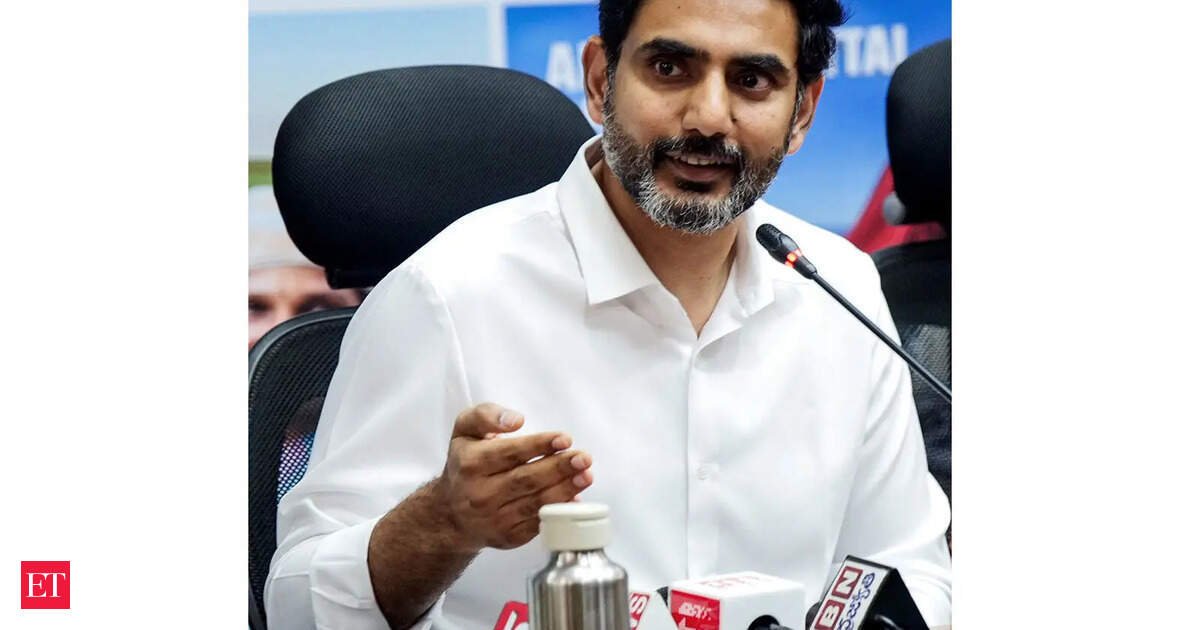
However, Lokesh did not give up. The result is the emergence of a more confident and polished leader, stepping out of his father and Chief Minister N Chandrababu Naidu‘s shadow and making a distinct political identity of his own.
In a politically significant development in the ruling Telugu Desam Party (TDP) in Andhra Pradesh, Lokesh, IT Minister in the Naidu-led cabinet, was appointed as the National Working President on Wednesday.
According to the TDP, positioning the 43 year-old Nara scion firmly at the helm of party affairs indicates a clear roadmap for the its future leadership
It is anybody’s guess that Lokesh would be made Working President of the TDP and eventually will take over the reins from his father. He is also the grandson of TDP founder and former CM, the legendary NT Rama Rao (NTR), and is also closely related to several other ruling politicians.
“I lost from Mangalagiri. But I did not give up. Though my father advised me to choose a safe constituency, I preferred Mangalagiri only because TDP never won from the constituency. I wanted to show that TDP can win from any seat,” he had said in one of the party meetings.
In the current Assembly, he represents Mangalagiri.Rajesh Kilaru, known as Lokesh’s closest confidant and backroom strategist for TDP, has been elevated to National General Secretary, a strong indication Lokesh will have his own team to take the party forward in the future.
Not only Rajesh, young leaders such as Union Minister K Ram Mohan Naidu and Lok Sabha MP Dr Byreddy Shabari have also been designated as national general secretaries.
“The appointment of IT Minister Nara Lokesh as the National Working President underscores a major generational transition within the TDP, positioning him firmly at the helm of party affairs and indicating a clear roadmap for the party’s future leadership,” TDP sources said.
Senior TDP leader and Legislative Assembly Deputy Speaker K Raghu Rama Krishna Raju told PTI that Lokesh’s elevation should have happened much earlier.
“People are very happy. The TDP cadre is also happy. He has been actively involved in the party activities. He is No.2 in the party after the CM. So definitely it will happen (Lokesh eventually taking over leadership from his father), but I cannot say when,” Raju added.
Instead of sulking in the aftermath of the 2019 defeat, Lokesh reinvented himself through physical and personality makeover, coupled with taking the responsibility of restructuring the party right from top to bottom, TDP spokesperson Neelayapalem Vijay Kumar said.
All this reinventing culminated into the “Yuvagalam Padayatra” he took up across the state. He was literally “punished” by the then YSRCP government for no fault of his without even allowing the microphone in the initial days, he claimed.
“Virtually the padayatra of one year catapulted Lokesh from the son of CBN (CM Naidu) to a leader of the party in his own right. The five years of struggle from 2019-24 not only helped him to have a makeover for himself into a lean and fit individual but helped the party to reinvent its real potential and reach the shores of victory in 2024,” Vijay Kumar told PTI.
The imprint of Lokesh’s leadership is widely seen across the restructuring exercise. Building on the vision articulated during the party’s “Mahanadu” meeting, Lokesh has translated the slogan “cadre is the leader” into a functional principle, party sources said.
Over the past year, as former general secretary, his focus has been on cadre welfare and recognition and the same can be seen in the party’s newly announced organisational structure that opens up leadership pathways for grassroots karyakartas, TDP sources said.
The newly constituted organisational structure of TDP includes a 29-member Politburo, a 31-member National Committee, and a 185-member State Committee. The committees have been formed after extensive deliberations, factoring in social, regional, and political balance, while keeping long-term goals, including the 2029 elections and potential constituency reorganisation, in mind, TDP said.


