


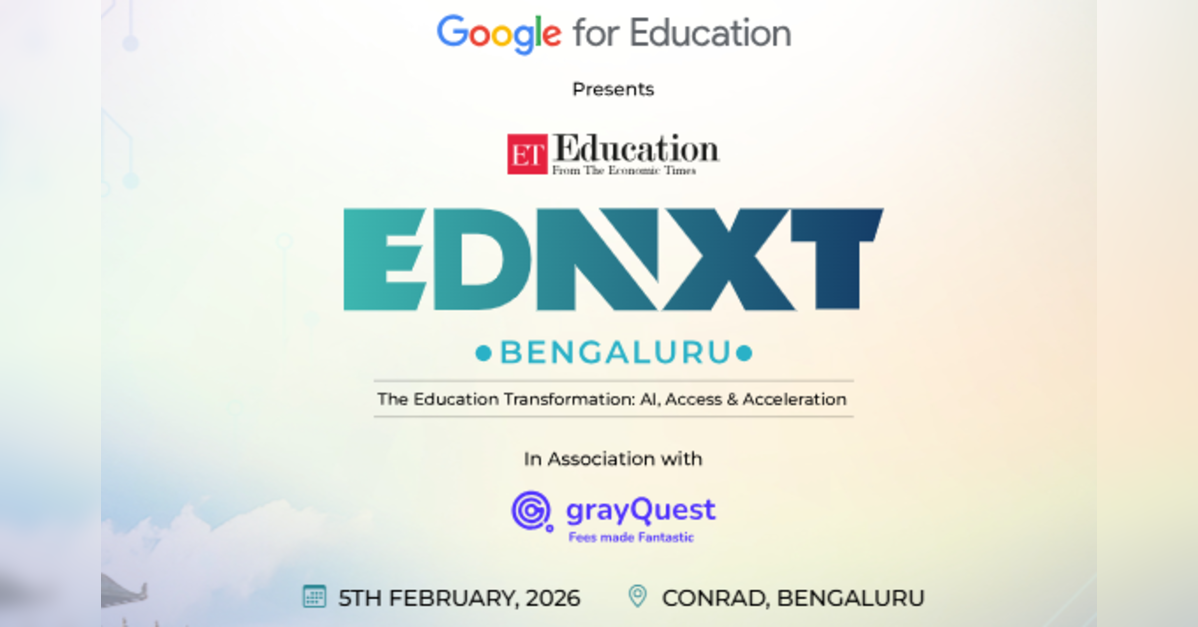
Bengaluru, India – The 7th edition of EDNXT Bengaluru 2026, organised by The Economic Times Education, concluded on a high note on Friday, bringing together a diverse cross-section of education leaders, institutional heads, policymakers, corporate innovators, and academic thinkers. Hosted at a pivotal moment in India’s education transformation journey, the summit witnessed robust participation that surpassed estimated delegate numbers, drawing a total of 684 delegates from school education, higher education, corporate leadership, and partner organisations. The resounding turnout and deep engagement underscored the event’s strategic importance as a forum for shaping the future of learning in an AI-transformed world.The summit commenced with a powerful welcome address titled “The Education Transformation: AI, Access & Acceleration” delivered by Yasmin Taj, Editor (Education & HRWorld), The Economic Times. Setting the strategic tone for the one-day summit, she reflected on how artificial intelligence is no longer a peripheral tool but a foundational force redefining access, equity, institutional strategy, and learner outcomes. Emphasising acceleration with accountability, she highlighted the need for education systems to move beyond experimentation toward systemic AI integration that balances innovation with inclusion.The summit opened with an inspiring inaugural ceremony that set the tone for two days of rich dialogue on policy, innovation, and institutional impact. Mohammad Mohsin, Additional Chief Secretary, Medical Education, Health and Family Welfare, Government of Karnataka, delivered a compelling address on integrating technology and clinical learning pathways in educational ecosystems. Khushboo Goel Chowdhary, Secretary, Higher Education Department, Government of Karnataka, emphasised the state’s commitment to inclusive and future-ready higher education reform, particularly around AI diffusion across campuses and research ecosystems. Prof U Dinesh Kumar, Director, IIM Bangalore, provided an academic perspective on translational research and leadership development. Deepankar Bhattacharyya, Senior General Manager and Country Head – Education, Nemetschek Group, shared insights on how digital design and engineering tools are reshaping pedagogical practices. These dignitaries collectively outlined a vision that embraced governance, institutional accountability, and learner-centric innovation.Across the higher education hall, EDNXT presented a series of dynamic discussions that explored the intersections of AI, pedagogy, research, and institutional strategy. The summit’s panel 1 “Empowering the educator — Faculty readiness in an AI-transformed higher education system brought together esteemed academic leaders committed to reimagining faculty roles in the era of intelligent systems. The panel included Prof B Ravi, Director, NIT Surathkal; Prof (Dr) Annapurni Subramaniam, Director, Indian Institute of Astrophysics, Bengaluru; Dr Ajith Padyana, Program Director, Visvesvaraya Technological University, Karnataka; DP Nagaraj, Pro Chancellor, RV University, Bengaluru; Abhay G Chebbi, Pro-Chancellor, Alliance University; and Prof Basuthkar Jagadeeshwar Rao, Vice Chancellor, University of Hyderabad, with Shantheri Mallaya, Editor – News, ETCIO & CISO, moderating the session. In this dialogue, panelists reflected on the transformative potential of AI when coupled with meaningful faculty development, the importance of change management in higher education, and the need for strategic digital integration across disciplinary boundaries.
Following this, expert talks on topics such as “Learning in the AI Era” by Sanjay Jain, Country Head – Google for Education, India, and “AI-Enabled Universities — What AI Is and What Comes Next” by Sumit Bhat, Founder & CEO, Coding Pro, provided audience members with sharp insights into evolving technological, organisational, and cognitive paradigms in contemporary academia. GuruTeja K, General Manager at GrayQuest, led a session on transforming fee collection systems, while Neeraj Panjwani of TruScholar unpacked innovations around credentials, careers, and credentialing frameworks powered by AI and blockchain.
The second higher education panel, India and the World: The next evolution of global higher education partnerships, explored pathways for strategic international alliances and knowledge exchange. The panel featured Dr Sekar Viswanathan, Vice President, Vellore Institute of Technology; Prof MR Gangadhar, Vice Chancellor, Chamarajanagara University; Salman Ahmed, Vice President, Presidency University; Dr Narayani Ramachandran, Director, SVKM’s Narsee Monjee Institute of Management Studies, Bengaluru; Jaysheel Singh, Chief Business Officer, IndiqAI; Gaurav Modi, Vice President, Vertoz Ltd; and Sharath Chandra, Deputy Manager – Business Development, Meritto, with moderator Yasmin Taj, Editor – Education & HRWorld. This panel underscored the urgency of building collaborative partnerships that elevate India’s global academic footprint while responding to workforce imperatives.
Throughout the afternoon, panel 3: Accelerating innovation — How AI and interdisciplinary research are powering the next wave of knowledge creation convened an esteemed group of chancellors, vice chancellors, and research leaders to discuss how AI is amplifying cross-disciplinary research outputs and industry applicability. Panelists included Dr SN Sridhara Col (Hon Retd), Vice-Chancellor of Adichunchanagiri University; Prof Ashok S Alur, Vice Chancellor, Kodagu University; Prof Amit Banerjee, Chancellor, Siksha ‘O’ Anusandhan University; Dr Madhavan Rajeevan, Vice Chancellor, Atria University, Bengaluru; Dr G Pardha Saradhi Varma, Vice Chancellor, KL University; Dr P Varalakshmi, Director – AI & Data Science Research at Anna University, Chennai; and education technology leaders Srinivasa Rao Poladi, Rishab Mehta, and Srikanth Yellapragada. This session vividly illuminated how interdisciplinary projects and AI-driven methodologies are reshaping the generation, dissemination, and application of new knowledge.
The higher education discourse continued with panel 4: Beyond academics — How India’s universities are competing on campus life and student experience, featuring Nishtha Shukla Anand of Shoolini University, Rajiv Tandon of BITS Pilani, Prof Sanjay Kumar Singh of IIT BHU, Dr Monit Kapoor of Amity University Bengaluru, Prof Manoj P of Amrita Vishwa Vidyapeetham, Sohom Dutta of Scholar Z by Elevate, and Revathy Dayanand of Curated Living Solutions. In focus were the holistic determinants of student engagement, campus culture, residential life, and well-being — all critical in attracting and retaining talent in today’s competitive higher education marketplace.
The final higher education panel, From automation to intelligence: How AI is rewriting the higher education experience, brought together Dr Easwaran Iyer, Vice-Chancellor, Arka JAIN University; Dr Prakash Sheelvanthmath, Pro Vice Chancellor, Dayanand Sagar University; Prof Kishor Buddha, Director – GITAM School of Core Engineering, Bengaluru; and Dr Ayatakshee Sarkar, Assistant Professor at XLRI Jamshedpur, with Vaishnavi J Desai, Senior Assistant Editor – Emerging Tech, ETCIO & CISO, moderating. The discussion examined AI’s role beyond administration — as an engine shaping personalised learning, student support, research administration, and future leadership competencies.
In parallel, the school education track of EDNXT Bengaluru 2026 presented a highly interactive portfolio of panels and expert discussions centred on how AI, pedagogy, and digital equity are shaping foundational learning environments. The inaugural keynote in the school hall was delivered by V Rashmi Mahesh, Additional Chief Secretary, Department of School Education and Literacy, Government of Karnataka, who outlined the state’s strategic vision for integrating AI into classroom practice, improving access, and advancing capacity-building among educators.
The school summit’s Panel 1: From smart tools to smart learning — How AI is Reshaping School Education assembled thought leaders including Aisshwarya DK Hegde of the National Education Foundation, Anishkaa Malpani of Dhruv Global School Pune, Anupama Ramachandra of DPS Electronic City, Anuradha Krishnan of Ebenezer International School, Dr. Gowri Prabha Prasad of Gurukul High School & Bangalore Sahodaya Schools Complex Association, Dr Ritu Chauhan of MEGA International Schools, Sumit Bhat of Coding Pro, and Rishab Mehta of GrayQuest, moderated by Dr Manjula Raman. Discussions centred on translating AI tools into learner-centric, outcomes-oriented classroom practices while preserving foundational pedagogical integrity.
Following this, an expert talk on Achieving 21st Century Educational Excellence Using AI by Dr Kandathil Jacob of Sambhuti Learning and an engaging session on Digital Creativity & AI in NEP 2020 Implementation by Raghuram CG of Adobe illustrated how creativity and technology are converging to unlock student potential. Additional expert contributions from Tejas Nandarshi of Siemens Digital Industries Software and Dr Sankar N Krishna of Ether expanded these insights into industry pathways and home-connected learning loops.
The second school panel, From Curriculum to Competencies: Accelerating Future-Ready Learning in Schools, featured Dr Nafeesa Ahmed of Presidency Group of Institutions, Saahil Ahmed of TCIS Group of Schools, Joe Lumsden of Stonehill International School, Dr Suja Bennet of Ekya Schools, Dr Sowmya Narayanan of Inventure Academy, Shahista Ismail of FloMont World School, Dr Shivananda CS of Bangalore International School, and Shruti Lohia of WealthVidya, with Pinkey Singh of Royale Concorde International School moderating. Their conversation emphasised competency-based learning, culturally responsive curricula, and pathways that link academic concepts with real-world applications.
In the afternoon, panels addressed Bridging the Digital Divide in School Education, Project-Based Learning for Inclusive Growth, and Industry-Aligned Pathways from Campus to Career, featuring leaders in school leadership, HR strategy, and corporate talent development. These sessions illuminated the demand for integrated learning ecosystems that prepare learners both for academic success and for the evolving demands of tomorrow’s workplaces.
A highlight of EDNXT Bengaluru was the Google for Education Exclusive Lunch Roundtable, where Vice Chancellors and senior academic leaders engaged in a closed-door strategic dialogue on The AI Activation Roadmap: Deploying Gemini. Participants included Prof Basuthkar Jagadeeshwar Rao of the University of Hyderabad, Brijesh Nair of VIT Bengaluru, Prof Sanjay Kumar Singh of IIT BHU, Dr P Varalakshmi of Anna University Chennai, Prof Manoj P of Amrita Vishwa Vidyapeetham, Rajiv Tandon of BITS Pilani, Nishtha Shukla Anand of Shoolini University, Dr Monit Kapoor of Amity University, and others. The session underscored shared institutional challenges, success stories of implementation, and collective strategies for scalable AI integration across campuses.
By the close of EDNXT Bengaluru 2026, delegates converged on the urgency and opportunity that the AI era brings to Indian education — from classrooms to research laboratories, from policy corridors to corporate boardrooms. The summit’s rich discourse, cross-sectoral participation, and actionable insights marked a landmark in India’s educational transformation narrative.
The Economic Times Education continues its mission to convene leaders who are pairing bold vision with operational execution. With EDNXT Bengaluru 2026 forging new relationships and catalysing innovation, the future of learning in India remains robust, inclusive, and unmistakably forward-looking.


