



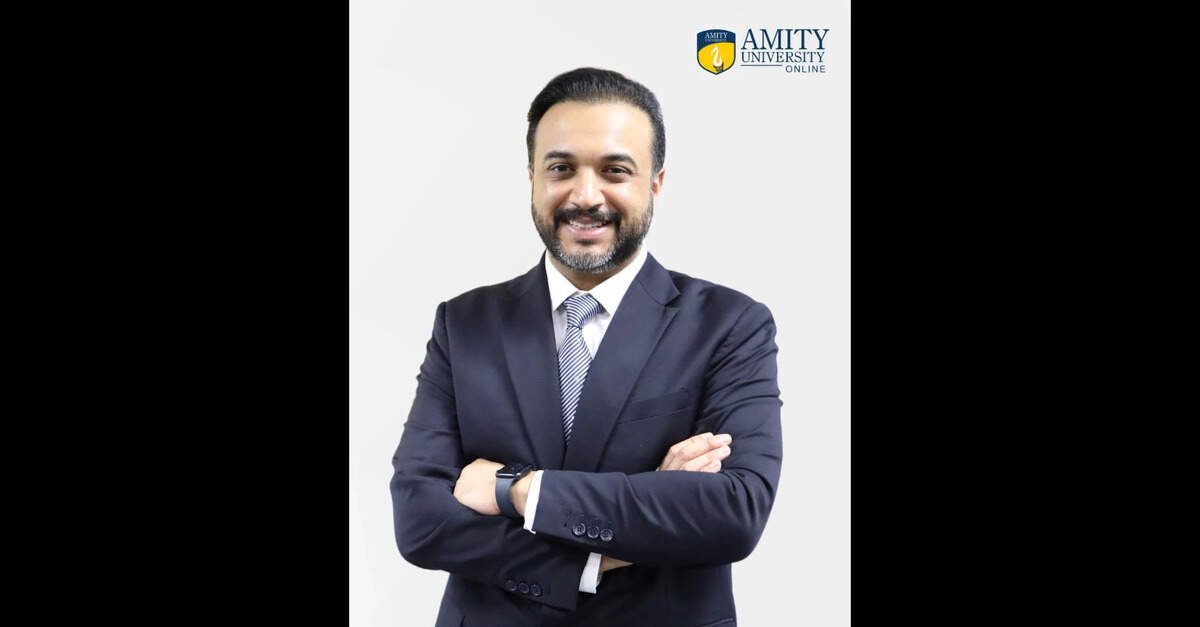
By Ajit Chauhan
For decades, higher education in India has been shaped by the experience of learning on a physical campus. Universities have brought learners together with faculty, peers and opportunities, while also creating vibrant academic communities. But for learners in Tier II and Tier III cities, pursuing a program at a university of their choice would sometimes involve relocating to another city. Access to opportunity was therefore closely connected to geography.
Today, technology is expanding that equation. Educational opportunities can now travel to the learner, opening new pathways to quality programs, distinguished faculty and career opportunities without making physical relocation a prerequisite.
India has spent the last 79 years since Independence, steadily changing that reality. From just 30 universities and 578 colleges in 1950-51with a Gross Enrolment Ratio (GER) of 0.4% to asystem that today enrols 4.5 crore students, with GER crossing 30% for the first time.
Yet the most significant transformation is not simply one of scale. It is one of access.
A working professional can return to university without leaving a job. A woman restarting her career after a break need not fit into a conventional campus timetable. A learner in a smaller city can increasingly access faculty, academic resources and career support once concentrated in larger urban centers. Regulation has evolved too: recognised online undergraduate and postgraduate degrees are treated as equivalent to corresponding conventional degrees, and learners within or outside India can enroll in recognised online programs.
This is more than a regulatory milestone. It represents a new idea of educational freedom – one where opportunity is determined less by where a learner lives and more by what they aspire to become.
The new lifecycle of learning
For generations, education followed a predictable path: earn a degree in your early twenties, begin your career and build on that foundation for decades. That model no longer reflects the realities of today’s economy.
Careers are becoming longer, more dynamic and increasingly non-linear. Professionals return to education at different stages of their lives – to prepare for leadership roles, transition into new industries or acquire capabilities that did not exist when they graduated. In this new reality, where entire sectors are being reshaped by technology - a qualification earned at twenty-two can no longer sustain a forty-year career. Degrees have been, and will always remain foundational, but they are increasingly being complemented by shorter, stackable credentials that allow professionals to continually refresh their skills as industries evolve.
The challenge, however, is not simply enabling lifelong learning through credentials. It is delivering it at a scale that matches India’s aspirations. Supporting millions of learners – each with different goals, schedules and learning needs, requires a fundamentally different model of education. Universities must be able to provide personalised academic guidance, timely interventions, industry specific credentials, flexible learning pathways and robust assessment, irrespective of where or when or even how a learner chooses to study. That, to my mind, is the true meaning of educational freedom.
Expanding access for all
The impact of greater access is already becoming visible. Women’s participation in higher education now exceeds men’s, and has done so for seven consecutive years, with female GER at 31.2 against 30.0 overall. That is not a marginal shift. It is what happens when an obstacle is removed.
The same principle applies to geography. When distance ceases to determine access, participation from smaller cities and towns expands rapidly.
Together, these shifts point towards a larger transformation. Higher education is evolving from a collection of physical campuses into a connected academic ecosystem where learners from different cities, professions, life stages and countries can learn together.
Building the world’s largest digital campus is not about replicating a physical campus on a screen; the ambition is to create an academic ecosystem that combines flexibility with quality, accessibility with credibility, and technology with meaningful human engagement.
The road to 2047
NEP 2020 has set an ambition of 50% GER by 2035. The learners who take India closer to it will increasingly be working professionals, learners across Tier II and Tier III India, women returning after career breaks, and people coming back to education at different stages of life.
As India moves towards Viksit Bharat 2047, our greatest competitive advantage will not simply be a young workforce, but a workforce that never stops learning. In the decades ahead, India’s success will depend on an education system that evolves as quickly as its economy - one that enables its citizens to continuously learn, adapt and grow.
At 79 years of independence, educational freedom is acquiring a broader meaning: location does not have to limit opportunity; age does not have to close the door; and learning does not have to fit within a traditional timetable or campus. By combining scale, academic quality, enabling regulation and technology, India is beginning to shape a model of lifelong higher education that others may increasingly want to learn from.
Ajit Chauhan is the Chairman of Amity University Online.
DISCLAIMER: The views expressed are solely of the author and ETEDUCATION does not necessarily subscribe to it. ETEDUCATION will not be responsible for any damage caused to any person or organisation directly or indirectly.


