


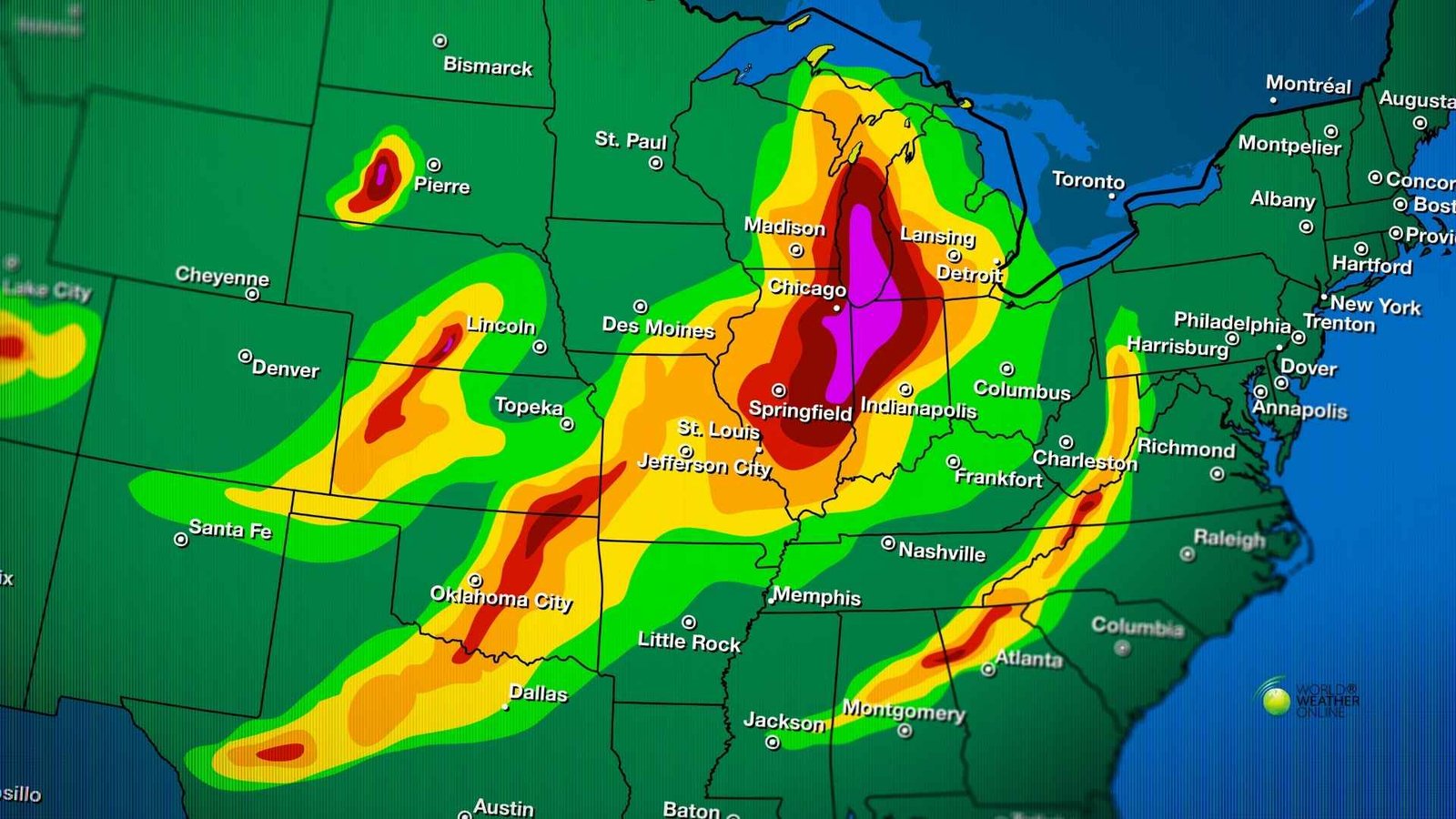
Across the United States, spring has always carried a perilous edge. Warm Gulf moisture surges north, cold air pushes down from Canada, and a powerful jet stream often turns the central states into a battleground of clashing air masses. However, during this year, 2026, that familiar spring pattern has felt unprecedently brutal.
Severe thunderstorms have produced tornadoes, giant hail, destructive winds, flash flooding, power cuts, and battered homes. Affected areas include Texas, Oklahoma, Missouri, Wisconsin, Illinois, Mississippi, the wider Plains, and especially the Midwest. This is not just about the violent storm, but about the repeated nature of outbreaks. Communities have little time to clear debris before another round of warning lights up the radar.
Six Days That Showed the Scale of the Threat
One of the most conspicuous examples came in North and Central Texas between April 24 and April 29, when severe storms struck for six consecutive days. The National Weather Service also recorded more than 570 reports of these heinous weather events. Moreover, 10 tornadoes had been confirmed from that outbreak alone.
One of the strongest of them hit Mineral Wells, Texas. It was rated EF3 due to its powerful winds that destroyed well-built homes, snapped large trees, and greatly damaged commercial buildings. Although the storm injured several people, no deaths were reported. Still, it is a frightening reminder that even in a country with advanced forecasting, a tornado can turn an ordinary evening into a disaster within a few minutes.
The Situation of Hail
Usually, hailstorms receive less attention than tornadoes. But this time, hail has been one of the most obliterating events of America’s severe weather crisis. During the Texas outbreak, hail reports dominated the storm logs. Due to repeated ice falling from the sky, vehicles were dented, roofs were battered, and windows were severely smashed.
Especially in Missouri, the situation was even more dramatic. Around Springfield, hailstones reached about 5 inches across. These were large enough to shatter windshields and cause serious injury to anyone caught outside. It was undoubtedly one of the costliest hail events in the city’s history. Scientifically, giant hail of this size forms inside powerful thunderstorm updrafts where ice is repeatedly lifted and coated with supercooled water before finally falling to the ground.
The Midwest and Great Lakes Are Already Busy
Not every dangerous storm produces a tornado. Straight-line winds can also be just as destructive as others, especially when they sweep across wide areas. Usually, gusts above 60 mph can topple trees, tear shingles from roofs, bring down power lines, and scatter debris across roads. When these winds are stronger, they can travel across multiple states, leaving a long trail of damage behind.
This weather pattern was not limited to Texas, as Chicago was also engulfed by the severe-weather season. By the third week of April, it experienced 11 individual thunderstorm events compared with a normal early-season average of around four. Around 128 severe thunderstorm and tornado warnings were also issued by the day it struck Chicago.
This matters because the severe-weather map in the U.S. is no longer understood through the old idea of one narrow “Tornado Alley.” Traditional tornado-prone states such as Texas, Oklahoma, and Kansas remain highly exposed, but damaging storms are also repeatedly affecting the Midwest, Great Lakes, Mississippi Valley, and the Deep South.
Mississippi’s Rain-Wrapped Tornado Warning
In the first week of May, Mississippi faced another dangerous round. Tornadoes struck the southern parts of the state, damaging hundreds of homes and apartments and injuring 17 people, as per credible emergency reports. The storms were especially dangerous because some tornadoes were rain-wrapped, meaning heavy rain hid the funnel and made it much harder for people to see the threat approaching.
That is one reason tornadoes in the Deep South can be particularly deadly. Low cloud bases, trees, hills, darkness, and heavy rain can reduce visibility. Many communities also have mobile homes or weaker structures that offer limited protection. In these situations, waiting to actually “see” a tornado before taking shelter can be a fatal mistake.
Why Are the Storms So Explosive?
Severe thunderstorms need several ingredients like warm, moist air near the surface, colder air above, strong winds changing with height, and a trigger such as a dryline, cold front, or upper-level disturbance. Especially during spring, the U.S. often has all of these ingredients in abundance.
Moreover, warm Gulf of Mexico moisture feeds thunderstorms with energy. Strong jet-stream winds help storms rotate, while sharp temperature contrasts create instability. When these ingredients overlap, supercell thunderstorms can form. This is the type most capable of producing large hail, damaging winds, and strong tornadoes.
Climate change adds another layer of concern. Meteorologists and scientists are still studying how warming affects tornado frequency. However, there is a fact that a warmer atmosphere can hold more moisture, which can intensify heavy rainfall and create more fuel for severe storm environments. The result is not always more tornadoes everywhere, but the atmosphere is increasingly loaded with ingredients that can make outbreaks more dangerous when conditions align.
How to Stay Safer This Severe Weather Season
The most important step is to take warnings seriously. A tornado warning means shelter immediately in a basement or an interior room on the lowest floor, away from windows. Mobile homes are not safe during tornadoes, so residents should know their nearest sturdy shelter before storms arrive.
For hail and damaging winds, you should move vehicles under cover when possible, stay away from windows, bring outdoor items inside, and avoid driving through storms unless extremely necessary. Every household should keep a basic emergency kit with water, flashlights, batteries, medicines, phone chargers, important documents, and a way to receive weather alerts even if power or mobile service fails.
In a nutshell, America’s severe storm season is a warning written in twisted metal, broken glass, uprooted trees, and damaged homes. Tornadoes, giant hail, and destructive winds are not rare background threats anymore. They are fast-moving, expensive, and sometimes deadly realities of spring. In fact, forecasts can give people time, but preparation is what turns that time into protection.
