


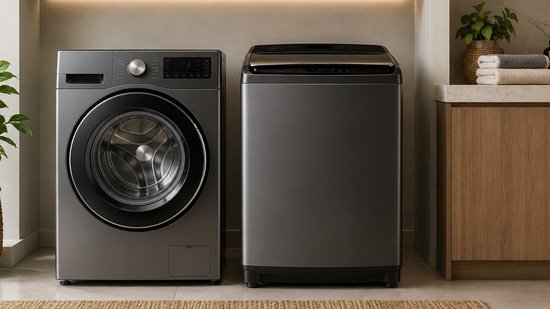
For decades, the choice was simple: buy a top-loader if you were on a budget, or a front-loader if you wanted the “best.” But as we move through 2026, that binary choice has evaporated. With the rise of AI-driven sensors, volatile energy prices, and the “right to repair” movement, the machine that made sense five years ago might be a liability today.
Buying a washing machine is no longer a “set it and forget it” purchase. It is a 10-year commitment to your utility bills, your wardrobe’s lifespan, and your own physical comfort. This guide deconstructs the mechanical, financial, and practical realities of both formats to help you decide which one genuinely fits your 2026 lifestyle.
And once your decide which one suits you the best, we have also listed the top washing machines deals from Amazon Great Summer Sale 2026 to help you shop.
The 2026 washing machine cheat sheet: Which one wins?
If you only have 30 seconds, here is how the two heavyweights stack up in today’s homes:
Front load vs top load washing machine: How they actually clean
Before we talk about “smart” features, we have to talk about physics. The way these machines move water determines everything else.
Front load: The gravity method
Front-load machines operate on a horizontal axis. As the drum turns, clothes are lifted to the top and dropped into the shallow pool of water at the bottom. This is called tumble action.
Why it matters: It mimics the gentle hand-scrubbing of a washboard. There is no central post (agitator) to snag sleeves or stretch out necklines.
Wish to upgrade to a front load washing machine? Amazon Summer Sale is Live: Check out the best deals on front load washing machines here.
Top load: The vortex method
Top loaders use a vertical drum. In 2026, you’ll find two types: Agitators (the classic central pole) and Impellers (a low-profile disc at the bottom).
The Agitator: This is the “heavy-duty” king. It moves clothes forcefully. Great for mud, terrible for lace.
The Impeller: This creates a whirlpool (vortex). It’s gentler than an agitator but still relies on clothes rubbing against each other to get clean.
Wish to upgrade to a top load washing machine? Amazon Summer Sale is Live: Check out the best deals on top load washing machines here.
The 2026 washing machine efficiency audit: Water, power, and price
With utility companies worldwide moving toward Real-Time Pricing (RTP), when and how you wash clothes impacts your monthly budget.
Water usage
A front-loader typically uses 35% to 50% less water than a top-loader. Because the drum doesn’t need to be fully submerged for the clothes to move, it only uses enough water to keep the fabrics saturated. In cities with water tankers or strict meters, this is the single biggest selling point.
Energy consumption
While front-loaders are “efficient,” they often have much longer cycle times (sometimes 2 hours for a heavy load). In 2026, energy-star ratings now account for the internal heater. Since front-loaders almost always heat their own water to precise temperatures (like 30°C or 40°C for optimal enzyme activation), they can actually spike your peak-hour electricity bill more than a quick, cold-wash top-load cycle.
Fabric longevity: Protecting your investment
Fast fashion is dying; “Buy Better, Wear Longer” is the 2026 mantra.
Front load washing machines are objectively better for your clothes. The tumbling action causes significantly less friction. If you wear high-end cotton, delicate silks, or technical activewear (like GORE-TEX), a front loader will keep those fibers intact for years longer.
Top Load washing machines are the “stress testers.” The twisting and pulling motion can cause “pilling” on sweaters and micro-tears in thin fabrics. However, for towels, bedding, and denim, the aggressive motion of a top loader often feels “cleaner” to the touch.
The ergonomics of laundry: Don’t ignore your back
This is where the marketing brochures fail you. You need to consider the physical act of doing laundry.
Top load washing machines: Zero bending: You stand upright. You drop clothes in. You pull them out. For the elderly, or those with lower back issues, this is a non-negotiable advantage.
Front load washing machines: The squat: Unless you spend an extra portion from your wallet on a pedestal to raise the machine, you will be kneeling or crouching every single time you load and unload. Over a decade, that’s thousands of squats. Is your back ready for that?
Maintenance and mold
In my experience, one issue has always dominated the front-load washing machines: The Smell.
The front-load gasket problem
Front loaders must be airtight to prevent leaks. This means the rubber gasket around the door stays wet long after the wash is done. If you don’t leave the door open and wipe the seal regularly, mold will grow. In humid climates, this can become a persistent battle.
The top-load simplicity
Top loaders are not airtight. Gravity keeps the water down, and the lid doesn’t need a vacuum seal. Moisture evaporates naturally out of the top. They are much more “forgiving” for owners who want to set it and forget it.
AI and smart features: What’s hype and what’s helpful?
In 2026, “AI” is the biggest buzzword in appliances. Here’s what actually works:
Auto-dosing: Available mostly on front loaders. You fill a large reservoir with detergent once a month, and the machine “decides” how much to use based on water hardness and soil. This saves a fortune in wasted detergent.
Microplastic filters: Many 2026 front-load models now come with built-in filters to catch synthetic fibers before they hit the ocean.
Remote start/diagnostic: Both types now offer phone integration. Useful? Rarely. But the diagnostic alerts (telling you exactly which part is broken) can save you a heavy “investigation fee” from a technician.
Space planning: The modern apartment dilemma
Space is the ultimate luxury.
Stackability: Front loaders can be stacked with a dryer. This frees up 50% of your floor space. In a modular 2026 apartment, this is often the deciding factor.
The top-load footprint: You can’t put anything on top of a top loader. You need “swing room” above the machine. However, they are often narrower, fitting into tight corners where a front-loader’s wide-swinging door wouldn’t have room to open.
Front load vs top load washing machine comparison breakdown
Common washing machine buying mistakes to avoid in 2026
Over-buying capacity: A 12kg machine sounds great until you realise you’re running it half-empty, wasting massive amounts of water and energy. For a family of four, 8kg–9kg is usually the sweet spot.
Ignoring hard water: If you live in an area with “hard” water (high mineral content), front loaders can suffer from scale buildup on the internal heating element. Ensure you have a descaler or a machine with a dedicated “Hard Water” mode.
Forgetting the “add-garment” feature: There is nothing more frustrating than starting a 90-minute front-load cycle and finding a dropped sock on the stairs. Look for models with a “Reload” button or a small access hatch.
Buy a front load washing machine if
You view your clothes as an investment. You want the lowest possible water bill, you enjoy the “premium” look of a modern utility room, and you don’t mind the occasional deep-clean of the rubber seals. It is the machine for the meticulous homeowner.
Buy a top load washing machine if:
Time and physical ease are your priorities. You need to get through three loads of laundry on a Saturday morning, you don’t want to bend down to move heavy wet blankets, and you want a machine that is easy and cheap to repair if something goes wrong. It is the machine for the practical, high-traffic household.
In 2026, the “best” washing machine isn’t the one with the most AI sensors or the sleekest glass door. It’s the one that integrates into your life without causing friction. Before you buy, measure your space, check your water pressure, and be honest about how much you hate bending over.
Common 2026 use cases: What should you choose?
I live in an apartment with hard water and low pressure. Which machine survives longer?”
In this scenario, a top load machine is the safer bet. Front loaders rely on internal heaters and complex valves that are highly sensitive to mineral buildup from hard water. Furthermore, front loaders often “error out” if water pressure is inconsistent. Top loaders use simple gravity-fed mechanisms that are far more resilient to poor water conditions and easier to descale manually.
I have a toddler and do laundry almost every day. Which is better for ‘quick’ messes?
The top load machine wins for high-frequency “chaos” laundry. Most top loaders offer a 30-minute “Quick Wash” that actually cleans, whereas a front loader’s quick cycle often skips deep rinsing. Additionally, the ability to pause a top loader to toss in a forgotten bib or sock mid-cycle is a lifesaver for busy parents that front-load doors often prevent.
I’m moving into a tiny studio apartment. How do I maximise my laundry space?
A front load machine is the only logical choice for micro-living. Because they don’t require top-lid clearance, they can be tucked under kitchen counters or “stacked” vertically with a dryer on top. This frees up valuable floor space for storage. In 2026, many brands also offer “All-in-One” front-load washer-dryers, which eliminate the need for a second appliance entirely in compact homes.
Similar stories for you
The Research & Expertise
I’ve been covering consumer technology and home appliances for several years and have closely tracked how washing machines have evolved in Indian households, from basic semi-automatic models to AI-powered fully automatic machines with smart diagnostics and fabric-specific wash technologies.
For this guide, I researched multiple top load and front load washing machines across different price ranges, capacities, and feature categories from brands like Samsung, LG, Whirlpool, and more.
I compared aspects such as wash performance, water and energy efficiency, inverter motor technology, drum design, spin speeds, smart features, noise levels, maintenance requirements, and overall usability in real Indian home conditions. I also analysed buyer reviews, service feedback, and long-term user experiences to understand reliability, fabric care, and everyday practicality. Like all HT journalists, my recommendations and insights are based entirely on independent research, hands-on understanding of the category, and consumer relevance.
Disclaimer: At Hindustan Times, we help you stay up-to-date with the latest trends and products. Hindustan Times has an affiliate partnership, so we may get a part of the revenue when you make a purchase. We shall not be liable for any claim under applicable laws, including but not limited to the Consumer Protection Act, 2019, with respect to the products. The products listed in this article are in no particular order of priority.
