


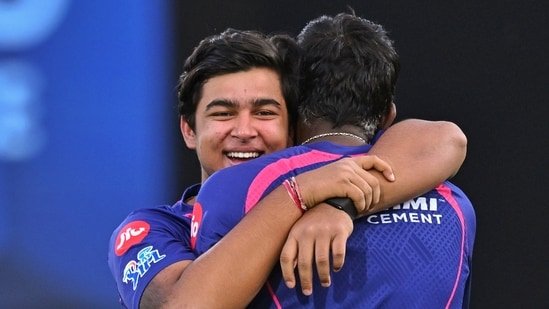
Vaibhav Sooryavanshi’s last appearance in the 2025 Indian Premier League (IPL) was both heartwarming and concerning. Heartwarming because it showed him in conversation with Rahul Dravid, and concerning because The Wall said something that stayed not only with the youngster but also with fans. “Next year will be crucial. It will be a real test for you because opposition bowlers would have figured you out.” By then, Sooryavanshi had already made headlines by becoming the youngest player ever to score an IPL century, but it appears he took those words seriously. That is perhaps why, a year later, Sooryavanshi remains far from easy to dismiss or contain. This season, he has already scored a century, two fifties and amassed more than 400 runs. And the season is far from over.
Even though Dravid parted ways with Rajasthan Royals, the franchise understood the weight his views carried. They made sure Sooryavanshi stayed in tune with the evolving demands of the game. The youngster even sacrificed his Class 10 board exams to join RR’s training camp and, despite already having scored centuries in England, Australia and South Africa, along with a match-winning 175 in the Under-19 World Cup final, continued to devote extra time to refine and nurture his game.
“Everybody predicted that he would not have a good second season in the IPL. And that was a very big motivating factor in terms of how we can get him ready, given now everybody knows his game, and how to counterattack him. What do we do to get one step ahead? He is intuitive and extremely intelligent. He is incredibly sharp. He would remember every tiny detail of every tiny ball bowled to him. Very specific, very well planned, always ready for what might happen and great with scenarios. It’s a combination of things you don’t get together,” Zubin Bharucha, Sooryavanshi’s mentor and RR’s former director of cricket, told Wisden.
RR started working on Sooryavanshi way in advance
It was not as if Rajasthan Royals only began working on Sooryavanshi after the season ended. The process started the moment the franchise spotted him. Bharucha revealed that when Sooryavanshi first came in, everything was documented, right from his bat speed and swing speed to his impact points. His bat swing speed hovered around 90 to 95 kmph. The Royals knew they needed to get more out of him in terms of speed and the way he used his bat. If anything, his bat speed needed to be the quickest among his peers because there are so many moving parts in his game that the faster it gets, the more it enhances his ball-striking ability.
“We worked on it very diligently. We used heavy bats, outfield drills where he was encouraged to hit every ball for six, and multiple-layered sequencing drills. Within three to four months, we saw his bat speed jump from the 92-95 range to nearly 110-115 kmph. That’s massive. In bat speed terms, that’s one hell of a leap. Those were the kind of improvements we focused on. Then came the second layer, which was his ability to access different balls,” said Bharucha.
“He was a little tilted towards the off-side initially, so there were a lot of off-side shots in his game and not many on the leg. We had to work on that. Even now, against fuller balls on middle stump through midwicket and square leg, he is probably not as comfortable as he could be. But we have made him substantially better than where he was.”
Sooryavanshi didn’t have the cut shot
Interestingly, Sooryavanshi did not have a cut shot in his arsenal. He never really played it because his bat flow did not allow for it, relying more on the backfoot drive instead. But one of the first conversations the Royals had with the youngster was that once he started dispatching length balls out of the park, bowlers would stop feeding him those deliveries. At the next level, bowlers would come hard at him, especially around the head, and RR knew they needed to prepare him for that.
“I do not think he had ever played an upper cut or even a proper cut shot before. He probably never needed those shots at the level he was playing. Those are the kinds of things we started introducing into his game.
“From a systems perspective, we always monitor the number of balls a player faces every day, every week and every month. Players like Yashasvi Jaiswal, Dhruv Jurel, Riyan Parag and Sanju Samson have all gone through thousands and thousands of repetitions and faced thousands of balls in training. We simply put him through the same process,” added Bharucha.
