


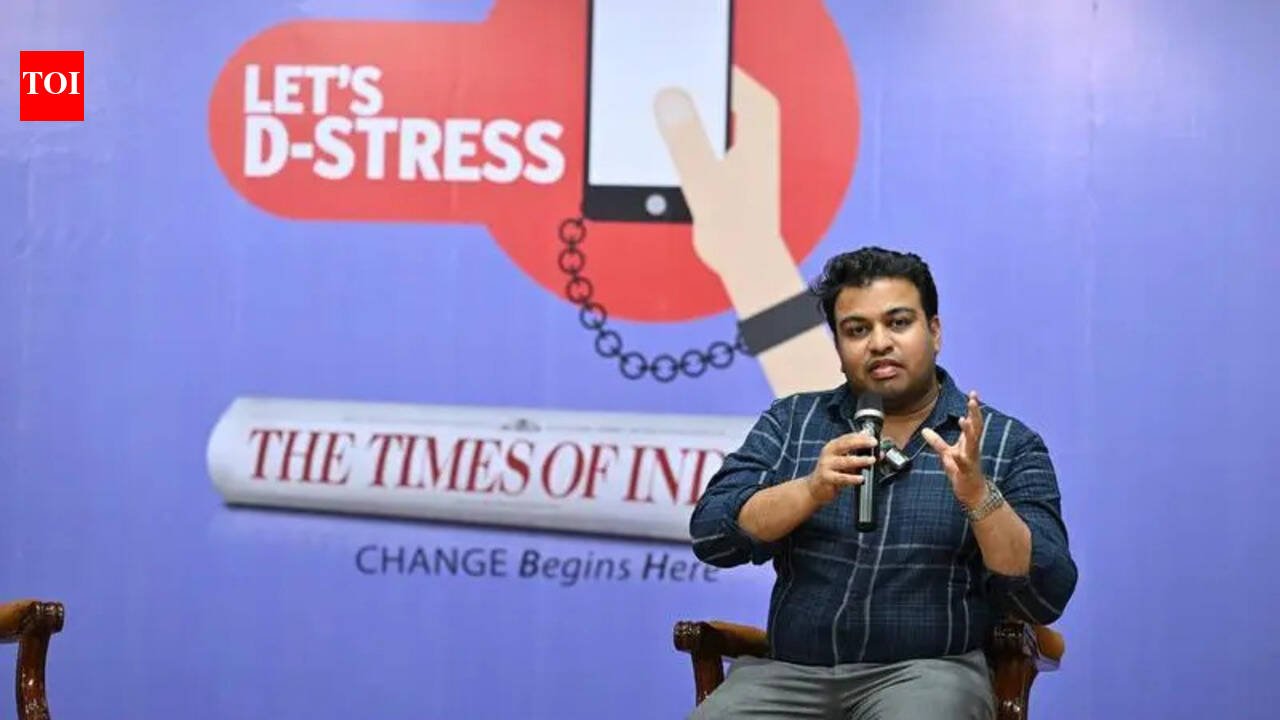
Hyderabad: Highlighting how “screen addiction” is now comparable to alcohol and gambling addiction, Dr Charan Teja Koganti, on Thursday said how people often do not realise they have spent hours on their device, they had picked up only to scroll for a few minutes. The consultant neuropsychiatrist with KIMS Hospitals & Jade Clinics, was speaking at the The Times of India’s ‘Let’s D-Stress: Campus Conversations’ held at NALSAR University of Law.Dr Koganti, while explaining compulsive phone usage, said how repeated engagement with screens turns into “muscle memory,” where users instinctively open apps without conscious thought. He attributed this behaviour to dopamine, the brain’s ‘feel-good’ chemical. “Your brain gets hooked to quick gratification, scrolling from one reel to another keeps delivering small dopamine hits, making it difficult to stop,” he said.The session, part of TOI’s national Let’s D-Stress initiative, marked its first campus edition in Hyderabad, bringing together students for an engaging discussion on digital well-being amid peak academic pressure. Moderated by RJ Chaitu, Dr Koganti shared scientific insight about the growing impact of screen dependency on young minds.‘Brain never truly rests’He also challenged the notion that screens help people relax. “Your brain is constantly stimulated, visually, emotionally and cognitively. It never truly rests,” he said, explaining that this continuous activation leads to fatigue, anxiety and shrinking attention spans.Addressing sleep disruption among students, the neuropsychiatrist highlighted the concept of ‘revenge bedtime procrastination’, where individuals delay sleep to reclaim personal time on their devices. “The light from screens suppresses melatonin, the hormone responsible for sleep, making it harder for the brain to switch off,” he added.Dr Koganti also pointed to behavioural and psychological signs of screen dependency, including phantom vibrations , where users feel their phone vibrating even when it is not , and anxiety when the device battery runs low, driven by fear of missing out (FOMO). He cautioned that excessive screen use could impact attention spans drastically and even alter brain function over time.On digital learning, he emphasised that reading on screens is not equivalent to reading physical books. “Beyond eye strain caused by prolonged exposure to blue light, it reduces hand-eye coordination from typing instead of writing may affect cognitive development and memory processes,” he said.
