


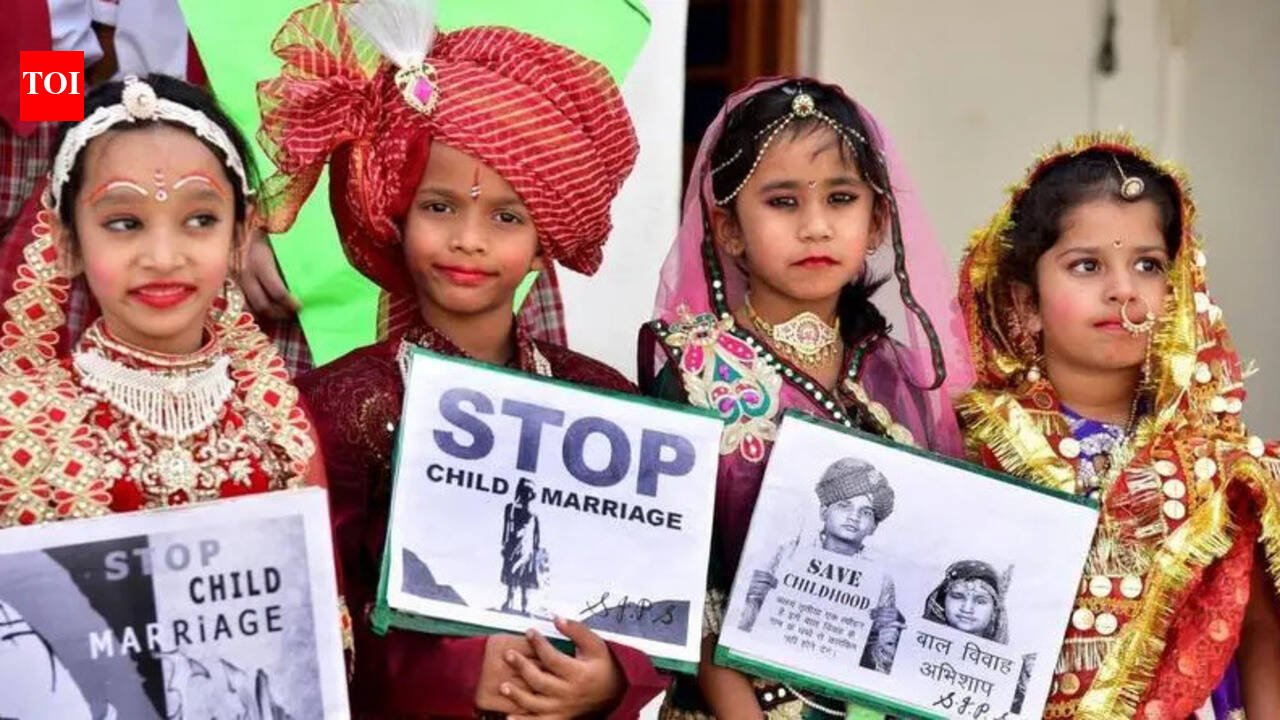
Hyderabad: Child marriage in Telangana is not confined to communities it is usually associated with. A careful reading of the Independent Expert Working Group (IEWG) report and related Telangana Socio-Economic, Educational, Employment, Political and Caste (SEEEPC) survey shows that while the overall burden remains spread across all social groups, some of the most unexpected spikes appear within relatively privileged caste groups, even as the broadest educational deprivation among women continues to be concentrated among tribal and other backward communities.The survey says about 2.16 lakh or around 5% girls were found to be married before the legal age, 18 years . At the broader social-group level, it places the highest share among BCs at 4.6%, followed by OCs at 4.4%, SCs at 4% and STs at 3.8%. But when the report breaks down data further across major castes, it flags a different and more striking pattern. It says the highest share of married girls below 18 was among Iyengar/Iyer (OC) at 21.2%, which is more than five times the state average, followed by Jains (OC) at 11%, or about twice the state average.At the same time, the report’s appendix presents another range for the 56 major castes, placing the state average for girl child marriage at 4.8%, the highest among major castes at 8.1% for Gangiredlavaru (BC-A) and the lowest at 2.1% for Kapu (OC). Volume II also says girl child marriage is present across communities, ranging from 2% among Kapu to 8% in BC-A Gangiredlavaru, and adds that it is higher among OC Muslims and BC-E Shaik Muslims. Taken together, the survey points to two simultaneous realities: BCs are slightly worse off at the broader social-group level, but within the caste-wise break-up, some OC groups show unusually high shares of child marriage.That is what makes the findings difficult to fit into a simple stereotype. The data suggests that child marriage persists across communities despite urbanisation, educational expansion and economic mobility. In that sense, the survey points to a social problem that survives even where material advancement is assumed to have reduced it.The survey material argues that cultural residues of backwardness can persist even in highly urbanised and supposedly advanced castes. It notes that caste detachment at a professional or official level does not necessarily insulate communities from traditional practices that restrict girls’ autonomy and education. Even in urban settings, where exposure and anonymity are greater, child marriage and discrimination appear to persist.Dr Mamatha Raghuveer Achanta of Tharuni Foundation, which has worked on preventing child marriages in Telangana, said: “It is more in BCs and Lambadas of STs. We do not have a big population of OCs, Iyengar and Iyers in Telangana. In our field studies, we found child marriage is highest in the Lambada (ST) community. We also found it high in certain BC communities, such as Perika and Budaga Jangalu. The recent trend is an increase in SCs. Earlier, districts like Adilabad, Warangal and Nizamabad reported high numbers.”Education gap remains the deeper warningThe survey places the issue in a wider context of women’s educational deprivation. It says 65.5% of women in Telangana have not studied beyond class 10. Among social groups, the share is highest among STs at 72.3%, followed by BCs at 67.1%, SCs at 66.5% and OCs at 55%.Among the major castes, the highest share of women who did not study beyond Class 10 was reported among ST Kolam women at 82.9%, or about 83%. The report says this reflects very poor educational access and outcomes among tribal girls. Other groups with very high shares include SC Beda, BC-D Mali, BC-A Odde and ST Gond. At the lower end, OC Brahmins reported the lowest share at 36.2%, followed by OC Rajus, OC Jains, OC Komatis, OC Kammas and OC Iyengars/Iyers, all well below the state average.
