



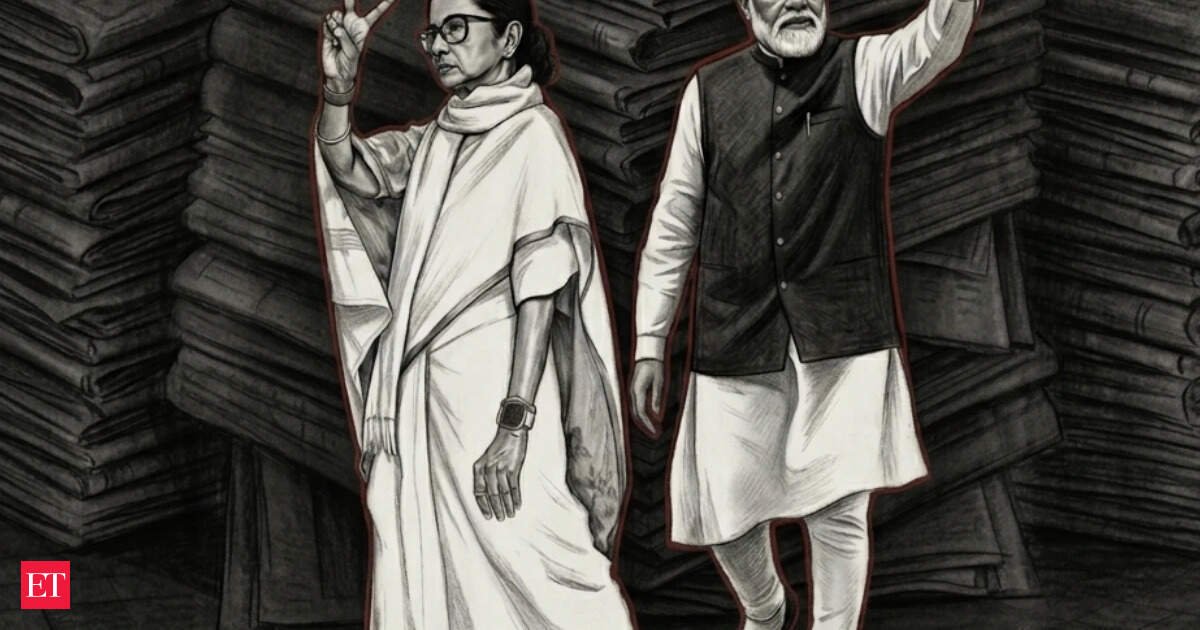
Majority of exit polls released after voting either point to:
a) an overwhelming lead and win by the BJP, or
b) a very tight contest, with the BJP having an edge.
Exit polls: BJP surge vs TMC resilience
Most exit polls project a strong performance by the Bharatiya Janata Party, with several surveys indicating that the party could cross the majority mark of 148 in the 294-member Assembly.
- ABP-CVoter: BJP 150–160 | TMC 130–140
- Praja Poll: BJP 178–208 | TMC 85–110
- Poll Diary: BJP 142–171 | TMC 99–127
- Matrize: BJP 146–161 | TMC 125–140
However, People’s Pulse stands out as an outlier, projecting a comfortable TMC win with 177–187 seats.
Taken together, the projections point to a razor-sharp contest, with a possible BJP breakthrough — but also enough variation to keep the outcome uncertain.
The anti-incumbency question
After three consecutive terms, anti-incumbency has been one of the defining undercurrents of the election.
Key voter concerns have included:
- Employment and economic opportunity
- Corruption allegations, particularly the school recruitment scam
- Law & order and women’s safety
- Everyday governance issues, including allegations of local-level extortion (“tolabazi”)
The school recruitment case, in particular, has weighed heavily on the campaign. Courts invalidated around 25,000 appointments from the 2016 SSC panel, calling the process “irretrievably tainted,” reinforcing opposition attacks on governance and institutional credibility.
The state government’s Education Minister, Partha Chatterjee, was also arrested due to his involvement in the corruption.
Banerjee’s counter: Welfare, identity and direct outreach
The TMC’s strategy has centred on offsetting anti-incumbency through:
- Welfare schemes and direct benefit transfers
- Targeting women voters as a decisive bloc
- Positioning itself as the defender of Bengali identity
Identity politics played a key role, with the TMC framing itself as a protector of regional identity and autonomy, while the BJP linked identity debates to citizenship, migration and consolidation of Hindu votes in select constituencies.
Banerjee’s campaign also leaned heavily on personal visibility and mobilisation — a hallmark of her political style since her rise through movements like Singur and Nandigram.
BJP’s push: Organisation, narrative and national leadership
For the BJP, the election represents the culmination of a multi-year expansion strategy in Bengal.
The party’s campaign focused on:
- Corruption and governance failures
- Industrial stagnation and jobs
- Women’s safety
- Citizenship and voter identity issues
Leaders including PM Modi and Home Minister Amit Shah led an aggressive campaign push, holding rallies and roadshows across key constituencies.
The BJP also sought to capitalise on the Special Intensive Revision (SIR) of electoral rolls, framing it around infiltration and citizenship, while the TMC alleged disenfranchisement of vulnerable groups.
Bhabanipur: A symbolic battleground
Few constituencies capture the broader political contest like Bhabanipur, Banerjee’s political bastion.
Her contest here against Suvendu Adhikari — a former ally turned rival — adds a layer of symbolism to the election.
Bhabanipur has historically been a safe seat for Banerjee.
Yet recent trends, including a narrower margin in 2016, likely suggest shifting currents.
Her visible presence on polling day — unusual in her political career — has been read by observers as a sign of a more competitive contest.
High turnout, high stakes
The election has seen exceptionally high voter turnout, with Phase 1 recording over 93%, among the highest in the state’s history.
Phase 2, covering 142 constituencies including urban strongholds, was seen as particularly crucial, with anti-incumbency and governance issues expected to weigh more heavily, recording a turnout of about 93%.
So, has anti-incumbency been contained? The answer, for now, is inconclusive.
Exit polls suggesting a BJP edge indicate that anti-incumbency may have translated into votes in several regions.
On the other hand, projections showing a TMC comeback point to the continued strength of Banerjee’s welfare and identity-driven strategy
The bottom line
West Bengal’s 2026 election appears to be less a one-sided verdict and more a test of competing forces:
- Fatigue vs welfare delivery
- Corruption narrative vs identity politics
- Organisational expansion vs entrenched leadership
Exit polls offer early clues — but with Bengal’s history of unpredictable outcomes, the final answer to whether Mamata Banerjee has successfully held off anti-incumbency will only emerge on counting day.


