



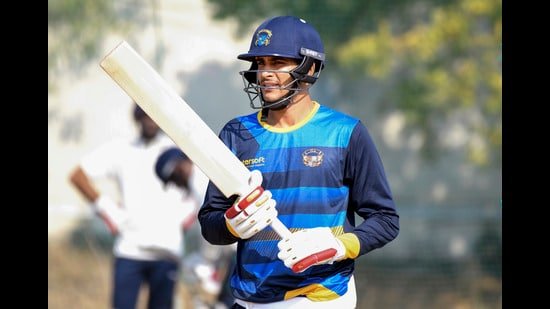
Kolkata: A few months ago, Shubman Gill was the undisputed anchor in India’s T20 batting lineup. Viewed as a long-term pillar and an all-format player, Gill’s elevation to T20 vice-captaincy was considered a natural progression for someone who had already mastered the two other formats.
And yet, within months, Gill found himself edged out. The reason wasn’t a sudden collapse of form nor was it a question of talent. Instead, it was about tempo. The new grammar of T20 batting—shaped by Abhishek Sharma, Ishan Kishan and Sanju Samson—had suddenly rendered Gill’s natural rhythm redundant.
All is not lost though. There might still be a scenario where Gill’s patience could be useful. Or maybe he could close the gap a little? This is why the new IPL season makes Gujarat Titans one of the teams to watch. Not because of their balance or squad depth alone, but because this tournament might become a deeply personal examination for their captain.
Classical in a chaotic format
Gill’s batting has always been defined by aesthetic precision. He is a high-elbowed, front-foot dominant player whose strokes make sense across formats. Timing is his currency, risk rarely the first instinct he would resort to. That approach has made him one of the most reliable run-scorers in the IPL—650 runs at a strike rate of 155.88 last season, which pitted against the best, is quite remarkable too.
It also allowed Gill to build monumental innings in ODIs and Tests. But T20 cricket has entered a new phase where reliability is sometimes seen as restraint.
Where Gill might begin with 12 runs off the first eight balls while assessing the conditions, batters like Abhishek are already attempting three sixes. Kishan, similarly, approaches the format like a sprint rather than a structured innings. Samson starts from a lower gear, but that too seems a notch higher than Gill’s. This difference is not simply about strike rate. It is about the early urgency that has begun to define modern T20 batting. For India’s selectors, that shift undid Gill’s importance in the squad.
Yet his numbers in T20s remain respectable. Gill’s IPL strike rate has not dropped below 147 in the last three years. More defining though has been his ability to convert starts into 12 fifties and four hundreds in the last three seasons, propelling Gujarat Titans to a runners-up finish in 2023 and the playoffs last year.
On the IPL front, everything seems to be working fine for Titans as well as Gill. But with the India team now appearing to prefer batters who impose themselves on the game from the very first ball, Gill could be forced to evolve.
A tricky season
Which in turn makes this IPL season unusually significant for Gill. Considering how Gill has emerged as the tactical and emotional core of the team, any change of batting approach could change the tone for the side’s batting style too. Not that it won’t help them. The Titans themselves have built a squad capable of supporting multiple styles. Jos Buttler might be in the same boat as Gill right now, while Sai Sudharsan will be backed to play his normal game.
With batters like New Zealander Glen Phillips and English wicketkeeper Tom Banton in the ranks, Titans have the muscle to accelerate drastically in the middle overs and finishers who can close games quickly. That flexibility theoretically allows Gill to bat in his preferred rhythm. But T20 cricket rarely respects theoretical comfort.
If Gill consumes too many deliveries early, it could place pressure on the middle order. If he changes his method too drastically, he risks losing the fluency that made him special. The challenge, therefore, is to strike a balance between efficiency and aggression, intent and steady accumulation. Having set the early standards of scoring high team totals, Titans don’t want to tinker with their approach too much when everything seems to have come together for them pretty seamlessly.
Reevaluating success
What will complicate matters though is the generational shift unfolding across franchise leagues. Young batters have begun treating the powerplay as a period of maximum capitalisation rather than careful construction. They swing earlier, accept more dismissals, and trust that the reward outweighs the risk. Sudharsan is not cut from that cloth. Neither is Gill, whose elegance makes him pleasing to watch but also probably sells him short in this current T20 economy. And this IPL will inevitably compare these approaches.
For Gill, success this season does not necessarily mean transforming into a six-hitting machine overnight. That would be both unrealistic and unnecessary. Instead, the evolution could be subtler. Maybe a slightly quicker start, a willingness to target specific bowlers earlier in the innings which will lead to a slight bump in powerplay strike rate.
While Gill may not be ready yet to accept the occasional reckless dismissal in pursuit of momentum, he would definitely seek to add urgency without sacrificing identity, something Rohit Sharma achieved in his last season as a white-ball player for India.
If he manages that balance, Gill could produce one of the most compelling IPL seasons of his career. Few players possess his ability to bat deep while maintaining control. If that quality is paired with sharper acceleration, it could make Gill devastating. For Gujarat Titans, that could spell transformative.


